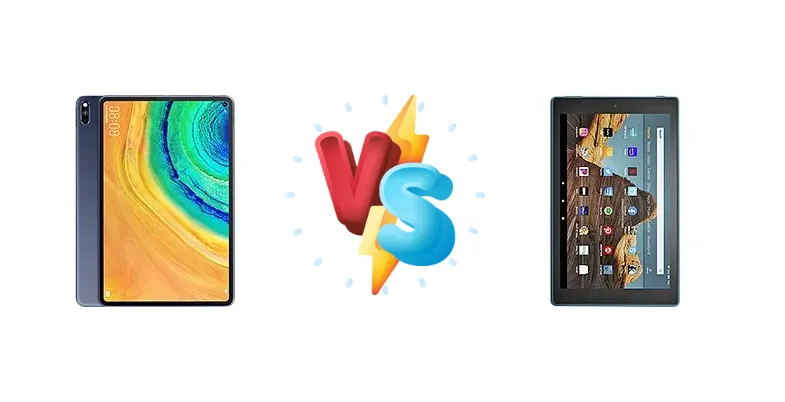
The tablet market offers a wide spectrum of choices, from premium productivity devices to affordable media consumption hubs. The Huawei MatePad Pro 10.8 (2019), with its flagship Kirin 990 chipset, represents the former, while the Amazon Fire HD 10 (2019) aims for the latter with its Mediatek Helio P60T. This comparison dissects the core differences to help you determine which tablet best suits your needs and budget.
🏆 Quick Verdict
For users prioritizing performance and versatility, the Huawei MatePad Pro 10.8 (2019) is the clear winner. Its Kirin 990 chipset delivers significantly faster processing speeds and supports advanced features like 40W fast charging. However, the Amazon Fire HD 10 (2019) remains a compelling option for budget-conscious consumers focused solely on basic media consumption.
| Network |
|---|
| 2G bands | GSM 850 / 900 / 1800 / 1900 | N/A |
| 3G bands | HSDPA 850 / 900 / 1900 / 2100 | HSDPA 900 / 2100 |
| 4G bands | 1, 3, 4, 5, 8, 19, 34, 38, 39, 40, 41 | - |
| EDGE | - | No |
| GPRS | - | No |
| Speed | HSPA, LTE - cellular model only | HSPA 21.1/5.76 Mbps |
| Technology | GSM / HSPA / LTE | No cellular connectivity |
| Launch |
|---|
| Announced | 2019, November 25. Released 2019, December 12 | 2019, September. Released 2019, October |
| Status | Discontinued | Discontinued |
| Body |
|---|
| Build | Glass front, aluminum back, aluminum frame | - |
| Dimensions | 246 x 159 x 7.2 mm (9.69 x 6.26 x 0.28 in) | 262 x 159 x 9.8 mm (10.31 x 6.26 x 0.39 in) |
| SIM | Nano-SIM (cellular model only) | No |
| Weight | 460 g (1.01 lb) | 504 g (1.11 lb) |
| | Stylus support (magnetic) | - |
| Display |
|---|
| Resolution | 2560 x 1600 pixels, 16:10 ratio (~280 ppi density) | 1920 x 1200 pixels, 16:10 ratio (~224 ppi density) |
| Size | 10.8 inches, 338.2 cm2 (~86.5% screen-to-body ratio) | 10.1 inches, 295.8 cm2 (~71.0% screen-to-body ratio) |
| Type | IPS LCD, 540 nits (typ) | IPS LCD |
| Platform |
|---|
| CPU | Octa-core (2x2.86 GHz Cortex-A76 & 2x2.09 GHz Cortex-A76 & 4x1.86 GHz Cortex-A55) | Octa-core (4x2.0 GHz Cortex-A73 & 4x2.0 GHz Cortex-A53) |
| Chipset | Kirin 990 (7 nm+) | Mediatek MT8183 Helio P60T (12 nm) |
| GPU | Mali-G76 MP16 | Mali-G72 MP3 |
| OS | Android 10, EMUI 10, no Google Play Services | Android 9.0 (Pie), Fire OS 7 |
| Memory |
|---|
| Card slot | Nano Memory (dedicated slot) | microSDXC (dedicated slot) |
| Internal | 128GB 6GB RAM, 256GB 8GB RAM, 512GB 8GB RAM | 32GB 2GB RAM, 64GB 2GB RAM |
| | UFS 3.0 | - |
| Main Camera |
|---|
| Features | LED flash, HDR, panorama | LED flash |
| Single | 13 MP, f/1.8, PDAF | 2 MP |
| Video | 4K@30fps, 1080p@30fps | 720p |
| Selfie camera |
|---|
| Features | HDR | - |
| Single | 8 MP, f/2.0 | 2 MP |
| Video | 1080p@30fps | 720p |
| Sound |
|---|
| 3.5mm jack | No | Yes |
| 35mm jack | No | Yes |
| Loudspeaker | Yes, with stereo speakers (4 speakers) | Yes, with stereo speakers |
| | Tuned by Harman Kardon | - |
| Comms |
|---|
| Bluetooth | 5.1, A2DP, LE | 4.2, A2DP, LE |
| NFC | No | No |
| Positioning | GPS, GLONASS, GALILEO, BDS, QZSS - cellular model only | No |
| Radio | No | No |
| USB | USB Type-C 3.1, OTG | USB Type-C 2.0, OTG |
| WLAN | Wi-Fi 802.11 a/b/g/n/ac, dual-band, Wi-Fi Direct | Wi-Fi 802.11 a/b/g/n/ac, dual-band |
| Features |
|---|
| Sensors | Accelerometer, gyro, proximity, compass | Accelerometer |
| Battery |
|---|
| Charging | 40W wired
15W wireless
7.5W reverse wireless | - |
| Type | Li-Po 7250 mAh, non-removable | Li-Ion |
| Misc |
|---|
| Colors | Gray, White, Green, Orange | Black, Plum, Twilight Blue, White |
| Models | MRX-AL09, MRX-AL19, MRX-W09, MRX-W19 | KFMAWI |
| Price | About 450 EUR | About 160 EUR |
| SAR EU | - | 0.38 W/kg (head) 0.55 W/kg (body) |
Huawei MatePad Pro 10.8 (2019)
- Significantly faster performance with Kirin 990
- 40W fast charging and wireless charging support
- Likely superior display quality and camera capabilities
- Higher price point
- Potential GMS (Google Mobile Services) limitations depending on region
Amazon Fire HD 10 (2019)
- Extremely affordable price
- Deep integration with Amazon ecosystem
- Suitable for basic media consumption
- Substantially slower performance with Helio P60T
- Limited multitasking capabilities
- Likely lower display and camera quality
Display Comparison
While both tablets feature 10.8-inch displays, the underlying technology and performance likely differ significantly. The MatePad Pro, being a higher-end device, likely boasts a superior panel with wider color gamut coverage and higher brightness. The Fire HD 10, given its price point, likely utilizes a standard IPS LCD. The Kirin 990’s image signal processor could also contribute to better display calibration and image processing. Details on resolution and panel type are missing, but the MatePad Pro’s overall positioning suggests a more visually refined experience.
Camera Comparison
Given the context data, a detailed camera comparison is limited. However, it’s safe to assume the MatePad Pro 10.8 features a more capable camera system. Huawei typically prioritizes camera technology in its devices, and the Kirin 990’s ISP would contribute to better image processing. The Fire HD 10’s camera is likely a basic module intended for casual snapshots. Without specific sensor details, it’s difficult to make precise comparisons, but the MatePad Pro is expected to deliver superior image quality and features.
Performance
The core difference lies in the chipsets. The Huawei MatePad Pro 10.8’s Kirin 990 (7nm+) is a flagship-level SoC, featuring a complex octa-core CPU configuration with both Cortex-A76 cores clocked at up to 2.86 GHz. This contrasts sharply with the Amazon Fire HD 10’s Mediatek MT8183 Helio P60T (12nm). The Helio P60T, while an octa-core processor, utilizes older Cortex-A73 and A53 cores clocked at 2.0 GHz. The 7nm+ fabrication process of the Kirin 990 offers significantly improved power efficiency and transistor density, translating to superior performance and thermal management. The MatePad Pro will handle demanding applications and multitasking with ease, while the Fire HD 10 will likely struggle with resource-intensive tasks. The Kirin 990 also benefits from a more powerful GPU, making it the better choice for gaming.
Battery Life
The Huawei MatePad Pro 10.8 offers a significant advantage in charging technology with its 40W wired charging, 15W wireless charging, and even 7.5W reverse wireless charging. The Fire HD 10’s charging specifications are not provided, but it’s likely limited to slower wired charging. While battery capacity (mAh) isn’t specified for either device, the Kirin 990’s superior power efficiency could offset a potentially smaller battery in the MatePad Pro, resulting in comparable or even better real-world battery life. The fast charging capabilities of the MatePad Pro are a major convenience factor.
Buying Guide
Buy the Huawei MatePad Pro 10.8 (2019) if you need a tablet capable of handling demanding tasks like video editing, gaming, or multitasking, and if fast charging and potential for broader app compatibility (with GMS installation) are important. Buy the Amazon Fire HD 10 (2019) if you primarily want a tablet for reading ebooks, streaming videos, and browsing the web, and if you're deeply embedded in the Amazon ecosystem and prioritize affordability.
Frequently Asked Questions
❓ Does the Kirin 990 in the MatePad Pro 10.8 experience throttling under sustained load, like during extended gaming sessions?
The Kirin 990, built on a 7nm+ process, is generally efficient. However, throttling is always a possibility with any SoC under heavy load. The MatePad Pro 10.8’s larger chassis and potential for advanced cooling solutions (details not provided) should mitigate throttling better than the Fire HD 10, which likely has a simpler thermal design. Expect sustained performance to be higher on the MatePad Pro.
❓ Is the Amazon Fire HD 10 (2019) a good choice for students who need to take notes or use productivity apps?
The Fire HD 10 is not ideal for intensive productivity tasks. The Helio P60T’s limited processing power will struggle with demanding apps like Microsoft Office or complex note-taking applications. The Fire OS environment is also less optimized for productivity compared to full Android. Students needing a tablet for serious work should strongly consider the MatePad Pro 10.8 or other Android/iPad options.
❓ Can I install Google Play Store on the Huawei MatePad Pro 10.8 (2019)?
The MatePad Pro 10.8 originally shipped without Google Mobile Services (GMS) due to US trade restrictions. However, workarounds and unofficial methods exist to sideload GMS, though this is not officially supported by Huawei and may void your warranty. The availability and ease of installation vary depending on the firmware version and region.