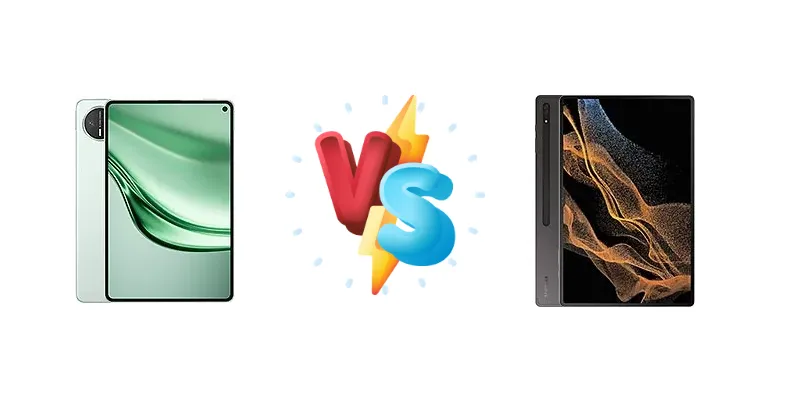
The tablet market offers a wide spectrum of choices, from ultra-portable devices like the Huawei MatePad Mini to expansive productivity powerhouses like the Samsung Galaxy Tab S8 Ultra. This comparison dissects these two tablets, focusing on their core strengths and weaknesses to determine which best suits your needs and budget.
🏆 Quick Verdict
For the average user prioritizing portability and basic tasks, the Huawei MatePad Mini offers a compelling value. However, the Samsung Galaxy Tab S8 Ultra dominates in performance, display quality, and overall versatility, making it the superior choice for power users and creative professionals.
| Network |
|---|
| 2G bands | GSM 850 / 900 / 1800 / 1900 | GSM 850 / 900 / 1800 / 1900 |
| 3G bands | HSDPA 850 / 900 / 1900 / 2100 | HSDPA 850 / 900 / 1700(AWS) / 1900 / 2100 |
| 4G bands | LTE | LTE |
| 5G bands | SA/NSA | SA/NSA |
| Speed | HSPA, LTE, 5G | HSPA, LTE, 5G - cellular model only |
| Technology | GSM / HSPA / LTE / 5G | GSM / HSPA / LTE / 5G |
| Launch |
|---|
| Announced | 2025, September 04 | 2022, February 09 |
| Status | Available. Released 2025, September 13 | Available. Released 2022, April 30 |
| Body |
|---|
| Dimensions | 198.6 x 127.3 x 5.2 mm (7.82 x 5.01 x 0.20 in) | 326.4 x 208.6 x 5.5 mm (12.85 x 8.21 x 0.22 in) |
| SIM | Nano-SIM | Nano-SIM (cellular model only) |
| Weight | 260 g (9.17 oz) | 726 g (Wi-Fi), 728 g (5G) (1.60 lb) |
| | - | Stylus, 2.8ms latency (Bluetooth integration, accelerometer, gyro) |
| Display |
|---|
| Protection | - | Corning Gorilla Glass 5 |
| Resolution | 1600 x 2560 pixels, 16:10 ratio (~343 ppi density) | 1848 x 2960 pixels, 16:10 ratio (~240 ppi density) |
| Size | 8.8 inches, 224.5 cm2 (~88.8% screen-to-body ratio) | 14.6 inches, 612.6 cm2 (~90.0% screen-to-body ratio) |
| Type | OLED, 1B colors, 120Hz, 1800 nits (peak), HDR Vivid | Super AMOLED, 120Hz, HDR10+ |
| Platform |
|---|
| CPU | - | Octa-core (1x3.00 GHz Cortex-X2 & 3x2.50 GHz Cortex-A710 & 4x1.80 GHz Cortex-A510) |
| Chipset | - | Qualcomm SM8450 Snapdragon 8 Gen 1 (4 nm) |
| GPU | - | Adreno 730 |
| OS | HarmonyOS 5.1 | Android 12, up to 4 major Android upgrades, One UI 6.1.1 |
| Memory |
|---|
| Card slot | No | microSDXC (dedicated slot) |
| Internal | 256GB 12GB RAM, 512GB 12GB RAM, 512GB 16GB RAM, 1TB 16GB RAM | 128GB 8GB RAM, 256GB 8GB RAM, 256GB 12GB RAM, 256GB 16GB RAM, 512GB 12GB RAM, 512GB 16GB RAM |
| | - | UFS |
| Main Camera |
|---|
| Dual | 50 MP, f/1.8, (wide), PDAF
8 MP, f/2.2, (ultrawide) | 13 MP, f/2.0, 26mm (wide), 1/3.4", 1.0µm, AF
6 MP, f/2.2, (ultrawide) |
| Features | LED flash, panorama | LED flash, HDR, panorama |
| Video | 4K, 1080p | 4K@30/60fps, 1080p@30fps |
| Selfie camera |
|---|
| Dual | - | 12 MP, f/2.2, 26mm (wide)
12 MP, f/2.4, 120˚ (ultrawide) |
| Features | - | HDR |
| Single | 32 MP, f/2.4 | - |
| Video | 1080p | 4K@30/60fps, 1080p@30fps |
| Sound |
|---|
| 3.5mm jack | - | No |
| 35mm jack | No | No |
| Loudspeaker | Yes, with stereo speakers | Yes, with stereo speakers (4 speakers) |
| | - | Tuned by AKG |
| Comms |
|---|
| Bluetooth | 5.2, A2DP, LE, L2HC | 5.2, A2DP, LE |
| NFC | No | No |
| Positioning | GPS, GLONASS, BDS, GALILEO | GPS, GLONASS, BDS, GALILEO - cellular model only |
| Radio | No | No |
| USB | USB Type-C 3.0 | USB Type-C 3.2, magnetic connector |
| WLAN | Wi-Fi 802.11 a/b/g/n/ac/6/7, dual-band, Wi-Fi Direct | Wi-Fi 802.11 a/b/g/n/ac/6e, dual-band, Wi-Fi Direct |
| Features |
|---|
| Sensors | Fingerprint (top-mounted), accelerometer, gyro, proximity, compass | Fingerprint (under display, optical), accelerometer, gyro, proximity, compass |
| | - | Wireless Samsung DeX |
| Battery |
|---|
| Charging | 66W wired | 45W wired, 100% in 82 min |
| Type | 6400 mAh | Li-Po 11200 mAh |
| Misc |
|---|
| Colors | Green, White, Black | Graphite |
| Models | MLR-AL10 | SM-X900, SM-X906, SM-X906B, SM-X906U, SM-X906N |
| Price | About 470 EUR | About 1150 EUR |
| SAR EU | - | 0.69 W/kg (body) |
Huawei MatePad Mini
- Faster 66W charging
- Highly portable and compact design
- Potentially more affordable price point
- Significantly lower performance
- Likely inferior display quality
- Limited camera capabilities
Samsung Galaxy Tab S8 Ultra
- Exceptional performance with Snapdragon 8 Gen 1
- Large, high-resolution display
- Versatile feature set for productivity and entertainment
- Slower 45W charging
- Larger and less portable design
- Higher price point
Display Comparison
While display specifications for the MatePad Mini are absent, its 'Mini' designation suggests a smaller screen size focused on portability. The Galaxy Tab S8 Ultra boasts a significantly larger display, likely with a higher resolution. Crucially, the Tab S8 Ultra benefits from the Qualcomm SM8450 Snapdragon 8 Gen 1 (4 nm) chipset, which can drive a higher refresh rate display without significant performance impact. The Tab S8 Ultra’s larger screen is ideal for multitasking and media consumption, while the MatePad Mini prioritizes pocketability. We anticipate the Tab S8 Ultra will have superior color accuracy and brightness.
Camera Comparison
Given the context data, a detailed camera comparison is limited. However, the Tab S8 Ultra, being a flagship device, likely features a more sophisticated camera system with larger sensors and advanced image processing capabilities. The MatePad Mini’s camera is likely adequate for basic video calls and casual snapshots, but will not compete with the Tab S8 Ultra in terms of image quality or features. The absence of specific camera details for the MatePad Mini suggests it’s not a primary selling point.
Performance
The Samsung Galaxy Tab S8 Ultra’s Qualcomm SM8450 Snapdragon 8 Gen 1 (4 nm) chipset is the clear performance leader. Its Octa-core CPU configuration – 1x3.00 GHz Cortex-X2, 3x2.50 GHz Cortex-A710, and 4x1.80 GHz Cortex-A510 – provides a substantial performance advantage over any chipset likely found in the MatePad Mini. The 4nm fabrication process of the Snapdragon 8 Gen 1 also contributes to improved thermal efficiency, reducing throttling during sustained workloads. This translates to smoother gaming, faster video editing, and a more responsive overall experience on the Tab S8 Ultra. The MatePad Mini is likely geared towards everyday tasks and will struggle with demanding applications.
Battery Life
The Samsung Galaxy Tab S8 Ultra charges at 45W, reaching 100% in 82 minutes. The Huawei MatePad Mini, with its 66W wired charging, offers significantly faster charging speeds. While the Tab S8 Ultra likely has a larger battery capacity to support its larger display and more powerful processor, the MatePad Mini’s faster charging could be a significant advantage for users who need a quick power boost. The trade-off is that the Tab S8 Ultra’s larger battery will likely provide longer overall usage time despite the slower charging speed.
Buying Guide
Buy the Huawei MatePad Mini if you need a highly portable tablet for casual media consumption, reading, and light productivity tasks on the go. Its compact size and potentially lower price point make it ideal for students or travelers. Buy the Samsung Galaxy Tab S8 Ultra if you prioritize a large, immersive display, top-tier performance for demanding applications, and a comprehensive feature set for work and play. This is the tablet for those who want a desktop-like experience in a mobile form factor.
Frequently Asked Questions
❓ Does the Snapdragon 8 Gen 1 in the Tab S8 Ultra get hot during extended gaming sessions?
The Snapdragon 8 Gen 1 is known to generate heat under sustained load. However, the Tab S8 Ultra’s large chassis and advanced thermal management system are designed to mitigate throttling and maintain stable performance during gaming. While some heat is expected, it shouldn't significantly impact the gaming experience.
❓ Is the 66W charging on the MatePad Mini truly faster in real-world use, considering the Tab S8 Ultra likely has a larger battery?
Yes, the 66W charging on the MatePad Mini will provide a faster initial charge. While the Tab S8 Ultra’s larger battery will take longer to fully charge, the MatePad Mini will reach a usable charge level much quicker, making it ideal for users who need a quick power boost before heading out.
❓ How does the size difference between these tablets affect multitasking?
The Samsung Galaxy Tab S8 Ultra’s expansive display is significantly better suited for multitasking. Its larger screen real estate allows for multiple apps to be displayed simultaneously without feeling cramped, enhancing productivity. The MatePad Mini’s smaller screen will require more app switching, making multitasking less efficient.