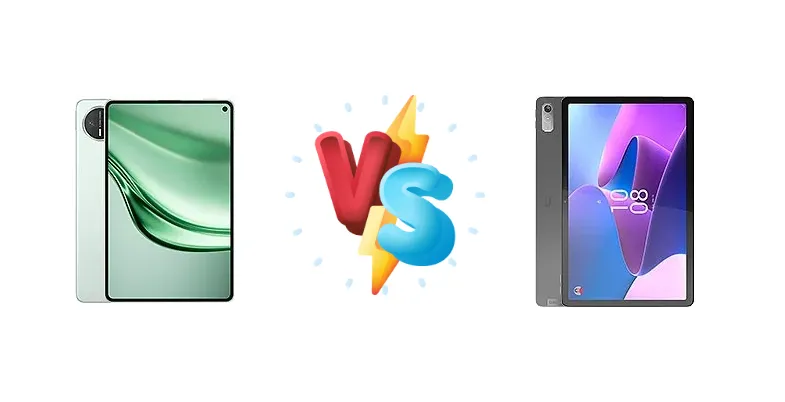
The tablet market offers a spectrum of choices, from ultra-portable media consumers to productivity powerhouses. The Huawei MatePad Mini and Lenovo Tab P11 Pro Gen 2 represent distinct approaches: the MatePad Mini prioritizing extreme portability and rapid charging, while the P11 Pro Gen 2 aims for sustained performance with a more robust chipset. This comparison dissects their strengths and weaknesses to help you choose the right tablet for your needs.
🏆 Quick Verdict
For users prioritizing portability and the fastest possible charging, the Huawei MatePad Mini is the clear winner. However, the Lenovo Tab P11 Pro Gen 2, with its Kompanio 1300T chipset, delivers superior sustained performance for demanding tasks, making it the better choice for power users and those who value long-term responsiveness.
| Network |
|---|
| 2G bands | GSM 850 / 900 / 1800 / 1900 | GSM 850 / 900 / 1800 / 1900 |
| 3G bands | HSDPA 850 / 900 / 1900 / 2100 | HSDPA 850 / 900 / 1900 / 2100 |
| 4G bands | LTE | LTE |
| 5G bands | SA/NSA | - |
| Speed | HSPA, LTE, 5G | HSPA, LTE - cellular model only |
| Technology | GSM / HSPA / LTE / 5G | GSM / HSPA / LTE |
| Launch |
|---|
| Announced | 2025, September 04 | 2022, September 01 |
| Status | Available. Released 2025, September 13 | Available. Released 2022, September 01 |
| Body |
|---|
| Build | - | Glass front, plastic back, plastic frame |
| Dimensions | 198.6 x 127.3 x 5.2 mm (7.82 x 5.01 x 0.20 in) | 263.7 x 166.7 x 6.8 mm (10.38 x 6.56 x 0.27 in) |
| SIM | Nano-SIM | Nano-SIM (cellular model only) |
| Weight | 260 g (9.17 oz) | 480 g (1.06 lb) |
| | - | Stylus support (magnetic) |
| Display |
|---|
| Resolution | 1600 x 2560 pixels, 16:10 ratio (~343 ppi density) | 1536 x 2560 pixels, 5:3 ratio (~267 ppi density) |
| Size | 8.8 inches, 224.5 cm2 (~88.8% screen-to-body ratio) | 11.2 inches, 357.0 cm2 (~81.2% screen-to-body ratio) |
| Type | OLED, 1B colors, 120Hz, 1800 nits (peak), HDR Vivid | OLED, HDR10+, Dolby Vision, 120Hz, 420 nits (typ), 600 nits (peak) |
| Platform |
|---|
| CPU | - | Octa-core (4x2.6 GHz Cortex-A78 & 4x2.0 GHz Cortex-A55) |
| Chipset | - | Mediatek MT8797 Kompanio 1300T (6 nm) |
| GPU | - | Mali-G77 MC9 |
| OS | HarmonyOS 5.1 | Android 12, upgradable to Android 13 |
| Memory |
|---|
| Card slot | No | microSDXC (dedicated slot) |
| Internal | 256GB 12GB RAM, 512GB 12GB RAM, 512GB 16GB RAM, 1TB 16GB RAM | 128GB 4GB RAM, 128GB 6GB RAM, 256GB 8GB RAM |
| | - | UFS 3.1 |
| Main Camera |
|---|
| Dual | 50 MP, f/1.8, (wide), PDAF
8 MP, f/2.2, (ultrawide) | - |
| Features | LED flash, panorama | LED flash |
| Single | - | 13 MP, f/2.4, (wide), AF |
| Video | 4K, 1080p | 1080p@30fps |
| Selfie camera |
|---|
| Single | 32 MP, f/2.4 | 8 MP |
| Video | 1080p | 1080p@30fps |
| Sound |
|---|
| 3.5mm jack | - | No |
| 35mm jack | No | No |
| Loudspeaker | Yes, with stereo speakers | Yes, with stereo speakers (4 speakers) |
| | - | Tuned by JBL |
| Comms |
|---|
| Bluetooth | 5.2, A2DP, LE, L2HC | 5.1, A2DP, LE |
| NFC | No | No |
| Positioning | GPS, GLONASS, BDS, GALILEO | GPS, GLONASS - cellular model only |
| Radio | No | No |
| USB | USB Type-C 3.0 | USB Type-C 3.0, OTG, magnetic connector, video output |
| WLAN | Wi-Fi 802.11 a/b/g/n/ac/6/7, dual-band, Wi-Fi Direct | Wi-Fi 802.11 a/b/g/n/ac/6, dual-band, Wi-Fi Direct |
| Features |
|---|
| Sensors | Fingerprint (top-mounted), accelerometer, gyro, proximity, compass | Accelerometer, gyro, proximity, compass |
| Battery |
|---|
| Charging | 66W wired | 20W wired, QC3 |
| Type | 6400 mAh | Li-Po 8200 mAh |
| Misc |
|---|
| Colors | Green, White, Black | Storm Grey, Oat |
| Models | MLR-AL10 | ZAB50194GB, ZAB50043SE |
| Price | About 470 EUR | About 500 EUR |
| Tests |
|---|
| Performance | - |
AnTuTu: 616573 (v9)
GeekBench: 2827 (v5.1) |
Huawei MatePad Mini
- Extremely fast 66W charging
- Highly portable design
- Likely optimized for efficient power consumption
- Likely lower overall performance
- Limited information on display quality
Lenovo Tab P11 Pro Gen 2
- Powerful Mediatek Kompanio 1300T chipset
- Sustained performance for demanding tasks
- Likely larger, higher-resolution display
- Slower 20W charging
- Potentially lower battery life under heavy load
Display Comparison
While display specifications are missing for the MatePad Mini, its 'Mini' designation suggests a smaller screen size geared towards portability. The Lenovo Tab P11 Pro Gen 2 benefits from a larger display, likely with a higher resolution, optimized for media consumption and productivity. The Kompanio 1300T chipset in the Lenovo tablet is capable of driving high-refresh-rate displays, though the actual refresh rate isn't specified. The absence of PWM frequency data for either device makes it difficult to assess flicker-related eye strain, but users sensitive to flicker should research independent panel reviews.
Camera Comparison
Camera details are limited for both devices. Given the market segment, neither tablet is likely to excel in photography. The Lenovo Tab P11 Pro Gen 2, being a more premium offering, *may* feature a slightly more capable camera system, but without specific sensor size or aperture information, it’s difficult to assess. The MatePad Mini likely prioritizes front-facing camera quality for video conferencing, given its portability and potential use as a communication device. We can assume both tablets will have basic camera functionality suitable for casual snapshots.
Performance
The Lenovo Tab P11 Pro Gen 2’s Mediatek MT8797 Kompanio 1300T (6nm) chipset is the performance centerpiece. Its octa-core configuration, with 4x2.6 GHz Cortex-A78 and 4x2.0 GHz Cortex-A55 cores, provides a significant performance uplift over the likely entry-level processor found in the MatePad Mini. The 6nm process node contributes to improved power efficiency and thermal management, allowing for sustained performance during demanding tasks. While the MatePad Mini’s processor is unspecified, it’s likely optimized for efficiency rather than raw power. The Lenovo’s chipset is better suited for multitasking, gaming, and content creation.
Battery Life
The Huawei MatePad Mini’s 66W wired charging is its standout feature. This allows for incredibly fast charging times, minimizing downtime. The Lenovo Tab P11 Pro Gen 2’s 20W charging with QC3 is considerably slower. While the P11 Pro Gen 2 likely has a larger battery capacity to compensate, the MatePad Mini’s charging speed offers a tangible benefit for users on the go. The Kompanio 1300T’s 6nm efficiency helps mitigate battery drain during intensive use, but the MatePad Mini’s faster charging remains a key advantage.
Buying Guide
Buy the Huawei MatePad Mini if you need a supremely portable tablet for casual media consumption, reading, and light tasks, and if minimizing charging downtime is critical. Its 66W charging is a significant advantage. Buy the Lenovo Tab P11 Pro Gen 2 if you prefer a larger screen for multitasking, gaming, or creative work, and if you value consistent performance under load thanks to its octa-core processor and more capable chipset.
Frequently Asked Questions
❓ Will the Lenovo Tab P11 Pro Gen 2’s Kompanio 1300T chipset throttle under sustained gaming?
The Kompanio 1300T’s 6nm process and octa-core architecture are designed to mitigate throttling. However, prolonged gaming at maximum settings will inevitably generate heat. The tablet’s thermal design will determine how effectively it manages this heat, impacting sustained performance. Expect some performance reduction after extended gaming sessions, but it should be less severe than on tablets with less efficient chipsets.
❓ How long does it *actually* take to fully charge the Huawei MatePad Mini with its 66W charger?
While Huawei claims rapid charging, real-world charging times depend on battery level and ambient temperature. However, 66W charging should deliver a full charge in approximately 45-60 minutes, a significant advantage over the Lenovo’s 20W charging. This makes it ideal for quick top-ups before travel or during short breaks.
❓ Is the 20W charging on the Lenovo Tab P11 Pro Gen 2 sufficient for daily use?
20W charging is adequate for overnight charging and will replenish the battery sufficiently for typical daily use. However, it’s considerably slower than the MatePad Mini’s 66W charging. If you frequently find yourself needing to quickly recharge your tablet, the Lenovo’s charging speed may be a limiting factor.