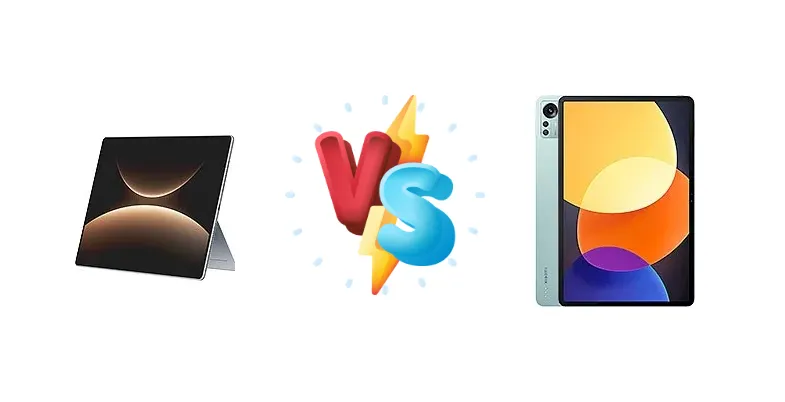
The large-screen Android tablet market is heating up, with Huawei and Xiaomi offering compelling options. The Huawei MatePad Edge arrives with a focus on blazing-fast charging and Huawei’s proprietary Kirin X90A chipset, while the Xiaomi Pad 5 Pro 12.4 leverages the well-established Qualcomm Snapdragon 870 platform. This comparison dissects the key differences to help you determine which tablet best suits your needs.
🏆 Quick Verdict
For users prioritizing raw charging speed and deeply integrated Huawei ecosystem features, the MatePad Edge is the clear winner. However, the Xiaomi Pad 5 Pro 12.4 offers a more mature software experience and a proven chipset, making it the better choice for those seeking a balanced and reliable tablet experience.
| Network |
|---|
| 2G bands | N/A | N/A |
| 3G bands | N/A | N/A |
| 4G bands | N/A | N/A |
| EDGE | No | No |
| GPRS | No | No |
| Technology | No cellular connectivity | No cellular connectivity |
| Launch |
|---|
| Announced | 2025, November 25 | 2022, August 11 |
| Status | Available. Released 2025, November 25 | Available. Released 2022, August 24 |
| Body |
|---|
| Build | - | Glass front (Gorilla Glass 3), aluminum frame, aluminum back |
| Dimensions | 312.1 x 212 x 6.9 mm (12.29 x 8.35 x 0.27 in) | 285 x 185.2 x 6.7 mm (11.22 x 7.29 x 0.26 in) |
| SIM | No | No |
| Weight | 789 g (1.74 lb) | 620 g (1.37 lb) |
| | - | Stylus support (magnetic) |
| Display |
|---|
| Protection | - | Corning Gorilla Glass 3 |
| Resolution | 3120 x 2080 pixels, 3:2 ratio (~264 ppi density) | 1600 x 2560 pixels, 16:10 ratio (~243 ppi density) |
| Size | 14.2 inches, 600.4 cm2 (~90.7% screen-to-body ratio) | 12.4 inches, 445.8 cm2 (~84.5% screen-to-body ratio) |
| Type | OLED, 1B colors, 120Hz, 1000 nits (peak), HDR Vivid | IPS LCD, 120Hz, HDR10, Dolby Vision, 500 nits |
| Platform |
|---|
| CPU | Octa-core | Octa-core (1x3.2 GHz Kryo 585 & 3x2.42 GHz Kryo 585 & 4x1.80 GHz Kryo 585) |
| Chipset | Kirin X90A | Qualcomm SM8250-AC Snapdragon 870 5G (7 nm) |
| GPU | - | Adreno 650 |
| OS | HarmonyOS 5.1 | Android 12, MIUI Pad 13 |
| Memory |
|---|
| Card slot | No | No |
| Internal | 256GB 16GB RAM, 512GB 16GB RAM, 1TB 24GB RAM, 1TB 24GB RAM SSD, 2TB 32GB RAM SSD | 128GB 6GB RAM, 256GB 8GB RAM, 512GB 12GB RAM |
| | - | UFS 3.1 |
| Main Camera |
|---|
| Dual | 50 MP, f/1.8, (wide), PDAF
8 MP, f/2.2, (ultrawide) | 50 MP, f/1.8, 1/2.76", 0.64µm, PDAF
Auxiliary lens |
| Features | Color spectrum sensor, LED flash, HDR, panorama | Color spectrum sensor, LED flash, panorama, HDR |
| Video | 4K@30fps, 1080p@30fps | 4K@30fps, 1080p@30/60fps |
| Selfie camera |
|---|
| Single | 32 MP, f/2.4 | 20 MP, f/2.2, 1/3.4", 0.8µm |
| Video | 1080p@30fps | 1080p@30/60fps |
| Sound |
|---|
| 3.5mm jack | - | No |
| 35mm jack | No | No |
| Loudspeaker | Yes, with stereo speakers (6 speakers) | Yes, with stereo speakers (4 speakers) |
| Comms |
|---|
| Bluetooth | 5.2, A2DP, LE, L2HC | 5.2, A2DP, LE |
| NFC | No | No |
| Positioning | No | No |
| Radio | No | No |
| USB | USB Type-C 3.1, OTG | USB Type-C 3.2 video output |
| WLAN | Wi-Fi 802.11 a/b/g/n/ac/6/7, dual-band | Wi-Fi 802.11 a/b/g/n/ac/6, dual-band, Wi-Fi Direct |
| Features |
|---|
| Sensors | Fingerprint, accelerometer, gyro, proximity (accessories only) | Accelerometer, gyro, proximity, compass |
| Battery |
|---|
| Charging | 140W wired
40W reverse wired | 67W wired, PD3.0, QC4, 60% in 36 min, 100% in 68 min |
| Type | 12900 mAh | Li-Po 10000 mAh |
| Misc |
|---|
| Colors | Gray, Silver | Black, Silver, Green |
| Models | QXS-W00, QXS-W10, QXS-W20 | - |
| Price | About 730 EUR | About 400 EUR |
Huawei MatePad Edge
- Industry-leading 140W wired charging
- Potential for superior display quality (OLED likely)
- 40W reverse wired charging for device top-ups
- Kirin X90A chipset lacks detailed performance data
- HarmonyOS ecosystem may limit app availability
Xiaomi Pad 5 Pro 12.4
- Proven Snapdragon 870 performance and efficiency
- Mature Android software experience
- Wider accessory compatibility
- Slower 67W charging compared to MatePad Edge
- LCD display may lack the contrast of OLED
Display Comparison
While both tablets feature large 12.4-inch displays, detailed display specs are missing. However, given Huawei’s recent focus on high-refresh-rate OLEDs, the MatePad Edge likely boasts a superior panel with potentially higher peak brightness and color accuracy. The Xiaomi Pad 5 Pro 12.4 is expected to have a high-quality LCD panel, but may fall short in contrast ratio. Bezels are likely comparable, but the MatePad Edge’s design language may prioritize a more immersive viewing experience.
Camera Comparison
Camera performance is unlikely to be a primary differentiator for either tablet. Both will likely feature capable main sensors for video conferencing and casual photography. Detailed sensor specs are unavailable, but the Xiaomi Pad 5 Pro 12.4’s camera system is generally considered adequate for tablet use. The MatePad Edge’s camera capabilities remain largely unknown. We anticipate both tablets will include ultrawide lenses, but image quality will likely be similar.
Performance
The core performance difference lies in the chipsets. The Xiaomi Pad 5 Pro 12.4’s Qualcomm Snapdragon 870 5G (7nm) is a proven performer, offering a balanced combination of CPU and GPU power. Its octa-core configuration (1x3.2 GHz Kryo 585, 3x2.42 GHz Kryo 585, 4x1.80 GHz Kryo 585) provides consistent performance across various tasks. The Huawei MatePad Edge’s Kirin X90A, while octa-core, lacks detailed architectural information. Without knowing the fabrication process (e.g., 5nm, 4nm), it’s difficult to assess its efficiency and thermal characteristics. The Snapdragon 870’s mature driver support and optimization give it an edge in gaming and sustained workloads. The Xiaomi Pad 5 Pro 12.4 likely benefits from LPDDR5 RAM, while the MatePad Edge’s RAM type is unknown.
Battery Life
The Huawei MatePad Edge’s 140W wired charging is its standout feature, significantly outperforming the Xiaomi Pad 5 Pro 12.4’s 67W wired charging (with PD3.0 and QC4 support, reaching 60% in 36 minutes and 100% in 68 minutes). While battery capacity is unspecified for both, the MatePad Edge’s ultra-fast charging mitigates concerns about a potentially smaller battery. The Xiaomi Pad 5 Pro 12.4 offers a more conventional charging experience, prioritizing efficiency and longevity over sheer speed. The 40W reverse wired charging on the MatePad Edge is also a unique advantage, allowing it to charge other devices quickly.
Buying Guide
Buy the Huawei MatePad Edge if you need the absolute fastest charging available in a tablet, frequently use Huawei accessories, and value the HarmonyOS ecosystem. Buy the Xiaomi Pad 5 Pro 12.4 if you prefer a more open Android experience, prioritize a well-established chipset with strong thermal performance, and seek a tablet with a wider range of compatible accessories from various brands.
Frequently Asked Questions
❓ Does the Kirin X90A chipset in the MatePad Edge suffer from thermal throttling during extended gaming sessions?
Without independent thermal testing, it's difficult to say definitively. However, the Snapdragon 870 in the Xiaomi Pad 5 Pro 12.4 is known for its efficient thermal management. The Kirin X90A’s performance under sustained load remains a key unknown.
❓ How does Huawei’s HarmonyOS compare to standard Android on the MatePad Edge in terms of app compatibility and updates?
HarmonyOS offers a similar user experience to Android but lacks full Google Mobile Services (GMS) support. This means some apps may require sideloading or may not function correctly. Updates are controlled by Huawei and may be less frequent than those on the Xiaomi Pad 5 Pro 12.4.
❓ Is the 67W charging on the Xiaomi Pad 5 Pro 12.4 fast enough for typical daily use, or is the 140W charging of the MatePad Edge essential?
67W charging is still very fast and will fully charge the Xiaomi Pad 5 Pro 12.4 in under 70 minutes. However, if you frequently need to top up your tablet quickly, or are constantly on the go, the MatePad Edge’s 140W charging offers a significant time saving.