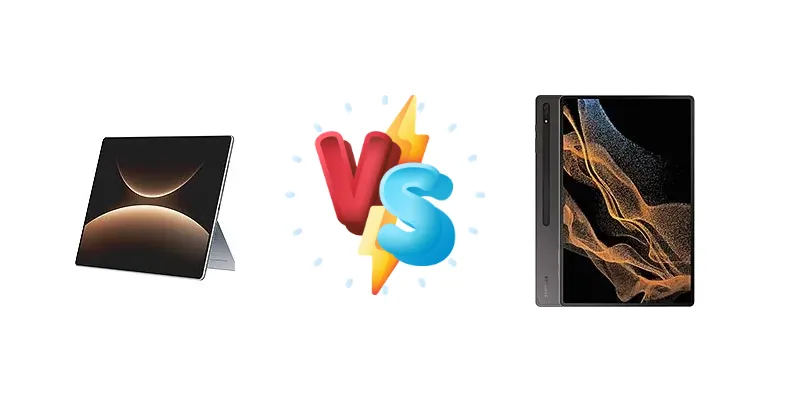
The large-screen Android tablet market is heating up. Huawei’s MatePad Edge enters the arena with a focus on blistering fast charging, while Samsung’s Galaxy Tab S8 Ultra doubles down on raw processing power with the Snapdragon 8 Gen 1. This comparison dissects the key differences to determine which tablet best suits demanding users.
🏆 Quick Verdict
For users prioritizing raw performance and a mature software ecosystem, the Samsung Galaxy Tab S8 Ultra is the clear winner. However, the Huawei MatePad Edge’s groundbreaking 140W charging offers a compelling advantage for those constantly on the move and needing rapid power replenishment.
| Network |
|---|
| 2G bands | N/A | GSM 850 / 900 / 1800 / 1900 |
| 3G bands | N/A | HSDPA 850 / 900 / 1700(AWS) / 1900 / 2100 |
| 4G bands | N/A | LTE |
| 5G bands | - | SA/NSA |
| EDGE | No | - |
| GPRS | No | - |
| Speed | - | HSPA, LTE, 5G - cellular model only |
| Technology | No cellular connectivity | GSM / HSPA / LTE / 5G |
| Launch |
|---|
| Announced | 2025, November 25 | 2022, February 09 |
| Status | Available. Released 2025, November 25 | Available. Released 2022, April 30 |
| Body |
|---|
| Dimensions | 312.1 x 212 x 6.9 mm (12.29 x 8.35 x 0.27 in) | 326.4 x 208.6 x 5.5 mm (12.85 x 8.21 x 0.22 in) |
| SIM | No | Nano-SIM (cellular model only) |
| Weight | 789 g (1.74 lb) | 726 g (Wi-Fi), 728 g (5G) (1.60 lb) |
| | - | Stylus, 2.8ms latency (Bluetooth integration, accelerometer, gyro) |
| Display |
|---|
| Protection | - | Corning Gorilla Glass 5 |
| Resolution | 3120 x 2080 pixels, 3:2 ratio (~264 ppi density) | 1848 x 2960 pixels, 16:10 ratio (~240 ppi density) |
| Size | 14.2 inches, 600.4 cm2 (~90.7% screen-to-body ratio) | 14.6 inches, 612.6 cm2 (~90.0% screen-to-body ratio) |
| Type | OLED, 1B colors, 120Hz, 1000 nits (peak), HDR Vivid | Super AMOLED, 120Hz, HDR10+ |
| Platform |
|---|
| CPU | Octa-core | Octa-core (1x3.00 GHz Cortex-X2 & 3x2.50 GHz Cortex-A710 & 4x1.80 GHz Cortex-A510) |
| Chipset | Kirin X90A | Qualcomm SM8450 Snapdragon 8 Gen 1 (4 nm) |
| GPU | - | Adreno 730 |
| OS | HarmonyOS 5.1 | Android 12, up to 4 major Android upgrades, One UI 6.1.1 |
| Memory |
|---|
| Card slot | No | microSDXC (dedicated slot) |
| Internal | 256GB 16GB RAM, 512GB 16GB RAM, 1TB 24GB RAM, 1TB 24GB RAM SSD, 2TB 32GB RAM SSD | 128GB 8GB RAM, 256GB 8GB RAM, 256GB 12GB RAM, 256GB 16GB RAM, 512GB 12GB RAM, 512GB 16GB RAM |
| | - | UFS |
| Main Camera |
|---|
| Dual | 50 MP, f/1.8, (wide), PDAF
8 MP, f/2.2, (ultrawide) | 13 MP, f/2.0, 26mm (wide), 1/3.4", 1.0µm, AF
6 MP, f/2.2, (ultrawide) |
| Features | Color spectrum sensor, LED flash, HDR, panorama | LED flash, HDR, panorama |
| Video | 4K@30fps, 1080p@30fps | 4K@30/60fps, 1080p@30fps |
| Selfie camera |
|---|
| Dual | - | 12 MP, f/2.2, 26mm (wide)
12 MP, f/2.4, 120˚ (ultrawide) |
| Features | - | HDR |
| Single | 32 MP, f/2.4 | - |
| Video | 1080p@30fps | 4K@30/60fps, 1080p@30fps |
| Sound |
|---|
| 3.5mm jack | - | No |
| 35mm jack | No | No |
| Loudspeaker | Yes, with stereo speakers (6 speakers) | Yes, with stereo speakers (4 speakers) |
| | - | Tuned by AKG |
| Comms |
|---|
| Bluetooth | 5.2, A2DP, LE, L2HC | 5.2, A2DP, LE |
| NFC | No | No |
| Positioning | No | GPS, GLONASS, BDS, GALILEO - cellular model only |
| Radio | No | No |
| USB | USB Type-C 3.1, OTG | USB Type-C 3.2, magnetic connector |
| WLAN | Wi-Fi 802.11 a/b/g/n/ac/6/7, dual-band | Wi-Fi 802.11 a/b/g/n/ac/6e, dual-band, Wi-Fi Direct |
| Features |
|---|
| Sensors | Fingerprint, accelerometer, gyro, proximity (accessories only) | Fingerprint (under display, optical), accelerometer, gyro, proximity, compass |
| | - | Wireless Samsung DeX |
| Battery |
|---|
| Charging | 140W wired
40W reverse wired | 45W wired, 100% in 82 min |
| Type | 12900 mAh | Li-Po 11200 mAh |
| Misc |
|---|
| Colors | Gray, Silver | Graphite |
| Models | QXS-W00, QXS-W10, QXS-W20 | SM-X900, SM-X906, SM-X906B, SM-X906U, SM-X906N |
| Price | About 730 EUR | About 1150 EUR |
| SAR EU | - | 0.69 W/kg (body) |
Huawei MatePad Edge
- Blazing-fast 140W charging
- Potentially competitive camera system (based on Huawei’s history)
- May offer a more affordable price point
- Kirin X90A chipset likely less powerful than Snapdragon 8 Gen 1
- HarmonyOS ecosystem may not appeal to all users
- Lack of detailed specifications
Samsung Galaxy Tab S8 Ultra
- Powerful Snapdragon 8 Gen 1 processor
- Mature Android ecosystem with Samsung One UI
- Likely superior display quality (AMOLED, LTPO)
- Slower 45W charging
- Higher price point
- Potential for thermal throttling under sustained load
Display Comparison
While both tablets likely feature high-resolution displays, the provided data doesn't allow for a direct comparison. However, Samsung’s history with AMOLED panels suggests the Tab S8 Ultra will offer superior contrast and color accuracy. The absence of display specs for the MatePad Edge is a notable omission. The Tab S8 Ultra’s larger screen size is a significant advantage for multitasking and media consumption. We anticipate the Tab S8 Ultra will also feature an adaptive refresh rate (LTPO) for improved power efficiency, a feature commonly found in Samsung’s flagship tablets.
Camera Comparison
The provided data lacks camera specifications for both devices. Given Samsung’s track record, the Tab S8 Ultra likely features a more sophisticated camera system with larger sensors and optical image stabilization (OIS). Huawei often prioritizes camera technology, so the MatePad Edge may offer competitive image quality, but without specific details, it’s difficult to assess. The absence of information regarding lens apertures and sensor sizes makes a detailed comparison impossible.
Performance
The Samsung Galaxy Tab S8 Ultra’s Qualcomm Snapdragon 8 Gen 1 (4nm) chipset represents a significant advantage over the Huawei MatePad Edge’s Kirin X90A. The 4nm fabrication process of the Snapdragon offers superior thermal efficiency, reducing throttling during sustained workloads. The Snapdragon 8 Gen 1’s CPU architecture – 1x3.00 GHz Cortex-X2, 3x2.50 GHz Cortex-A710, and 4x1.80 GHz Cortex-A510 – is optimized for both peak performance and power efficiency. While the Kirin X90A is an octa-core processor, the lack of specific core details hinders a precise performance assessment. Users engaging in demanding tasks like video editing or 3D rendering will see a noticeable benefit from the Tab S8 Ultra’s more powerful chipset.
Battery Life
The Huawei MatePad Edge’s 140W wired charging is a game-changer, significantly faster than the Samsung Galaxy Tab S8 Ultra’s 45W charging. While the Tab S8 Ultra takes 82 minutes for a full charge, the MatePad Edge will likely achieve a full charge in under 30 minutes. This rapid charging capability is a major advantage for users who need to quickly top up their battery. The actual battery capacity (mAh) of both devices is unknown, but the faster charging speed of the MatePad Edge partially mitigates any potential capacity disadvantage.
Buying Guide
Buy the Huawei MatePad Edge if you absolutely need the fastest charging available in a tablet and are comfortable with Huawei’s HarmonyOS ecosystem. This is ideal for professionals who frequently travel and require minimal downtime. Buy the Samsung Galaxy Tab S8 Ultra if you prioritize peak performance for demanding tasks like video editing, gaming, and multitasking, and prefer the established Android experience with Samsung’s One UI.
Frequently Asked Questions
❓ Will the Kirin X90A chipset struggle with demanding games like Genshin Impact?
While the Kirin X90A is an octa-core processor, the Snapdragon 8 Gen 1 in the Tab S8 Ultra offers significantly more processing power and a more efficient thermal design. Expect lower frame rates and potential throttling on the MatePad Edge during extended gaming sessions.
❓ How much faster is the 140W charging on the MatePad Edge in real-world use?
The 140W charging on the MatePad Edge can add a substantial amount of battery life in just a few minutes. While a full charge time isn't specified, it's expected to be under 30 minutes, compared to the Tab S8 Ultra’s 82 minutes. This is a significant advantage for users who need a quick power boost.
❓ Does the Samsung Galaxy Tab S8 Ultra support DeX mode for a desktop-like experience?
Yes, the Samsung Galaxy Tab S8 Ultra fully supports Samsung DeX, allowing you to connect to an external monitor, keyboard, and mouse for a desktop-like experience. This enhances productivity and multitasking capabilities.
❓ What are the potential drawbacks of using Huawei’s HarmonyOS instead of standard Android?
HarmonyOS lacks the extensive app ecosystem of standard Android, although compatibility with many Android apps is present. Some users may experience issues with specific apps or services that are not fully optimized for HarmonyOS. Google Mobile Services (GMS) are also absent, requiring alternative methods for accessing Google apps.