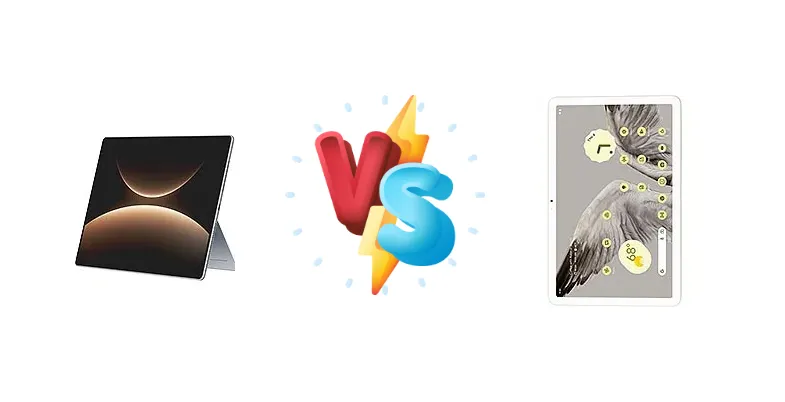
The tablet market is heating up, with Huawei’s MatePad Edge aiming for raw power and the Google Pixel Tablet focusing on seamless integration with the Google ecosystem. This comparison dissects their core components – from chipsets and charging speeds to overall usability – to determine which tablet best suits your needs.
🏆 Quick Verdict
For users prioritizing raw performance and incredibly fast charging, the Huawei MatePad Edge takes the lead. However, the Google Pixel Tablet’s Tensor G2 chip and tight Google integration make it the superior choice for those deeply invested in the Google ecosystem and seeking a smart home hub.
| Network |
|---|
| 2G bands | N/A | N/A |
| 3G bands | N/A | N/A |
| 4G bands | N/A | N/A |
| EDGE | No | No |
| GPRS | No | No |
| Technology | No cellular connectivity | No cellular connectivity |
| Launch |
|---|
| Announced | 2025, November 25 | 2023, May 10 |
| Status | Available. Released 2025, November 25 | Available. Released 2023, June 20 |
| Body |
|---|
| Build | - | Glass front, aluminum frame, aluminum back |
| Dimensions | 312.1 x 212 x 6.9 mm (12.29 x 8.35 x 0.27 in) | 258 x 169 x 8.1 mm (10.16 x 6.65 x 0.32 in) |
| SIM | No | No |
| Weight | 789 g (1.74 lb) | 493 g (1.09 lb) |
| | - | Stylus support |
| Display |
|---|
| Resolution | 3120 x 2080 pixels, 3:2 ratio (~264 ppi density) | 1600 x 2560 pixels, 16:10 ratio (~276 ppi density) |
| Size | 14.2 inches, 600.4 cm2 (~90.7% screen-to-body ratio) | 10.95 inches, 347.7 cm2 (~79.7% screen-to-body ratio) |
| Type | OLED, 1B colors, 120Hz, 1000 nits (peak), HDR Vivid | IPS LCD |
| Platform |
|---|
| CPU | Octa-core | Octa-core (2x2.85 GHz Cortex-X1 & 2x2.35 GHz Cortex-A78 & 4x1.80 GHz Cortex-A55) |
| Chipset | Kirin X90A | Google Tensor G2 (5 nm) |
| GPU | - | Mali-G710 MP7 |
| OS | HarmonyOS 5.1 | Android 13, upgradable to Android 15 |
| Memory |
|---|
| Card slot | No | No |
| Internal | 256GB 16GB RAM, 512GB 16GB RAM, 1TB 24GB RAM, 1TB 24GB RAM SSD, 2TB 32GB RAM SSD | 128GB 8GB RAM, 256GB 8GB RAM |
| | - | UFS 3.1 |
| Main Camera |
|---|
| Dual | 50 MP, f/1.8, (wide), PDAF
8 MP, f/2.2, (ultrawide) | - |
| Features | Color spectrum sensor, LED flash, HDR, panorama | HDR, panorama |
| Single | - | 8 MP, f/2.0, 24mm (wide), 1/4.0", 1.12µm |
| Video | 4K@30fps, 1080p@30fps | 1080p@30fps |
| Selfie camera |
|---|
| Features | - | HDR, panorama |
| Single | 32 MP, f/2.4 | 8 MP, f/2.0, 24mm (wide), 1/4.0", 1.12µm |
| Video | 1080p@30fps | 1080p@30fps |
| Sound |
|---|
| 3.5mm jack | - | No |
| 35mm jack | No | No |
| Loudspeaker | Yes, with stereo speakers (6 speakers) | Yes, with stereo speakers (4 speakers) |
| Comms |
|---|
| Bluetooth | 5.2, A2DP, LE, L2HC | 5.2, A2DP, LE |
| NFC | No | No |
| Positioning | No | No |
| Radio | No | No |
| USB | USB Type-C 3.1, OTG | USB Type-C 3.2 (Gen 1), magnetic connector |
| WLAN | Wi-Fi 802.11 a/b/g/n/ac/6/7, dual-band | Wi-Fi 802.11 a/b/g/n/ac/6, dual-band |
| Features |
|---|
| Sensors | Fingerprint, accelerometer, gyro, proximity (accessories only) | Accelerometer, gyro, compass, proximity (accessories only) |
| | - | Ultra Wideband (UWB) support |
| Battery |
|---|
| Charging | 140W wired
40W reverse wired | 15W wired |
| Type | 12900 mAh | Li-Po 7020 mAh (27 Wh) |
| Misc |
|---|
| Colors | Gray, Silver | Porcelain, Hazel, Rose |
| Models | QXS-W00, QXS-W10, QXS-W20 | GA06156-EU, GA06157-EU, GA06158-EU |
| Price | About 730 EUR | About 670 EUR |
Huawei MatePad Edge
- Blazing-fast 140W wired charging
- Potentially higher performance with Kirin X90A
- 40W reverse wired charging for versatile power delivery
- Limited information on display specifications
- Software support and updates may be less frequent than Google's
Google Pixel Tablet
- Google Tensor G2 offers excellent performance and efficiency
- Seamless integration with the Google ecosystem
- Guaranteed software updates and feature drops
- Slow 15W wired charging
- Performance may be limited in sustained intensive tasks compared to a potentially more powerful Kirin X90A
Display Comparison
While display specs are missing for the MatePad Edge, Huawei typically focuses on high-resolution panels. The Pixel Tablet’s display is likely a standard LCD, but its strength lies in its integration with the charging speaker dock. The MatePad Edge’s potential for a higher refresh rate and peak brightness, if present, would benefit gamers and media consumers. The Pixel Tablet’s display is adequate for general use, but doesn’t appear to be a standout feature.
Camera Comparison
Camera details are absent for both devices in the provided data. Given Huawei’s history, the MatePad Edge likely features a more robust camera system, potentially with a higher megapixel count and more advanced features. However, tablet cameras are rarely a primary purchasing factor. The Pixel Tablet will likely leverage Google’s computational photography expertise, potentially delivering better image quality in challenging lighting conditions despite potentially lower hardware specifications.
Performance
The core difference lies in the chipsets. The Huawei MatePad Edge utilizes the Kirin X90A, an octa-core processor, but lacks detailed architectural information. Conversely, the Google Pixel Tablet’s Tensor G2 (5nm) is a well-understood chip, featuring a tri-cluster configuration with 2x2.85 GHz Cortex-X1 cores for peak performance, 2x2.35 GHz Cortex-A78 cores for sustained tasks, and 4x1.80 GHz Cortex-A55 cores for efficiency. The 5nm fabrication process of the Tensor G2 provides a significant advantage in thermal efficiency, potentially leading to less throttling during prolonged intensive use compared to the Kirin X90A, whose node size is unknown. The Tensor G2 also benefits from Google’s machine learning capabilities, enhancing features like voice recognition and image processing.
Battery Life
Battery capacity is not specified for either tablet. However, the charging capabilities are drastically different. The MatePad Edge’s 140W wired charging is a game-changer, promising incredibly fast top-ups. The Pixel Tablet’s 15W wired charging is comparatively slow. While a larger battery on the Pixel Tablet could offset this, the MatePad Edge’s charging speed offers a significant convenience advantage, allowing users to quickly regain substantial battery life. The 40W reverse wired charging on the MatePad Edge also adds versatility, enabling it to charge other devices.
Buying Guide
Buy the Huawei MatePad Edge if you need a tablet for demanding tasks like video editing, gaming, or running resource-intensive applications, and value the convenience of 140W charging. Buy the Google Pixel Tablet if you prefer a tablet that seamlessly integrates with your Google Home setup, prioritizes software features and updates, and serves as a central hub for smart home control.
Frequently Asked Questions
❓ Does the Kirin X90A chipset in the MatePad Edge tend to throttle under sustained load, and how does it compare to the Tensor G2 in this regard?
Without detailed thermal testing data, it's difficult to say definitively. However, the Tensor G2's 5nm fabrication process generally leads to better thermal efficiency, reducing the likelihood of significant throttling during prolonged gaming or video editing. The Kirin X90A's node size is unknown, potentially making it more prone to throttling.
❓ How does the Google Pixel Tablet's integration with the charging speaker dock enhance its functionality beyond just charging?
The charging speaker dock transforms the Pixel Tablet into a smart home hub. It provides enhanced audio output, allowing for a more immersive media experience. It also enables hands-free Google Assistant access, turning the tablet into a smart display when docked. This integration is a key differentiator for the Pixel Tablet.
❓ Is the 15W charging on the Pixel Tablet realistically slow in everyday use, or is it manageable?
15W charging is noticeably slower than the MatePad Edge's 140W. While it's sufficient for overnight charging, topping up quickly during the day will take considerably longer. Users accustomed to fast charging will find the Pixel Tablet's charging speed a significant drawback.