
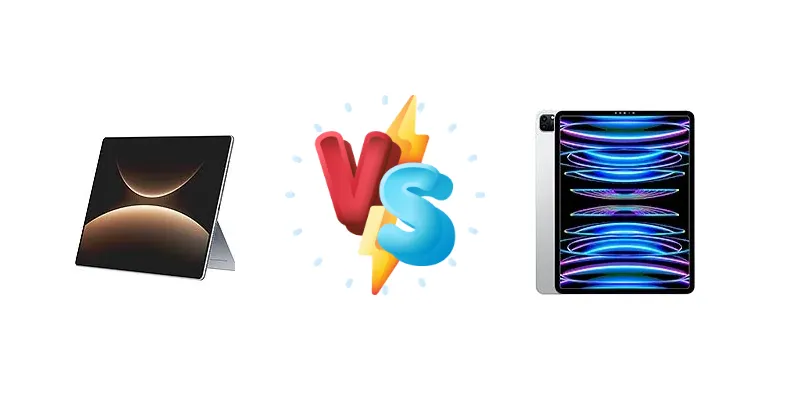
Huawei MatePad Edge vs. Apple iPad Pro 12.9 (2022): A Performance and Charging Showdown
| Phones Images | |||||
|---|---|---|---|---|---|
|
🏆 Quick Verdict
For the average user prioritizing raw performance and a mature tablet ecosystem, the Apple iPad Pro 12.9 (2022) remains the superior choice. However, the Huawei MatePad Edge’s incredibly fast 140W charging and potentially more competitive pricing make it a compelling alternative for those seeking speed and value.
| PHONES | ||
|---|---|---|
| Phone Names | Huawei MatePad Edge | Apple iPad Pro 12.9 (2022) |
| Network | ||
|---|---|---|
| 2G bands | N/A | GSM 850 / 900 / 1800 / 1900 |
| 3G bands | N/A | HSDPA 850 / 900 / 1700(AWS) / 1900 / 2100 |
| 4G bands | N/A | 1, 2, 3, 4, 5, 7, 8, 11, 12, 13, 14, 17, 18, 19, 20, 21, 25, 26, 28, 29, 30, 32, 34, 38, 39, 40, 41, 42, 46, 48, 66, 71 - A2764, A2437 |
| 5G bands | - | 1, 2, 3, 5, 7, 8, 12, 14, 20, 25, 26, 28, 29, 30, 38, 40, 41, 48, 66, 70, 71, 77, 78, 79, 258, 260, 261 SA/NSA/Sub6/mmWave - A2764 |
| EDGE | No | - |
| GPRS | No | - |
| Speed | - | HSPA, LTE, 5G |
| Technology | No cellular connectivity | GSM / HSPA / LTE / 5G |
| - | 1, 2, 3, 5, 7, 8, 12, 14, 20, 25, 26, 28, 29, 30, 38, 40, 41, 48, 66, 70, 71, 77, 78, 79 SA/NSA/Sub6 - A2437, A2766 | |
| Launch | ||
|---|---|---|
| Announced | 2025, November 25 | 2022, October 18 |
| Status | Available. Released 2025, November 25 | Available. Released 2022, October 26 |
| Body | ||
|---|---|---|
| Build | - | Glass front, aluminum back, aluminum frame |
| Dimensions | 312.1 x 212 x 6.9 mm (12.29 x 8.35 x 0.27 in) | 280.6 x 214.9 x 6.4 mm (11.05 x 8.46 x 0.25 in) |
| SIM | No | Nano-SIM + eSIM |
| Weight | 789 g (1.74 lb) | 682 g (Wi-Fi), 685 g (5G) (1.50 lb) |
| - | Stylus support (Bluetooth integration; magnetic) | |
| Display | ||
|---|---|---|
| Protection | - | Scratch-resistant glass, oleophobic coating |
| Resolution | 3120 x 2080 pixels, 3:2 ratio (~264 ppi density) | 2048 x 2732 pixels, 4:3 ratio (~265 ppi density) |
| Size | 14.2 inches, 600.4 cm2 (~90.7% screen-to-body ratio) | 12.9 inches, 515.3 cm2 (~85.4% screen-to-body ratio) |
| Type | OLED, 1B colors, 120Hz, 1000 nits (peak), HDR Vivid | Liquid Retina XDR mini-LED LCD, 120Hz, HDR10, Dolby Vision, 1000 nits (typ), 1600 nits (peak) |
| Platform | ||
|---|---|---|
| CPU | Octa-core | Octa-core (4x3.49 GHz performance cores, 4 efficiency cores) |
| Chipset | Kirin X90A | Apple M2 |
| GPU | - | Apple GPU (10-core graphics) |
| OS | HarmonyOS 5.1 | iPadOS 16.1, upgradable to iPadOS 26.1 |
| Memory | ||
|---|---|---|
| Card slot | No | No |
| Internal | 256GB 16GB RAM, 512GB 16GB RAM, 1TB 24GB RAM, 1TB 24GB RAM SSD, 2TB 32GB RAM SSD | 128GB 8GB RAM, 256GB 8GB RAM, 512GB 8GB RAM, 1TB 16GB RAM, 2TB 16GB RAM |
| Main Camera | ||
|---|---|---|
| Dual | 50 MP, f/1.8, (wide), PDAF 8 MP, f/2.2, (ultrawide) | 12 MP, f/1.8, (wide), 1/3.0", 1.22µm, dual pixel PDAF 10 MP, f/2.4, 125˚ (ultrawide) TOF 3D LiDAR scanner (depth) |
| Features | Color spectrum sensor, LED flash, HDR, panorama | Quad-LED dual-tone flash, HDR |
| Single | - | 12 MP, f/2.4, 122˚ (ultrawide) |
| Video | 4K@30fps, 1080p@30fps | 4K@24/25/30/60fps, 1080p@25/30/60/120/240fps; gyro-EIS, ProRes |
| Selfie camera | ||
|---|---|---|
| Features | - | Face detection, HDR, panorama |
| Single | 32 MP, f/2.4 | 12 MP, f/2.4, 122˚ (ultrawide) |
| Video | 1080p@30fps | 1080p@25/30/60fps, gyro-EIS, HDR |
| Sound | ||
|---|---|---|
| 3.5mm jack | - | No |
| 35mm jack | No | No |
| Loudspeaker | Yes, with stereo speakers (6 speakers) | Yes, with stereo speakers (4 speakers) |
| Comms | ||
|---|---|---|
| Bluetooth | 5.2, A2DP, LE, L2HC | 5.3, A2DP, LE, EDR |
| NFC | No | No |
| Positioning | No | GPS, GLONASS, GALILEO, QZSS (Wi‑Fi + Cellular model only) |
| Radio | No | No |
| USB | USB Type-C 3.1, OTG | USB Type-C 4 (Thunderbolt 3), DisplayPort, magnetic connector |
| WLAN | Wi-Fi 802.11 a/b/g/n/ac/6/7, dual-band | Wi-Fi 802.11 a/b/g/n/ac/6e, dual-band, hotspot |
| Features | ||
|---|---|---|
| Sensors | Fingerprint, accelerometer, gyro, proximity (accessories only) | Face ID, accelerometer, gyro, compass, barometer |
| Battery | ||
|---|---|---|
| Charging | 140W wired 40W reverse wired | - |
| Type | 12900 mAh | Li-Po 10758 mAh (40.88 Wh) |
| Misc | ||
|---|---|---|
| Colors | Gray, Silver | Silver, Space Gray |
| Models | QXS-W00, QXS-W10, QXS-W20 | A2764, A2437, A2766, A2436, iPad14,5, iPad14,6 |
| Price | About 730 EUR | About 1450 EUR |
Huawei MatePad Edge
- Incredibly fast 140W charging
- 40W reverse wired charging
- Potentially more affordable price point
- Performance likely lags behind the Apple M2
- HarmonyOS ecosystem may be limiting for some users
Apple iPad Pro 12.9 (2022)
- Exceptional performance with the Apple M2 chip
- Mature and feature-rich iPadOS ecosystem
- Industry-leading Liquid Retina XDR display
- Slower charging speeds compared to the MatePad Edge
- Higher price point
Display Comparison
While both tablets likely feature high-resolution displays, specific details like peak brightness and panel technology are missing for the MatePad Edge. The iPad Pro 12.9 (2022) boasts a Liquid Retina XDR display with mini-LED backlighting, achieving exceptional brightness and contrast. The iPad Pro’s ProMotion technology (adaptive refresh rates up to 120Hz) is also a significant advantage, offering smoother scrolling and responsiveness. Without comparable specs for the MatePad Edge, it’s difficult to assess its display quality relative to Apple’s industry-leading panel.
Camera Comparison
Details regarding the MatePad Edge’s camera system are absent. The iPad Pro 12.9 (2022) features a 12MP Wide camera and a 10MP Ultra Wide camera, along with LiDAR Scanner for enhanced AR experiences. While tablet cameras aren’t typically a primary focus, the iPad Pro’s camera system is capable of capturing high-quality photos and videos, and the LiDAR Scanner adds unique functionality. Without knowing the sensor sizes, apertures, or image processing capabilities of the MatePad Edge, a direct comparison is impossible.
Performance
The core difference lies in the chipsets. Apple’s M2 is a system-on-a-chip (SoC) built on a 5nm process, featuring an 8-core CPU (4 performance, 4 efficiency) and a powerful GPU. This architecture delivers exceptional performance in demanding tasks like video editing and 3D rendering. The Huawei MatePad Edge utilizes the Kirin X90A, an octa-core processor. While core count is similar, the M2’s architectural advantages and optimized software integration give it a significant edge in sustained performance and power efficiency. The iPad Pro’s LPDDR5X RAM further enhances its multitasking capabilities.
Battery Life
The Huawei MatePad Edge’s standout feature is its 140W wired charging, a massive leap over the iPad Pro’s charging capabilities. This allows for incredibly fast charging times, potentially going from 0-100% in under 30 minutes. The MatePad Edge also offers 40W reverse wired charging, enabling it to charge other devices. While the iPad Pro’s battery capacity is likely larger, the MatePad Edge’s charging speed significantly reduces downtime. The real-world impact of this difference is substantial for users who rely heavily on their tablets throughout the day.
Buying Guide
Buy the Huawei MatePad Edge if you need blazing-fast charging speeds and are comfortable within the HarmonyOS ecosystem. Its 140W charging is unmatched in this segment, ideal for users who demand minimal downtime. Buy the Apple iPad Pro 12.9 (2022) if you prioritize peak performance, a vast app library, seamless integration with other Apple devices, and a refined user experience. It’s the go-to choice for creative professionals and power users.