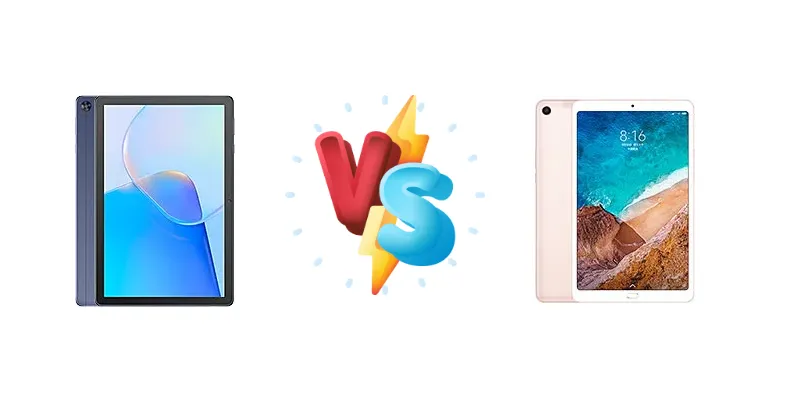
The Huawei MatePad C5e and Xiaomi Mi Pad 4 Plus represent compelling options in the increasingly competitive budget tablet space. Both devices aim to deliver a functional Android experience without breaking the bank, but they achieve this through different approaches to chipset selection and overall design. This comparison dives deep into the specifics to determine which tablet offers the best value for your money.
🏆 Quick Verdict
For the average user prioritizing consistent performance and a slightly more modern chipset architecture, the Xiaomi Mi Pad 4 Plus emerges as the better choice. While both tablets share 10W charging, the Snapdragon 660’s Kryo cores offer a demonstrable edge in sustained workloads compared to the Kirin 710A.
| Network |
|---|
| 2G bands | N/A | - |
| 3G bands | N/A | - |
| 4G bands | N/A | 1, 3, 5, 7, 8, 34, 38, 39, 40, 41 |
| EDGE | No | No |
| GPRS | No | No |
| Speed | - | LTE (3CA) Cat12 600/150 Mbps |
| Technology | No cellular connectivity | LTE |
| Launch |
|---|
| Announced | 2022, October 19 | 2018, August. Released 2018, August |
| Status | Available. Released 2022, November | Discontinued |
| Body |
|---|
| Build | - | Glass front, aluminum back, aluminum frame |
| Dimensions | 240.2 x 159 x 7.9 mm (9.46 x 6.26 x 0.31 in) | 245.6 x 149.1 x 8 mm (9.67 x 5.87 x 0.31 in) |
| SIM | No | Nano-SIM |
| Weight | 450 g (0.99 lb) | 485 g (1.07 lb) |
| Display |
|---|
| Resolution | 1200 x 1920 pixels, 16:10 ratio (~224 ppi density) | 1200 x 1920 pixels, 16:10 ratio (~224 ppi density) |
| Size | 10.1 inches, 295.8 cm2 (~77.4% screen-to-body ratio) | 10.1 inches, 295.8 cm2 (~80.8% screen-to-body ratio) |
| Type | IPS LCD | IPS LCD |
| Platform |
|---|
| CPU | Octa-core (4x2.0 GHz Cortex-A73 & 4x1.7 GHz Cortex-A53) | Octa-core (4x2.2 GHz Kryo 260 Gold & 4x1.8 GHz Kryo 260 Silver) |
| Chipset | Kirin 710A (14 nm) | Qualcomm SDM660 Snapdragon 660 (14 nm) |
| GPU | Mali-G51 MP4 | Adreno 512 |
| OS | Android 10, EMUI 10.1 | Android 8.1 (Oreo), MIUI 10 |
| Memory |
|---|
| Card slot | microSDXC (dedicated slot) | microSDXC (dedicated slot) |
| Internal | 64GB 4GB RAM | 64GB 4GB RAM, 128GB 4GB RAM |
| | - | eMMC 5.1 |
| Main Camera |
|---|
| Features | HDR | Panorama, HDR |
| Single | 5 MP, f/2.2, AF | 13 MP, f/2.0 |
| Video | 1080p@30fps | 1080p@30fps |
| Selfie camera |
|---|
| Single | 2 MP, f/2.4 | 5 MP, f/2.0 |
| Video | 720p@30fps | - |
| Sound |
|---|
| 3.5mm jack | Yes | Yes |
| 35mm jack | Yes | Yes |
| Loudspeaker | Yes, with stereo speakers | Yes, with stereo speakers |
| Comms |
|---|
| Bluetooth | 5.1, A2DP, LE | 5.0, A2DP, LE |
| NFC | No | No |
| Positioning | GPS, GLONASS, BDS | GPS, GLONASS, BDS (LTE model only) |
| Radio | No | No |
| USB | USB Type-C 2.0, OTG | USB Type-C |
| WLAN | Wi-Fi 802.11 a/b/g/n/ac, dual-band | Wi-Fi 802.11 a/b/g/n/ac, dual-band, Wi-Fi Direct |
| Features |
|---|
| Sensors | Accelerometer | Accelerometer, gyro, proximity, compass (LTE model only) |
| Battery |
|---|
| Charging | 10W wired
5W reverse wired | 10W wired |
| Type | Li-Po 5100 mAh | Li-Po 8620 mAh, non-removable |
| Misc |
|---|
| Colors | Deepsea Blue | Black, Rose Gold |
| Models | BZI-W00 | - |
| Price | - | About 260 EUR |
Huawei MatePad C5e
- Potential for Huawei software optimizations
- May benefit from Huawei ecosystem integration
- Likely a slightly lower price point (depending on region)
- Kirin 710A chipset offers less sustained performance
- Limited to 10W charging
- Display specs are unknown and likely average
Xiaomi Mi Pad 4 Plus
- Snapdragon 660 provides better sustained performance
- Qualcomm chipset offers wider app compatibility
- Established Snapdragon platform for gaming
- Limited to 10W charging
- Display specs are unknown and likely average
- May be slightly more expensive than the MatePad C5e
Display Comparison
Neither Huawei nor Xiaomi provide detailed display specifications in the provided data. However, given the market positioning of both tablets, it’s reasonable to assume both utilize IPS LCD panels. The absence of information regarding resolution, peak brightness, or color gamut makes a direct comparison impossible. Users should expect typical budget tablet display quality – adequate for everyday use but not exceptional. Bezels are likely to be substantial on both devices, reflecting their cost-conscious design.
Camera Comparison
Camera performance is unlikely to be a deciding factor for either tablet, given their budget nature. Detailed camera specs are unavailable, but it’s safe to assume both feature basic camera setups geared towards casual snapshots. Without sensor size or aperture information, a meaningful comparison is impossible. Users should not expect flagship-level image quality from either device.
Performance
The core difference lies in the chipsets: Huawei’s MatePad C5e features the Kirin 710A, built on a 14nm process, while the Xiaomi Mi Pad 4 Plus utilizes the Qualcomm Snapdragon 660, also on 14nm. The Snapdragon 660 boasts a slightly higher clock speed (2.2 GHz vs 2.0 GHz for the Cortex-A73 cores in the Kirin 710A) and utilizes Qualcomm’s Kryo CPU architecture. Kryo cores generally exhibit better sustained performance and efficiency compared to ARM’s Cortex designs. While both are octa-core CPUs, the Snapdragon 660’s architecture provides a slight advantage in multi-threaded tasks and gaming. The Kirin 710A’s strength lies in Huawei’s software optimizations, but this is unlikely to fully close the performance gap.
Battery Life
Both tablets are limited to 10W wired charging, indicating a focus on cost savings rather than fast charging capabilities. While battery capacity isn’t specified, the similar chipsets and display technologies suggest comparable battery life. A full charge from 0-100% will likely take around 3-4 hours on both devices. The real-world battery experience will depend heavily on usage patterns, but neither tablet is expected to deliver exceptional endurance.
Buying Guide
Buy the Huawei MatePad C5e if you need a tablet primarily for light tasks like media consumption and basic productivity, and value Huawei’s ecosystem integration. Buy the Xiaomi Mi Pad 4 Plus if you prefer a tablet capable of handling more demanding applications, enjoy slightly better sustained performance for gaming, and appreciate Qualcomm’s established track record in mobile processing.
Frequently Asked Questions
❓ Will the Snapdragon 660 in the Mi Pad 4 Plus handle demanding games like PUBG Mobile?
The Snapdragon 660 is capable of running PUBG Mobile, but you’ll likely need to lower the graphics settings to medium or low to achieve a smooth frame rate. While not a dedicated gaming chipset, it offers better sustained performance than the Kirin 710A, making it the preferable choice for mobile gaming.
❓ Is the 10W charging speed on either tablet acceptable for daily use?
10W charging is relatively slow by modern standards. Expect a full charge to take several hours. Neither tablet prioritizes fast charging, focusing instead on affordability. If fast charging is a priority, you’ll need to consider more expensive tablet options.
❓ Which tablet is better for watching videos and browsing the web?
Both tablets are adequate for these tasks. The experience will largely depend on the display quality, which is unknown for both devices. However, the Snapdragon 660 in the Mi Pad 4 Plus will provide a smoother experience when multitasking or loading complex web pages.