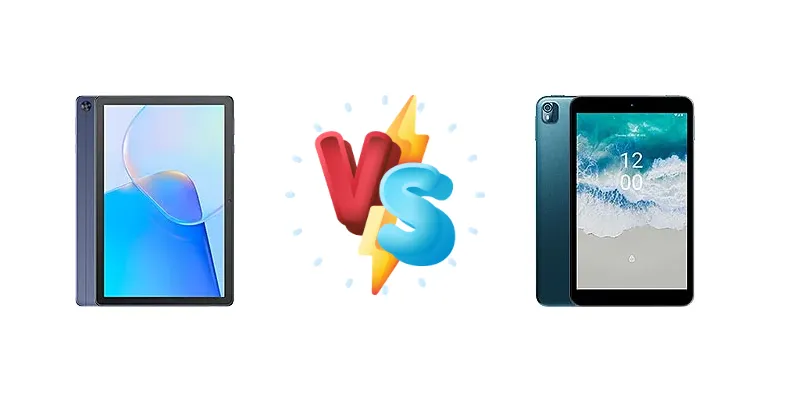
The sub-$200 tablet market is fiercely competitive, and the Huawei MatePad C5e and Nokia T10 represent two compelling options. Both aim to deliver a functional Android experience without breaking the bank, but they achieve this with different approaches to chipset architecture and overall design. This comparison dives deep into the specifications to determine which tablet offers the best value for your needs.
🏆 Quick Verdict
For most users, the Nokia T10 edges out the Huawei MatePad C5e. While the Kirin 710A in the MatePad C5e is technically a more complex chip, the newer 12nm Unisoc T606 in the T10 offers a more efficient architecture, translating to potentially better sustained performance and a more modern Android experience.
| Network |
|---|
| 2G bands | N/A | GSM 850 / 900 / 1800 / 1900 |
| 3G bands | N/A | HSDPA 850 / 900 / 2100 |
| 4G bands | N/A | 1, 3, 5, 7, 8, 20, 28, 38, 40, 41 |
| EDGE | No | - |
| GPRS | No | - |
| Speed | - | HSPA 42.2/5.76 Mbps, LTE Cat4 150/50 Mbps |
| Technology | No cellular connectivity | GSM / HSPA / LTE |
| Launch |
|---|
| Announced | 2022, October 19 | 2022, July 12 |
| Status | Available. Released 2022, November | Available. Released 2022, August 20 |
| Body |
|---|
| Build | - | Glass front, plastic back, plastic frame |
| Dimensions | 240.2 x 159 x 7.9 mm (9.46 x 6.26 x 0.31 in) | 208 x 123.2 x 9 mm (8.19 x 4.85 x 0.35 in) |
| SIM | No | Nano-SIM |
| Weight | 450 g (0.99 lb) | 375 g (13.23 oz) |
| | - | Splash resistant |
| Display |
|---|
| Resolution | 1200 x 1920 pixels, 16:10 ratio (~224 ppi density) | 800 x 1280 pixels, 16:10 ratio (~189 ppi density) |
| Size | 10.1 inches, 295.8 cm2 (~77.4% screen-to-body ratio) | 8.0 inches, 185.6 cm2 (~72.4% screen-to-body ratio) |
| Type | IPS LCD | IPS LCD, 360 nits (typ), 450 nits (peak) |
| Platform |
|---|
| CPU | Octa-core (4x2.0 GHz Cortex-A73 & 4x1.7 GHz Cortex-A53) | Octa-core (2x1.6 GHz Cortex-A75 & 6x1.6 GHz Cortex-A55) |
| Chipset | Kirin 710A (14 nm) | Unisoc T606 (12 nm) |
| GPU | Mali-G51 MP4 | Mali-G57 MP1 |
| OS | Android 10, EMUI 10.1 | Android 12, upgradable to Android 13 |
| Memory |
|---|
| Card slot | microSDXC (dedicated slot) | microSDXC |
| Internal | 64GB 4GB RAM | 32GB 3GB RAM, 64GB 4GB RAM |
| Main Camera |
|---|
| Features | HDR | LED flash |
| Single | 5 MP, f/2.2, AF | 8 MP, 1/4.0", 1.12µm, AF |
| Video | 1080p@30fps | 1080p |
| Selfie camera |
|---|
| Single | 2 MP, f/2.4 | 2 MP, 1/5.0", 1.65µm |
| Video | 720p@30fps | 720p |
| Sound |
|---|
| 3.5mm jack | Yes | Yes |
| 35mm jack | Yes | Yes |
| Loudspeaker | Yes, with stereo speakers | Yes, with stereo speakers |
| Comms |
|---|
| Bluetooth | 5.1, A2DP, LE | 5.0, A2DP, LE |
| NFC | No | No |
| Positioning | GPS, GLONASS, BDS | GPS, GLONASS, GALILEO |
| Radio | No | No |
| USB | USB Type-C 2.0, OTG | USB Type-C 2.0, OTG |
| WLAN | Wi-Fi 802.11 a/b/g/n/ac, dual-band | Wi-Fi 802.11 a/b/g/n/ac, dual-band |
| Features |
|---|
| Sensors | Accelerometer | Accelerometer, proximity |
| Battery |
|---|
| Charging | 10W wired
5W reverse wired | 10W wired |
| Type | Li-Po 5100 mAh | Li-Po 5250 mAh |
| Misc |
|---|
| Colors | Deepsea Blue | Ocean Blue |
| Models | BZI-W00 | TA-1503, TA-1472, TA-1462, TA-1457 |
| Price | - | About 160 EUR |
| SAR | - | 1.19 W/kg (body) |
| SAR EU | - | 0.27 W/kg (head) 1.57 W/kg (body) |
Huawei MatePad C5e
- Potentially higher peak CPU performance due to faster A73 cores.
- 5W reverse wired charging for emergency device top-ups.
- Huawei ecosystem integration (for existing Huawei users).
- Older 14nm manufacturing process leads to lower efficiency.
- Kirin 710A may throttle under sustained load.
- Software updates may be less frequent.
Nokia T10
- More efficient 12nm Unisoc T606 chipset.
- Modern CPU architecture (Cortex-A75 cores).
- Cleaner Android experience with potential for guaranteed updates.
- Better thermal management for sustained performance.
- Slightly lower peak CPU clock speeds.
- No reverse wired charging.
- Unisoc chipset may have limited software optimization.
Display Comparison
Neither tablet boasts a particularly impressive display. Specifications are missing regarding panel type, resolution, and brightness. However, given their price point, both likely utilize IPS LCD panels. The absence of details suggests neither offers high color accuracy or HDR support. Bezels are expected to be noticeable on both devices, prioritizing affordability over a premium aesthetic. The user experience will likely be similar in terms of visual quality, leaning towards adequate for basic tasks and media viewing.
Camera Comparison
Camera performance is unlikely to be a deciding factor for either tablet. Details are missing regarding sensor sizes and image processing capabilities. Given the target market, both tablets likely feature basic camera setups primarily intended for video calls and casual snapshots. Expect limited low-light performance and a lack of advanced features like optical image stabilization (OIS). Focusing on the chipset differences is far more relevant than scrutinizing camera specs.
Performance
The core difference lies in the chipsets. The Huawei MatePad C5e features the Kirin 710A, a 14nm chip with an octa-core configuration split between 2.0 GHz Cortex-A73 and 1.7 GHz Cortex-A53 cores. The Nokia T10 utilizes the Unisoc T606, a 12nm chip with 2x1.6 GHz Cortex-A75 and 6x1.6 GHz Cortex-A55 cores. While the Kirin 710A has a higher peak clock speed on its performance cores, the Unisoc T606 benefits from a more modern architecture and a smaller manufacturing process. The Cortex-A75 cores in the T10 are more efficient than the A73 cores in the MatePad C5e, potentially leading to better sustained performance under load. The 12nm process also contributes to improved thermal efficiency, reducing the likelihood of throttling during extended use. This means the T10 is likely to maintain performance for longer periods during gaming or video editing.
Battery Life
Both tablets offer 10W wired charging, a relatively slow charging speed by today’s standards. Battery capacity is not specified, but given the similar size and target market, they are likely comparable. The Unisoc T606’s improved efficiency in the Nokia T10 could translate to slightly longer battery life during typical usage. The 5W reverse wired charging on the MatePad C5e is a niche feature, allowing it to charge other devices, but its slow speed limits its practicality. Expect both tablets to provide a full day of light to moderate use.
Buying Guide
Buy the Huawei MatePad C5e if you prioritize a slightly more powerful CPU core configuration for occasional demanding tasks, and if Huawei’s ecosystem and software features appeal to you. Buy the Nokia T10 if you value a more modern and efficient chipset, a cleaner Android experience with guaranteed updates, and a potentially longer lifespan due to better thermal management. The T10 is the better choice for everyday use and media consumption.
Frequently Asked Questions
❓ Will the Unisoc T606 in the Nokia T10 struggle with demanding games like PUBG Mobile?
While the Unisoc T606 isn't a gaming powerhouse, it's capable of running PUBG Mobile at medium settings with reasonable frame rates. The improved thermal efficiency compared to the Kirin 710A means it's less likely to throttle during extended gaming sessions, providing a more consistent experience. Don't expect ultra settings or consistently high frame rates, but it's perfectly playable for casual gaming.
❓ How important is the 5W reverse wired charging on the Huawei MatePad C5e?
The 5W reverse wired charging is a convenient but limited feature. It can provide a small emergency boost to your smartphone or other devices, but the slow charging speed means it's not a practical replacement for a dedicated power bank or fast charger. It's more of a 'nice-to-have' than a crucial feature.
❓ Which tablet is more likely to receive Android updates?
Nokia has a stronger track record of providing software updates for its tablets, particularly security patches. Huawei's software update support can be less consistent, especially given geopolitical factors. The Nokia T10 is therefore the more likely candidate to receive future Android version updates and security patches.