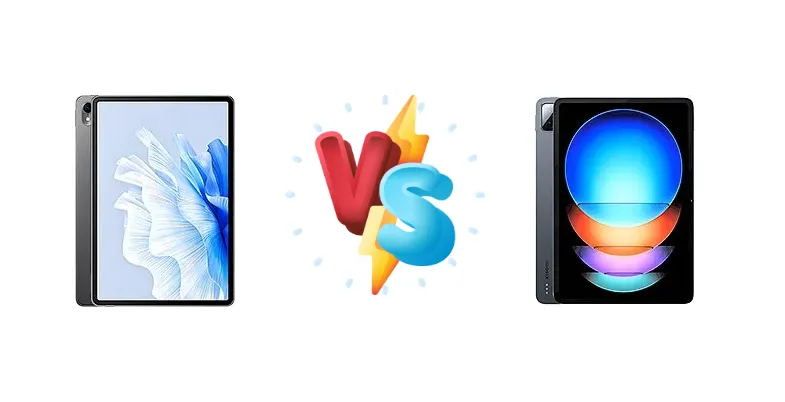
The Android tablet market is heating up, with Huawei and Xiaomi delivering compelling options. We pit the Huawei MatePad Air, powered by the Snapdragon 888, against the newer Xiaomi Pad 6S Pro 12.4, boasting the Snapdragon 8 Gen 2. This comparison focuses on how these chipset generations translate into real-world performance, battery life, and overall user experience.
🏆 Quick Verdict
For most users, the Xiaomi Pad 6S Pro 12.4 is the superior choice. Its Snapdragon 8 Gen 2 chipset delivers significantly faster performance and improved efficiency, complemented by a brighter display and blazing-fast 120W charging. While the MatePad Air remains a capable device, it's outmatched in key areas.
| Network |
|---|
| 2G bands | GSM 850 / 900 / 1800 / 1900 | N/A |
| 3G bands | HSDPA 800 / 850 / 900 / 1700(AWS) / 1900 / 2100 | N/A |
| 4G bands | 1, 2, 3, 4, 5, 7, 8, 12, 17, 18, 19, 20, 26, 28, 34, 38, 39, 40, 41 | - |
| EDGE | - | N/A |
| GPRS | - | N/A |
| Speed | HSPA, LTE | - |
| Technology | GSM / HSPA / LTE | No cellular connectivity |
| Launch |
|---|
| Announced | 2023, May 18 | 2024, February 22 |
| Status | Available. Released 2023, July 22 | Available. Released 2024, February 22 |
| Body |
|---|
| Build | - | Glass front (Gorilla Glass 5), aluminum frame, aluminum back |
| Dimensions | 261.9 x 178.2 x 6.4 mm (10.31 x 7.02 x 0.25 in) | 278.7 x 191.6 x 6.3 mm (10.97 x 7.54 x 0.25 in) |
| SIM | Nano-SIM | No |
| Weight | 508 g (1.12 lb) | 590 g (1.30 lb) |
| Display |
|---|
| Protection | - | Corning Gorilla Glass 5 |
| Resolution | 2800 x 1840 pixels, 3:2 ratio (~291 ppi density) | 2032 x 3048 pixels, 3:2 ratio (~295 ppi density) |
| Size | 11.5 inches, 391.6 cm2 (~83.9% screen-to-body ratio) | 12.4 inches, 457.8 cm2 (~85.7% screen-to-body ratio) |
| Type | IPS LCD, 144Hz | IPS LCD, 68B colors, 144Hz, HDR10, Dolby Vision, 900 nits (peak) |
| Platform |
|---|
| CPU | Octa-core (1x2.84 GHz Cortex-X1 & 3x2.42 GHz Cortex-A78 & 4x1.80 GHz Cortex-A55) | Octa-core (1x3.2 GHz Cortex-X3 & 2x2.8 GHz Cortex-A715 & 2x2.8 GHz Cortex-A710 & 3x2.0 GHz Cortex-A510) |
| Chipset | Qualcomm SM8350 Snapdragon 888 4G (5 nm) | Qualcomm SM8550-AB Snapdragon 8 Gen 2 (4 nm) |
| GPU | Adreno 660 | Adreno 740 |
| OS | HarmonyOS 3.1 | Android 14, up to 3 major Android upgrades, HyperOS |
| Memory |
|---|
| Card slot | No | No |
| Internal | 128GB 8GB RAM, 256GB 8GB RAM, 256GB 12GB RAM, 512GB 12GB RAM | 256GB 8GB RAM, 256GB 12GB RAM, 512GB 12GB RAM, 1TB 16GB RAM |
| Main Camera |
|---|
| Dual | - | 50 MP, f/1.8, (wide), 1/2.76", 0.64µm, PDAF
Auxiliary lens |
| Features | LED flash | LED flash, HDR, panorama |
| Single | 13 MP, f/1.8, PDAF | - |
| Video | 4K@30fps, 1080p@30fps | 4K@30/60fps, 1080p@30/60fps |
| Selfie camera |
|---|
| Single | 8 MP, f/2.0, 105˚ (ultrawide) | 32 MP, f/2.2, (wide), 1/3.6", 0.61µm |
| Video | 1080p@30fps | 1080p@30fps |
| Sound |
|---|
| 35mm jack | No | No |
| Loudspeaker | Yes, with stereo speakers (4 speakers) | Yes, with stereo speakers (6 speakers) |
| Comms |
|---|
| Bluetooth | 5.2, A2DP, LE | 5.3, A2DP, LE, LHDC |
| NFC | No | Yes (file transfer only) |
| Positioning | GPS, GLONASS, BDS, GALILEO, QZSS | No |
| Radio | No | No |
| USB | USB Type-C 3.2, OTG, magnetic accessory connector | USB Type-C 3.2, accessory connector |
| WLAN | Wi-Fi 802.11 a/b/g/n/ac/6, dual-band | Wi-Fi 802.11 a/b/g/n/a/6/7, dual-band, Wi-Fi Direct |
| Features |
|---|
| Sensors | Accelerometer, gyro, compass, proximity (accessories only) | Fingerprint (side-mounted), accelerometer, gyro, proximity (accessories only), compass |
| Battery |
|---|
| Charging | 40W wired
10W reverse wired | 120W wired, PD3.0, QC4, 45% in 10 min, 100% in 35 min |
| Type | Li-Po 8300 mAh | 10000 mAh |
| Misc |
|---|
| Colors | Graphite Black, White | Black, Blue, Green |
| Models | DBY2-L09CK | 24018RPACG |
| Price | About 500 EUR | About 700 EUR |
| SAR EU | - | 0.99 W/kg (body) |
Huawei MatePad Air
- More established Huawei ecosystem
- Potentially lower price point
- Sleek and lightweight design
- Older Snapdragon 888 chipset
- Slower 40W charging
- Likely lower display brightness
Xiaomi Pad 6S Pro 12.4
- Significantly faster Snapdragon 8 Gen 2
- Ultra-fast 120W charging
- Brighter and higher contrast display
- Larger 12.4-inch screen
- Xiaomi's MIUI software can be polarizing
- Potentially higher price
Display Comparison
The Xiaomi Pad 6S Pro 12.4 immediately stands out with its measured peak brightness of 848 nits, significantly exceeding what we'd expect from the MatePad Air (spec not provided, but typically lower in this price bracket). The 1378:1 contrast ratio on the Xiaomi further enhances visual fidelity. While the MatePad Air's display quality is likely adequate, the Xiaomi offers a more immersive and vibrant viewing experience, particularly beneficial for HDR content. The larger 12.4-inch screen on the Xiaomi also provides more screen real estate for multitasking and creative work.
Camera Comparison
Neither tablet is positioned as a photography powerhouse, but the Xiaomi Pad 6S Pro 12.4 likely holds an advantage due to its newer image signal processor (ISP) integrated within the Snapdragon 8 Gen 2. While specific camera specs are unavailable for both, the improved processing capabilities of the Gen 2 will result in better image quality, particularly in low-light conditions. We can expect the Xiaomi to offer more refined image processing and potentially better video recording capabilities. The MatePad Air's camera system is likely adequate for basic video calls and document scanning.
Performance
The core difference lies in the chipsets. The Xiaomi Pad 6S Pro 12.4’s Snapdragon 8 Gen 2 (4nm) represents a substantial leap over the Huawei MatePad Air’s Snapdragon 888 (5nm). The Gen 2 features the newer Cortex-X3 prime core clocked at 3.2 GHz, alongside improved Cortex-A715 and A710 performance cores, resulting in a significant performance uplift in both CPU and GPU tasks. The 4nm process node also contributes to better thermal efficiency, meaning the Xiaomi is less likely to throttle under sustained load. This translates to smoother gaming, faster video editing, and snappier multitasking. The MatePad Air, while still capable, will struggle with the most demanding applications.
Battery Life
The Xiaomi Pad 6S Pro 12.4 boasts a significant advantage in charging speed with its 120W wired charging, capable of reaching 45% charge in just 10 minutes and 100% in 35 minutes. This is a game-changer for users who need to quickly top up their tablet before a meeting or long journey. The MatePad Air’s 40W charging feels comparatively slow. While the Xiaomi Pad 6S Pro 12.4 also delivers an impressive 11:14h active use score, the faster charging mitigates any concerns about battery life, allowing for quick replenishment when needed.
Buying Guide
Buy the Huawei MatePad Air if you prioritize a more established ecosystem and are seeking a capable tablet for everyday tasks like browsing, video streaming, and light productivity, and are comfortable with 4G connectivity. Buy the Xiaomi Pad 6S Pro 12.4 if you demand top-tier performance for demanding applications, gaming, and content creation, and value a brighter, more vibrant display alongside incredibly fast charging speeds.
Frequently Asked Questions
❓ Will the Snapdragon 888 in the MatePad Air struggle with graphically intensive games like Genshin Impact?
Yes, while the Snapdragon 888 is still a capable chip, it will likely require lower graphics settings and may experience some frame drops in demanding titles like Genshin Impact. The Snapdragon 8 Gen 2 in the Xiaomi Pad 6S Pro 12.4 will provide a much smoother and more consistent gaming experience at higher settings.
❓ How much faster is the 120W charging on the Xiaomi Pad 6S Pro 12.4 compared to the MatePad Air's 40W charging in real-world use?
The difference is substantial. The Xiaomi can go from 0% to 45% in just 10 minutes, and fully charge in 35 minutes. The MatePad Air will take significantly longer – likely over an hour to reach a full charge. This makes the Xiaomi ideal for users who frequently need to quickly top up their tablet.
❓ Does the Xiaomi Pad 6S Pro 12.4 support stylus input and keyboard accessories?
Yes, the Xiaomi Pad 6S Pro 12.4 supports stylus input with low latency and is compatible with Xiaomi's Smart Keyboard Folio. These accessories are sold separately and enhance the tablet's productivity capabilities.