
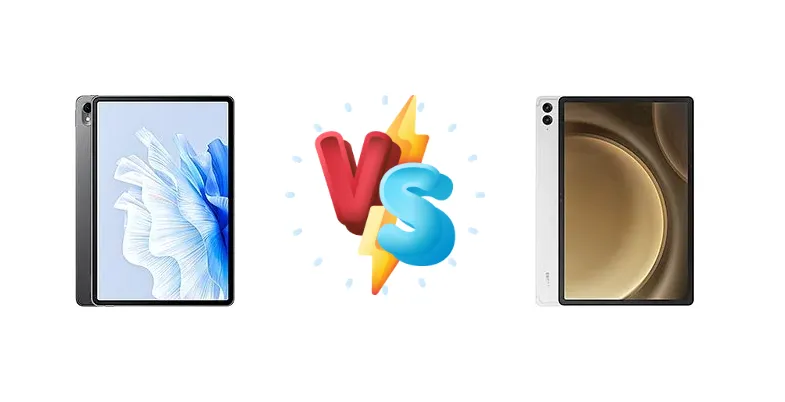
Huawei MatePad Air vs Samsung Galaxy Tab S9 FE+: A Detailed Performance and Value Showdown
| Phones Images | |||||
|---|---|---|---|---|---|
|
🏆 Quick Verdict
For users prioritizing raw performance and potentially benefiting from a more mature software experience, the Huawei MatePad Air emerges as the winner. Its Snapdragon 888 chipset offers a noticeable edge in demanding tasks. However, the Samsung Galaxy Tab S9 FE+ provides a compelling alternative with its 45W charging and broader ecosystem integration, making it a strong contender for everyday use.
| PHONES | ||
|---|---|---|
| Phone Names | Huawei MatePad Air | Samsung Galaxy Tab S9 FE+ |
| Network | ||
|---|---|---|
| 2G bands | GSM 850 / 900 / 1800 / 1900 | GSM 850 / 900 / 1800 / 1900 |
| 3G bands | HSDPA 800 / 850 / 900 / 1700(AWS) / 1900 / 2100 | HSDPA 850 / 900 / 1700(AWS) / 1900 / 2100 |
| 4G bands | 1, 2, 3, 4, 5, 7, 8, 12, 17, 18, 19, 20, 26, 28, 34, 38, 39, 40, 41 | 1, 2, 3, 4, 5, 7, 8, 12, 13, 17, 20, 26, 28, 32, 38, 40, 41, 66 |
| 5G bands | - | 1, 3, 5, 7, 8, 20, 28, 38, 40, 41, 66, 77, 78 SA/NSA/Sub6 |
| Speed | HSPA, LTE | HSPA, LTE, 5G - cellular model only |
| Technology | GSM / HSPA / LTE | GSM / HSPA / LTE / 5G |
| Launch | ||
|---|---|---|
| Announced | 2023, May 18 | 2023, October 04 |
| Status | Available. Released 2023, July 22 | Available. Released 2023, October 16 |
| Body | ||
|---|---|---|
| Build | - | Glass front, aluminum back, aluminum frame |
| Dimensions | 261.9 x 178.2 x 6.4 mm (10.31 x 7.02 x 0.25 in) | 285.4 x 185.4 x 6.5 mm (11.24 x 7.30 x 0.26 in) |
| SIM | Nano-SIM | Nano-SIM + eSIM (cellular model only) |
| Weight | 508 g (1.12 lb) | 627 g or 628 g (1.38 lb) |
| Display | ||
|---|---|---|
| Resolution | 2800 x 1840 pixels, 3:2 ratio (~291 ppi density) | 1600 x 2560 pixels, 16:10 ratio (~243 ppi density) |
| Size | 11.5 inches, 391.6 cm2 (~83.9% screen-to-body ratio) | 12.4 inches, 445.8 cm2 (~84.3% screen-to-body ratio) |
| Type | IPS LCD, 144Hz | IPS LCD, 90Hz |
| Platform | ||
|---|---|---|
| CPU | Octa-core (1x2.84 GHz Cortex-X1 & 3x2.42 GHz Cortex-A78 & 4x1.80 GHz Cortex-A55) | Octa-core (4x2.4 GHz Cortex-A78 & 4x2.0 GHz Cortex-A55) |
| Chipset | Qualcomm SM8350 Snapdragon 888 4G (5 nm) | Exynos 1380 (5 nm) |
| GPU | Adreno 660 | Mali-G68 MP5 |
| OS | HarmonyOS 3.1 | Android 13, up to 4 major Android upgrades, One UI 6 |
| Memory | ||
|---|---|---|
| Card slot | No | microSDXC (dedicated slot) |
| Internal | 128GB 8GB RAM, 256GB 8GB RAM, 256GB 12GB RAM, 512GB 12GB RAM | 128GB 6GB RAM, 128GB 8GB RAM, 256GB 8GB RAM, 256GB 12GB RAM |
| Main Camera | ||
|---|---|---|
| Dual | - | 8 MP, (wide) 8 MP, (ultrawide) |
| Features | LED flash | - |
| Single | 13 MP, f/1.8, PDAF | - |
| Video | 4K@30fps, 1080p@30fps | 4K@30fps, 1080p@30fps |
| Selfie camera | ||
|---|---|---|
| Single | 8 MP, f/2.0, 105˚ (ultrawide) | 12 MP, (ultrawide) |
| Video | 1080p@30fps | Yes |
| Sound | ||
|---|---|---|
| 35mm jack | No | No |
| Loudspeaker | Yes, with stereo speakers (4 speakers) | Yes, with stereo speakers |
| Comms | ||
|---|---|---|
| Bluetooth | 5.2, A2DP, LE | 5.3, A2DP, LE |
| NFC | No | No |
| Positioning | GPS, GLONASS, BDS, GALILEO, QZSS | GPS, GALILEO, GLONASS, BDS, QZSS - cellular model only |
| Radio | No | No |
| USB | USB Type-C 3.2, OTG, magnetic accessory connector | USB Type-C 2.0, magnetic connector |
| WLAN | Wi-Fi 802.11 a/b/g/n/ac/6, dual-band | Wi-Fi 802.11 a/b/g/n/ac/6, dual-band, Wi-Fi Direct |
| Features | ||
|---|---|---|
| Sensors | Accelerometer, gyro, compass, proximity (accessories only) | Fingerprint (side-mounted), accelerometer, gyro, compass, proximity (accessories only) |
| Battery | ||
|---|---|---|
| Charging | 40W wired 10W reverse wired | 45W wired, QC2.0 |
| Type | Li-Po 8300 mAh | Li-Po 10090 mAh |
| Misc | ||
|---|---|---|
| Colors | Graphite Black, White | Mint, Silver, Gray, Lavender |
| Models | DBY2-L09CK | SM-X610, SM-X616B |
| Price | About 500 EUR | About 770 EUR |
| SAR | - | 0.77 W/kg (body) |
| SAR EU | - | 0.50 W/kg (body) |
Huawei MatePad Air
- Superior CPU performance with Snapdragon 888
- Potentially more mature software optimization
- Stronger performance for demanding apps
- Slower charging speed (40W)
- Limited ecosystem integration compared to Samsung
Samsung Galaxy Tab S9 FE+
- Faster 45W charging with Quick Charge 2.0
- Seamless integration with Samsung ecosystem
- Potentially longer software support
- Less powerful CPU compared to Snapdragon 888
- Performance may struggle with very demanding tasks
Display Comparison
Both tablets likely feature LCD panels, a common trait in this price bracket. While specific display specs (resolution, brightness) are missing, the focus shifts to processing power impacting UI smoothness. The absence of LTPO technology in either device suggests standard refresh rates, meaning neither will dynamically adjust for power savings like higher-end tablets. Bezels are likely comparable, impacting immersion but not significantly differentiating the user experience.
Camera Comparison
Camera performance is unlikely to be a deciding factor for most tablet buyers. Given the context data, detailed analysis is limited. Both tablets likely feature a primary camera and an ultrawide, with the Tab S9 FE+ potentially offering a slightly more refined image processing pipeline due to Samsung’s established camera software. The absence of details regarding sensor size and aperture makes a definitive comparison impossible, but the focus should remain on the tablets’ primary functions – productivity and media consumption – rather than photography.
Performance
The core battleground is the chipset. The Huawei MatePad Air’s Snapdragon 888 (5nm) boasts a more powerful CPU configuration – an octa-core setup with a Cortex-X1 prime core clocked at 2.84GHz – compared to the Tab S9 FE+'s Exynos 1380 (5nm) which utilizes four Cortex-A78 cores at 2.4GHz. This translates to a clear advantage for the MatePad Air in CPU-intensive tasks. While both are 5nm chips, the Snapdragon 888’s architectural advantages and higher clock speeds provide a performance edge. The Exynos 1380, however, benefits from newer instruction sets and potentially improved efficiency in certain workloads. Both devices likely utilize LPDDR4X RAM, limiting memory bandwidth as a bottleneck.
Battery Life
Battery capacity is not specified, but the charging capabilities are. The Samsung Galaxy Tab S9 FE+ takes a clear lead with 45W wired charging and Quick Charge 2.0 support, promising significantly faster charging times compared to the MatePad Air’s 40W charging. This difference is substantial; a 45W charger can replenish a battery much quicker than a 40W one, reducing downtime. While a larger battery capacity on the MatePad Air could offset this, the faster charging of the Tab S9 FE+ is a significant convenience factor.
Buying Guide
Buy the Huawei MatePad Air if you need a tablet capable of handling demanding applications, gaming, or video editing without significant slowdown. Its Snapdragon 888 provides a performance advantage. Buy the Samsung Galaxy Tab S9 FE+ if you prioritize faster charging speeds, seamless integration with other Samsung devices, and a more modern software feature set, even if it means sacrificing some peak performance.