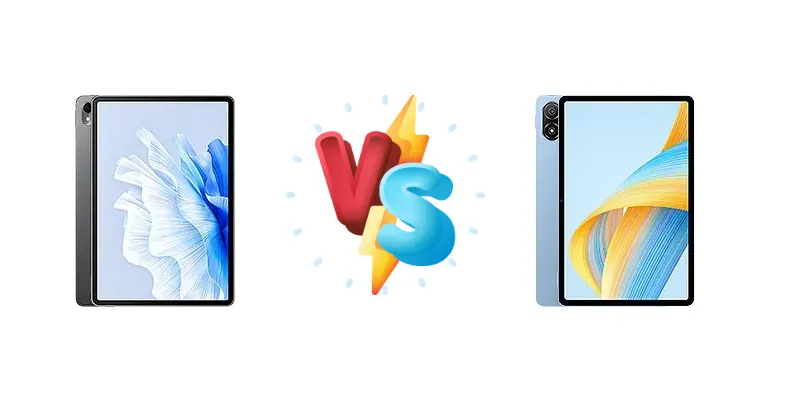
The Huawei MatePad Air and Honor Pad V8 Pro represent compelling options in the increasingly competitive Android tablet space. While both aim for a premium experience, they diverge in their core hardware choices – the Snapdragon 888 in the MatePad Air versus the MediaTek Dimensity 8100 in the Pad V8 Pro. This comparison dissects these differences to determine which tablet best suits your needs.
🏆 Quick Verdict
For users prioritizing raw processing power and potentially longer software support, the Honor Pad V8 Pro with its Dimensity 8100 chipset is the stronger choice. While the MatePad Air offers a familiar Snapdragon experience, the Dimensity 8100’s architectural advantages give the V8 Pro an edge in demanding tasks and sustained performance.
| Network |
|---|
| 2G bands | GSM 850 / 900 / 1800 / 1900 | N/A |
| 3G bands | HSDPA 800 / 850 / 900 / 1700(AWS) / 1900 / 2100 | N/A |
| 4G bands | 1, 2, 3, 4, 5, 7, 8, 12, 17, 18, 19, 20, 26, 28, 34, 38, 39, 40, 41 | N/A |
| EDGE | - | N/A |
| GPRS | - | N/A |
| Speed | HSPA, LTE | - |
| Technology | GSM / HSPA / LTE | No cellular connectivity |
| Launch |
|---|
| Announced | 2023, May 18 | 2022, December 26 |
| Status | Available. Released 2023, July 22 | Available. Released 2022, December 30 |
| Body |
|---|
| Build | - | Glass front, aluminum frame, aluminum back or eco leather back |
| Dimensions | 261.9 x 178.2 x 6.4 mm (10.31 x 7.02 x 0.25 in) | 277 x 179 x 6.6 mm or 7 mm |
| SIM | Nano-SIM | No |
| Weight | 508 g (1.12 lb) | 589 g or 599 g (1.30 lb) |
| | - | Honor Pencil 3 (15ms latency) |
| Display |
|---|
| Resolution | 2800 x 1840 pixels, 3:2 ratio (~291 ppi density) | 2560 x 1600 pixels, 16:10 ratio (~249 ppi density) |
| Size | 11.5 inches, 391.6 cm2 (~83.9% screen-to-body ratio) | 12.1 inches, 424.5 cm2 (~85.6% screen-to-body ratio) |
| Type | IPS LCD, 144Hz | IPS LCD, 1B colors, 144Hz, 600 nits |
| | - | IMAX enhanced |
| Platform |
|---|
| CPU | Octa-core (1x2.84 GHz Cortex-X1 & 3x2.42 GHz Cortex-A78 & 4x1.80 GHz Cortex-A55) | Octa-core (4x2.85 GHz Cortex-A78 & 4x2.0 GHz Cortex-A55) |
| Chipset | Qualcomm SM8350 Snapdragon 888 4G (5 nm) | Mediatek Dimensity 8100 (5 nm) |
| GPU | Adreno 660 | Mali-G610 MC6 |
| OS | HarmonyOS 3.1 | Android 12, MagicOS 7 |
| Memory |
|---|
| Card slot | No | No |
| Internal | 128GB 8GB RAM, 256GB 8GB RAM, 256GB 12GB RAM, 512GB 12GB RAM | 128GB 8GB RAM, 256GB 8GB RAM, 256GB 12GB RAM |
| Main Camera |
|---|
| Features | LED flash | LED flash, HDR |
| Single | 13 MP, f/1.8, PDAF | 13 MP, f/2.0, (wide), 1/3.0", AF |
| Video | 4K@30fps, 1080p@30fps | 4K@30fps, 1080p@30fps |
| Selfie camera |
|---|
| Single | 8 MP, f/2.0, 105˚ (ultrawide) | 5 MP, f/2.2 |
| Video | 1080p@30fps | 1080p@30fps |
| Sound |
|---|
| 3.5mm jack | - | No |
| 35mm jack | No | No |
| Loudspeaker | Yes, with stereo speakers (4 speakers) | Yes, with stereo speakers (8 speakers) |
| | - | 24-bit/192kHz audio |
| Comms |
|---|
| Bluetooth | 5.2, A2DP, LE | 5.2, A2DP, LE |
| NFC | No | No |
| Positioning | GPS, GLONASS, BDS, GALILEO, QZSS | GPS, GLONASS, BDS |
| Radio | No | No |
| USB | USB Type-C 3.2, OTG, magnetic accessory connector | USB Type-C, magnetic connector |
| WLAN | Wi-Fi 802.11 a/b/g/n/ac/6, dual-band | Wi-Fi 802.11 a/b/g/n/ac/6, dual-band |
| Features |
|---|
| Sensors | Accelerometer, gyro, compass, proximity (accessories only) | Accelerometer |
| Battery |
|---|
| Charging | 40W wired
10W reverse wired | 35W wired |
| Type | Li-Po 8300 mAh | Li-Po 10050 mAh |
| Misc |
|---|
| Colors | Graphite Black, White | Grey, Blue, Orange |
| Models | DBY2-L09CK | ROD-W09 |
| Price | About 500 EUR | About 350 EUR |
Huawei MatePad Air
- Faster 40W wired charging
- Established Huawei ecosystem integration
- Familiar Snapdragon platform
- Snapdragon 888 prone to throttling
- Potentially shorter software support lifecycle
- Older chipset architecture
Honor Pad V8 Pro
- More powerful MediaTek Dimensity 8100 chipset
- Improved thermal management and sustained performance
- Potentially longer software support from Honor
- Slower 35W wired charging
- Less established ecosystem compared to Huawei
- MediaTek chipset may have limited custom ROM support
Display Comparison
Display specifications are not provided, so a direct comparison is limited. However, given the target market, both tablets likely feature IPS LCD panels with resolutions around 2560x1600. The absence of LTPO technology suggests neither will offer adaptive refresh rates for power saving. Bezels are likely similar, aiming for a modern, immersive experience. Color accuracy will be a key differentiator, and independent testing would be needed to determine which panel performs better in sRGB and DCI-P3 color spaces.
Camera Comparison
Camera details are absent, making a meaningful comparison impossible. However, given the price points, both tablets likely feature a primary camera around 13MP, potentially accompanied by an ultrawide lens. Image processing will be a key differentiator, with Huawei historically emphasizing AI-powered scene optimization. The absence of telephoto lenses suggests neither tablet is geared towards serious photography.
Performance
The core difference lies in the chipsets. The Honor Pad V8 Pro’s MediaTek Dimensity 8100 (5nm) boasts a more modern CPU architecture than the Huawei MatePad Air’s Qualcomm Snapdragon 888 (5nm). While both are 5nm chips, the Dimensity 8100 utilizes four Cortex-A78 cores clocked at 2.85 GHz, compared to the Snapdragon 888’s single Cortex-X1 at 2.84 GHz and three A78 cores at 2.42 GHz. This configuration, coupled with architectural improvements in the Dimensity 8100, translates to better multi-core performance and sustained speeds. The Snapdragon 888 is known to throttle under prolonged load, a potential issue the Dimensity 8100 mitigates. Both utilize LPDDR5 RAM, but the Dimensity 8100’s integrated memory controller may offer slight advantages.
Battery Life
Battery capacity is not specified. However, the charging speeds provide insight. The Huawei MatePad Air supports 40W wired charging, while the Honor Pad V8 Pro is limited to 35W. This suggests Huawei prioritized faster charging, potentially compensating for a slightly smaller battery. In real-world usage, the Dimensity 8100’s superior power efficiency could offset the charging speed difference, resulting in comparable battery life despite potential capacity variations. A 0-100% charge on the MatePad Air will likely be slightly faster, but the V8 Pro may offer longer usage between charges.
Buying Guide
Buy the Huawei MatePad Air if you need a tablet deeply integrated with the Huawei ecosystem and prefer the Qualcomm Snapdragon platform. Its 40W charging and established software experience are key benefits. Buy the Honor Pad V8 Pro if you prioritize peak performance for gaming and multitasking, and value the newer MediaTek Dimensity 8100 chipset, which offers a more efficient architecture and potentially better long-term software updates from Honor.
Frequently Asked Questions
❓ Will the Snapdragon 888 in the MatePad Air struggle with demanding games like Genshin Impact after extended play sessions?
The Snapdragon 888 is known to throttle under sustained load. While it can initially handle demanding games, expect frame rate drops and increased heat after 20-30 minutes of gameplay. The Honor Pad V8 Pro’s Dimensity 8100 is better equipped to maintain consistent performance over longer gaming sessions due to its improved thermal efficiency.
❓ Does the Honor Pad V8 Pro support any stylus functionality, and if so, is a stylus included in the box?
Stylus support is not explicitly stated in the provided specifications. However, Honor often includes stylus compatibility in their Pro-level tablets. Whether a stylus is included in the box is unknown and would require checking the retail packaging or Honor’s official website. The MatePad Air also lacks stylus information based on the provided data.
❓ How does the software experience differ between the Huawei MatePad Air and the Honor Pad V8 Pro?
The Huawei MatePad Air runs on Huawei’s EMUI, which has a distinct interface and features. The Honor Pad V8 Pro runs on Magic UI, based on Android, and is generally closer to stock Android with fewer pre-installed apps. Honor has also committed to more frequent software updates than Huawei, particularly given the geopolitical situation affecting Huawei’s access to Google services.