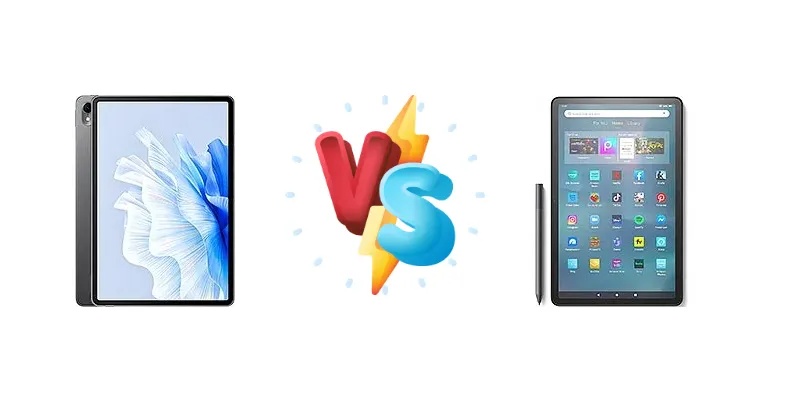
The tablet market offers a spectrum of choices, from budget-friendly options to high-performance powerhouses. The Huawei MatePad Air and Amazon Fire Max 11 represent distinct approaches: the MatePad Air leverages a flagship-tier Snapdragon 888 chipset, while the Fire Max 11 aims for affordability with a MediaTek processor. This comparison dissects their strengths and weaknesses to determine which tablet delivers the best experience for your needs.
🏆 Quick Verdict
For users prioritizing performance and versatility, the Huawei MatePad Air is the superior choice. Its Snapdragon 888 offers significantly more processing power, making it ideal for demanding tasks and gaming. However, the Amazon Fire Max 11 provides a compelling value proposition for basic media consumption and light productivity.
| Network |
|---|
| 2G bands | GSM 850 / 900 / 1800 / 1900 | N/A |
| 3G bands | HSDPA 800 / 850 / 900 / 1700(AWS) / 1900 / 2100 | - |
| 4G bands | 1, 2, 3, 4, 5, 7, 8, 12, 17, 18, 19, 20, 26, 28, 34, 38, 39, 40, 41 | - |
| EDGE | - | No |
| GPRS | - | No |
| Speed | HSPA, LTE | - |
| Technology | GSM / HSPA / LTE | No cellular connectivity |
| Launch |
|---|
| Announced | 2023, May 18 | 2023, May 23 |
| Status | Available. Released 2023, July 22 | Available. Released 2023, May 23 |
| Body |
|---|
| Dimensions | 261.9 x 178.2 x 6.4 mm (10.31 x 7.02 x 0.25 in) | 259.1 x 163.7 x 7.5 mm (10.20 x 6.44 x 0.30 in) |
| SIM | Nano-SIM | No |
| Weight | 508 g (1.12 lb) | 490 g (1.08 lb) |
| Display |
|---|
| Resolution | 2800 x 1840 pixels, 3:2 ratio (~291 ppi density) | 2000 x 1200 pixels, 5:3 ratio (~212 ppi density) |
| Size | 11.5 inches, 391.6 cm2 (~83.9% screen-to-body ratio) | 11.0 inches, 344.4 cm2 (~81.2% screen-to-body ratio) |
| Type | IPS LCD, 144Hz | IPS LCD |
| Platform |
|---|
| CPU | Octa-core (1x2.84 GHz Cortex-X1 & 3x2.42 GHz Cortex-A78 & 4x1.80 GHz Cortex-A55) | Octa-core (2x2.2 GHz Cortex-A78 & 6x2.0 GHz Cortex-A55) |
| Chipset | Qualcomm SM8350 Snapdragon 888 4G (5 nm) | Mediatek MT8188J |
| GPU | Adreno 660 | Mali-G57 MC2 |
| OS | HarmonyOS 3.1 | Android 11, Fire OS 8 |
| Memory |
|---|
| Card slot | No | microSDXC (dedicated slot) |
| Internal | 128GB 8GB RAM, 256GB 8GB RAM, 256GB 12GB RAM, 512GB 12GB RAM | 64GB 4GB RAM, 128GB 4GB RAM |
| Main Camera |
|---|
| Features | LED flash | - |
| Single | 13 MP, f/1.8, PDAF | 8 MP, AF |
| Video | 4K@30fps, 1080p@30fps | 1080p |
| Selfie camera |
|---|
| Single | 8 MP, f/2.0, 105˚ (ultrawide) | 8 MP |
| Video | 1080p@30fps | 1080p |
| Sound |
|---|
| 35mm jack | No | No |
| Loudspeaker | Yes, with stereo speakers (4 speakers) | Yes, with stereo speakers |
| Comms |
|---|
| Bluetooth | 5.2, A2DP, LE | 5.3, A2DP, LE |
| NFC | No | No |
| Positioning | GPS, GLONASS, BDS, GALILEO, QZSS | No |
| Radio | No | No |
| USB | USB Type-C 3.2, OTG, magnetic accessory connector | USB Type-C 2.0, OTG, magnetic accessory connector |
| WLAN | Wi-Fi 802.11 a/b/g/n/ac/6, dual-band | Wi-Fi 802.11 a/b/g/n/ac/6, dual-band |
| Features |
|---|
| Sensors | Accelerometer, gyro, compass, proximity (accessories only) | Fingerprint (side-mounted), accelerometer, proximity (accessories only) |
| Battery |
|---|
| Charging | 40W wired
10W reverse wired | 15W wired |
| Type | Li-Po 8300 mAh | Li-Ion |
| Misc |
|---|
| Colors | Graphite Black, White | Gray |
| Models | DBY2-L09CK | KFSNWI |
| Price | About 500 EUR | About 270 EUR |
Huawei MatePad Air
- Significantly more powerful Snapdragon 888 processor
- Faster 40W wired charging
- 10W reverse wired charging capability
- Likely higher price point
- 4G connectivity only (no 5G)
Amazon Fire Max 11
- More affordable price
- Decent performance for basic tasks
- Amazon ecosystem integration
- Slower MediaTek MT8188J processor
- Slower 15W wired charging
- Limited performance for demanding applications
Display Comparison
While both tablets likely feature LCD panels (data unavailable), the core difference lies in the processing power driving the visuals. The absence of display specs like resolution, brightness, and refresh rate necessitates a focus on the chipset's ability to render content smoothly. The Snapdragon 888's Adreno 660 GPU will provide a more fluid experience with graphically intensive applications and games, even if the panels themselves are similar. Bezels are also a key consideration, but without data, we can only assume they are comparable within the budget/mid-range segment.
Camera Comparison
Given the context data, a detailed camera comparison is limited. Both tablets likely feature modest camera setups geared towards video calls and casual snapshots. The absence of sensor size or aperture information suggests neither device prioritizes photography. The focus should be on the chipset's image signal processor (ISP); the Snapdragon 888’s ISP will likely offer superior image processing capabilities, resulting in better dynamic range and noise reduction, even with similar sensors. We can assume the Fire Max 11's ISP is adequate for its intended use case, but won't match the MatePad Air's capabilities.
Performance
The Huawei MatePad Air’s Qualcomm Snapdragon 888 4G (5nm) is the clear performance leader. Its octa-core CPU, featuring a Cortex-X1 prime core clocked at 2.84 GHz, significantly outperforms the Amazon Fire Max 11’s MediaTek MT8188J. The MT8188J, with its 2x2.2 GHz Cortex-A78 and 6x2.0 GHz Cortex-A55 cores, is geared towards efficiency rather than raw power. The 5nm fabrication process of the Snapdragon 888 also contributes to better thermal efficiency, reducing the likelihood of throttling during sustained workloads. This translates to smoother multitasking, faster app loading times, and a more responsive user experience on the MatePad Air.
Battery Life
Battery capacity is not provided, making a direct comparison challenging. However, the charging speeds offer a clear distinction. The Huawei MatePad Air supports 40W wired charging, enabling significantly faster top-ups compared to the Amazon Fire Max 11’s 15W charging. While a larger battery on the Fire Max 11 could offset the slower charging, the MatePad Air’s faster charging is a significant convenience factor. The MatePad Air also offers 10W reverse wired charging, a feature absent on the Fire Max 11, allowing it to charge other devices.
Buying Guide
Buy the Huawei MatePad Air if you need a tablet capable of handling demanding applications, multitasking, and occasional gaming. Its superior chipset and faster charging are worth the investment for power users. Buy the Amazon Fire Max 11 if you prioritize affordability and primarily intend to use the tablet for streaming video, reading, and basic web browsing. It’s a solid option for families or those on a tight budget.
Frequently Asked Questions
❓ Will the Snapdragon 888 in the MatePad Air handle demanding games like Genshin Impact at high settings?
Yes, the Snapdragon 888 is a capable chipset that can handle Genshin Impact and other demanding games at high settings, though sustained performance may be limited by thermal throttling. Expect a smoother and more consistent gaming experience compared to the Fire Max 11.
❓ Is the Amazon Fire Max 11 a good choice for reading ebooks and watching videos?
Absolutely. The Fire Max 11 is well-suited for media consumption. Its MediaTek processor is sufficient for streaming video and reading ebooks, and the Amazon ecosystem provides easy access to a vast library of content. However, it won't offer the same level of performance for other tasks.
❓ Does the Huawei MatePad Air support Google Play Services?
This is a key consideration. Huawei's tablets typically do not come with Google Play Services pre-installed. Users can sideload apps or use Huawei's AppGallery, but compatibility may vary. This is a significant drawback for users heavily reliant on Google apps.
❓ How long will it take to fully charge the Huawei MatePad Air with the 40W charger?
While a precise time requires testing, the 40W charging should fully charge the MatePad Air in approximately 1.5 to 2 hours, depending on the battery capacity. This is considerably faster than the Fire Max 11's 15W charging.