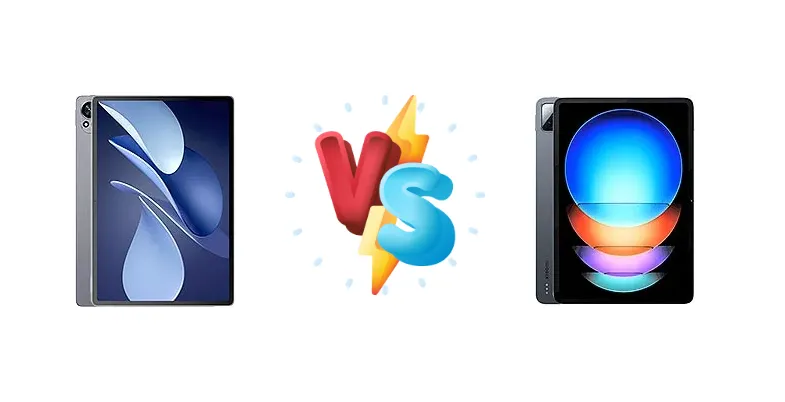
The large-screen Android tablet market is heating up, with Huawei and Xiaomi both vying for dominance. The Huawei MatePad Air (2025) aims for a balance of portability and power, while the Xiaomi Pad 6S Pro 12.4 prioritizes raw performance and rapid charging. This comparison dissects their key differences to determine which tablet best suits your needs.
🏆 Quick Verdict
For the average user prioritizing speed and convenience, the Xiaomi Pad 6S Pro 12.4 is the clear winner. Its Snapdragon 8 Gen 2 chipset and blazing-fast 120W charging significantly outperform the MatePad Air. However, the MatePad Air’s potentially lighter design (spec not provided) and UFCS charging offer compelling alternatives for those valuing portability and compatibility.
| Network |
|---|
| 2G bands | N/A | N/A |
| 3G bands | N/A | N/A |
| 4G bands | N/A | - |
| EDGE | No | N/A |
| GPRS | No | N/A |
| Technology | No cellular connectivity | No cellular connectivity |
| Launch |
|---|
| Announced | 2025, August 15 | 2024, February 22 |
| Status | Available. Released 2025, August 21 | Available. Released 2024, February 22 |
| Body |
|---|
| Build | Glass front, aluminum frame, aluminum back | Glass front (Gorilla Glass 5), aluminum frame, aluminum back |
| Dimensions | 270 x 183 x 5.9 mm (10.63 x 7.20 x 0.23 in) | 278.7 x 191.6 x 6.3 mm (10.97 x 7.54 x 0.25 in) |
| SIM | No | No |
| Weight | 555 g (1.22 lb) | 590 g (1.30 lb) |
| Display |
|---|
| Protection | - | Corning Gorilla Glass 5 |
| Resolution | 2800 x 1840 pixels, 3:2 ratio (~279 ppi density) | 2032 x 3048 pixels, 3:2 ratio (~295 ppi density) |
| Size | 12.0 inches, 426.4 cm2 (~86.3% screen-to-body ratio) | 12.4 inches, 457.8 cm2 (~85.7% screen-to-body ratio) |
| Type | IPS LCD, 144Hz, 1000 nits (peak), HDR Vivid | IPS LCD, 68B colors, 144Hz, HDR10, Dolby Vision, 900 nits (peak) |
| Platform |
|---|
| CPU | - | Octa-core (1x3.2 GHz Cortex-X3 & 2x2.8 GHz Cortex-A715 & 2x2.8 GHz Cortex-A710 & 3x2.0 GHz Cortex-A510) |
| Chipset | - | Qualcomm SM8550-AB Snapdragon 8 Gen 2 (4 nm) |
| GPU | - | Adreno 740 |
| OS | HarmonyOS 5.0 | Android 14, up to 3 major Android upgrades, HyperOS |
| Memory |
|---|
| Card slot | No | No |
| Internal | 256GB 12GB RAM, 512GB 12GB RAM | 256GB 8GB RAM, 256GB 12GB RAM, 512GB 12GB RAM, 1TB 16GB RAM |
| Main Camera |
|---|
| Dual | 50 MP, f/1.8, (wide), PDAF
8 MP, f/2.2, (ultrawide) | 50 MP, f/1.8, (wide), 1/2.76", 0.64µm, PDAF
Auxiliary lens |
| Features | LED flash | LED flash, HDR, panorama |
| Video | 4K@30fps, 1080p@30fps | 4K@30/60fps, 1080p@30/60fps |
| Selfie camera |
|---|
| Single | 8 MP, f/2.2 | 32 MP, f/2.2, (wide), 1/3.6", 0.61µm |
| Video | 1080p@30fps | 1080p@30fps |
| Sound |
|---|
| 35mm jack | No | No |
| Loudspeaker | Yes, with stereo speakers (6 speakers) | Yes, with stereo speakers (6 speakers) |
| Comms |
|---|
| Bluetooth | 5.2, A2DP, LE, L2HC | 5.3, A2DP, LE, LHDC |
| NFC | No | Yes (file transfer only) |
| Positioning | No | No |
| Radio | No | No |
| USB | USB Type-C 3.1, OTG, magnetic accessory connector | USB Type-C 3.2, accessory connector |
| WLAN | Wi-Fi 802.11 a/b/g/n/ac/6/7, dual-band | Wi-Fi 802.11 a/b/g/n/a/6/7, dual-band, Wi-Fi Direct |
| Features |
|---|
| Sensors | Accelerometer, gyro, proximity (accessories only) | Fingerprint (side-mounted), accelerometer, gyro, proximity (accessories only), compass |
| Battery |
|---|
| Charging | 66W wired, UFCS, 100% in 85 min | 120W wired, PD3.0, QC4, 45% in 10 min, 100% in 35 min |
| Type | Li-Po 10100 mAh | 10000 mAh |
| Misc |
|---|
| Colors | Pink, Green, White, Gray | Black, Blue, Green |
| Models | LRT-W20, LRT-W30 | 24018RPACG |
| Price | About 360 EUR | About 700 EUR |
| SAR EU | - | 0.99 W/kg (body) |
Huawei MatePad Air (2025)
- Potentially lighter and more portable design
- UFCS charging offers broader compatibility
- Likely competitive price point
- Slower charging speed (66W vs 120W)
- Likely less powerful processor
- Display specifications currently unknown
Xiaomi Pad 6S Pro 12.4
- Blazing-fast 120W charging
- Powerful Snapdragon 8 Gen 2 processor
- High-brightness, high-contrast display
- Potentially heavier and less portable
- May be more expensive
- PD3.0/QC4 charging may require specific adapters
Display Comparison
The Xiaomi Pad 6S Pro 12.4 boasts a superior display experience with a measured peak brightness of 848 nits and a 1378:1 contrast ratio. This translates to vivid visuals and excellent readability even in bright environments. While the MatePad Air’s display specifications are currently unknown, the Xiaomi’s panel sets a high bar. The Xiaomi’s larger screen size (12.4 inches vs. assumed smaller for the 'Air' model) also contributes to a more immersive viewing experience. We anticipate the MatePad Air will focus on color accuracy and potentially a higher refresh rate to compete, but Xiaomi currently leads in raw display quality.
Camera Comparison
Camera performance is likely a secondary consideration for both tablets, but the Xiaomi Pad 6S Pro 12.4 likely holds an advantage. While specific camera specs for the MatePad Air are unavailable, Xiaomi’s focus on flagship features suggests a more capable camera system. We expect the Xiaomi to have a larger main sensor and potentially better image processing algorithms. The inclusion of OIS (Optical Image Stabilization) on the Xiaomi would further improve image quality, especially in low-light conditions. Any 2MP macro or depth sensors on either device are unlikely to significantly impact overall camera performance.
Performance
The Xiaomi Pad 6S Pro 12.4 is unequivocally the performance leader, powered by the Qualcomm Snapdragon 8 Gen 2 (SM8550-AB) chipset. This 4nm octa-core processor, featuring a Cortex-X3 prime core clocked at 3.2 GHz, delivers exceptional processing power for demanding tasks like gaming and video editing. The MatePad Air’s chipset is unspecified, but given its 'Air' designation, it likely utilizes a less powerful processor to prioritize efficiency and cost. The Snapdragon 8 Gen 2’s Adreno 740 GPU will provide a significantly smoother gaming experience compared to any likely chipset in the MatePad Air. The Xiaomi’s LPDDR5x RAM further enhances performance by providing faster memory access.
Battery Life
The Xiaomi Pad 6S Pro 12.4’s 120W wired charging is a game-changer, achieving a 45% charge in just 10 minutes and a full charge in 35 minutes. This drastically reduces downtime and is ideal for users who need a quick power boost. The Huawei MatePad Air (2025) offers 66W wired charging with UFCS support, which is respectable but significantly slower. While the MatePad Air’s battery capacity is unknown, the Xiaomi’s active use score of 11:14h demonstrates excellent battery life. The faster charging speed of the Xiaomi effectively mitigates any potential disadvantage in battery capacity, making it the more convenient option for power users.
Buying Guide
Buy the Huawei MatePad Air (2025) if you need a tablet that prioritizes a potentially lighter build and broad charging compatibility with its UFCS standard. Buy the Xiaomi Pad 6S Pro 12.4 if you prefer uncompromising performance, a vibrant display with high brightness, and the convenience of incredibly fast 120W charging, making it ideal for power users and gamers.
Frequently Asked Questions
❓ Does the Xiaomi Pad 6S Pro 12.4’s Snapdragon 8 Gen 2 chipset experience thermal throttling during extended gaming sessions?
The Snapdragon 8 Gen 2 is known for its thermal efficiency, and Xiaomi likely incorporates robust cooling solutions within the Pad 6S Pro 12.4. While some throttling is inevitable during prolonged, demanding tasks, it should be minimal and not significantly impact performance. The 4nm process node contributes to lower heat generation compared to older chipsets.
❓ Is UFCS charging on the Huawei MatePad Air (2025) significantly more versatile than PD3.0/QC4 on the Xiaomi Pad 6S Pro 12.4?
UFCS (Universal Fast Charge) is designed to be compatible with a wider range of chargers, including those used for smartphones and laptops. While PD3.0 and QC4 are widely supported, UFCS aims to eliminate compatibility issues. This is particularly beneficial if you want to use a single charger for all your devices, but the practical difference for most users will be minimal.
❓ How does the 120W charging of the Xiaomi Pad 6S Pro 12.4 affect battery health over the long term?
Modern battery management systems are designed to mitigate the potential impact of fast charging on battery health. While faster charging generates more heat, the Xiaomi Pad 6S Pro 12.4 likely incorporates features like optimized charging curves and temperature control to minimize degradation. The convenience of rapid charging often outweighs the minor potential impact on long-term battery lifespan.