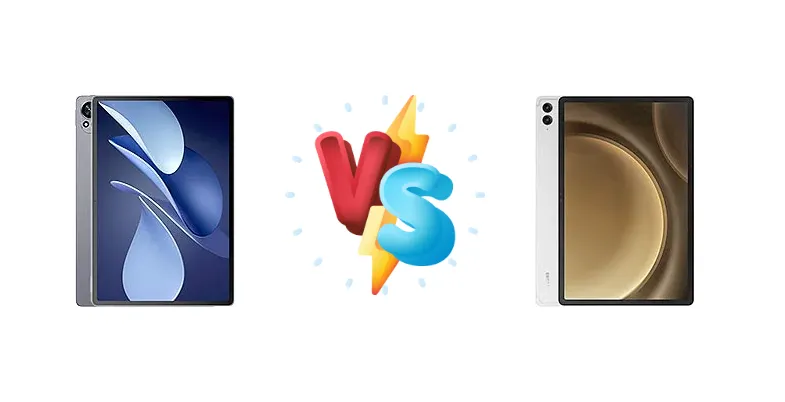
The mid-range tablet space is heating up. Huawei’s MatePad Air (2025) enters the arena with a focus on rapid charging, while Samsung’s Galaxy Tab S9 FE+ aims for a balance of performance and features. This comparison dissects both devices to determine which offers the best value and user experience.
🏆 Quick Verdict
For the average user prioritizing quick top-ups and streamlined operation, the Huawei MatePad Air (2025) edges out the Samsung Galaxy Tab S9 FE+. Its 66W UFCS charging significantly reduces downtime, a crucial advantage for on-the-go professionals and students, despite the FE+'s more powerful chipset.
| Network |
|---|
| 2G bands | N/A | GSM 850 / 900 / 1800 / 1900 |
| 3G bands | N/A | HSDPA 850 / 900 / 1700(AWS) / 1900 / 2100 |
| 4G bands | N/A | 1, 2, 3, 4, 5, 7, 8, 12, 13, 17, 20, 26, 28, 32, 38, 40, 41, 66 |
| 5G bands | - | 1, 3, 5, 7, 8, 20, 28, 38, 40, 41, 66, 77, 78 SA/NSA/Sub6 |
| EDGE | No | - |
| GPRS | No | - |
| Speed | - | HSPA, LTE, 5G - cellular model only |
| Technology | No cellular connectivity | GSM / HSPA / LTE / 5G |
| Launch |
|---|
| Announced | 2025, August 15 | 2023, October 04 |
| Status | Available. Released 2025, August 21 | Available. Released 2023, October 16 |
| Body |
|---|
| Build | Glass front, aluminum frame, aluminum back | Glass front, aluminum back, aluminum frame |
| Dimensions | 270 x 183 x 5.9 mm (10.63 x 7.20 x 0.23 in) | 285.4 x 185.4 x 6.5 mm (11.24 x 7.30 x 0.26 in) |
| SIM | No | Nano-SIM + eSIM (cellular model only) |
| Weight | 555 g (1.22 lb) | 627 g or 628 g (1.38 lb) |
| Display |
|---|
| Resolution | 2800 x 1840 pixels, 3:2 ratio (~279 ppi density) | 1600 x 2560 pixels, 16:10 ratio (~243 ppi density) |
| Size | 12.0 inches, 426.4 cm2 (~86.3% screen-to-body ratio) | 12.4 inches, 445.8 cm2 (~84.3% screen-to-body ratio) |
| Type | IPS LCD, 144Hz, 1000 nits (peak), HDR Vivid | IPS LCD, 90Hz |
| Platform |
|---|
| CPU | - | Octa-core (4x2.4 GHz Cortex-A78 & 4x2.0 GHz Cortex-A55) |
| Chipset | - | Exynos 1380 (5 nm) |
| GPU | - | Mali-G68 MP5 |
| OS | HarmonyOS 5.0 | Android 13, up to 4 major Android upgrades, One UI 6 |
| Memory |
|---|
| Card slot | No | microSDXC (dedicated slot) |
| Internal | 256GB 12GB RAM, 512GB 12GB RAM | 128GB 6GB RAM, 128GB 8GB RAM, 256GB 8GB RAM, 256GB 12GB RAM |
| Main Camera |
|---|
| Dual | 50 MP, f/1.8, (wide), PDAF
8 MP, f/2.2, (ultrawide) | 8 MP, (wide)
8 MP, (ultrawide) |
| Features | LED flash | - |
| Video | 4K@30fps, 1080p@30fps | 4K@30fps, 1080p@30fps |
| Selfie camera |
|---|
| Single | 8 MP, f/2.2 | 12 MP, (ultrawide) |
| Video | 1080p@30fps | Yes |
| Sound |
|---|
| 35mm jack | No | No |
| Loudspeaker | Yes, with stereo speakers (6 speakers) | Yes, with stereo speakers |
| Comms |
|---|
| Bluetooth | 5.2, A2DP, LE, L2HC | 5.3, A2DP, LE |
| NFC | No | No |
| Positioning | No | GPS, GALILEO, GLONASS, BDS, QZSS - cellular model only |
| Radio | No | No |
| USB | USB Type-C 3.1, OTG, magnetic accessory connector | USB Type-C 2.0, magnetic connector |
| WLAN | Wi-Fi 802.11 a/b/g/n/ac/6/7, dual-band | Wi-Fi 802.11 a/b/g/n/ac/6, dual-band, Wi-Fi Direct |
| Features |
|---|
| Sensors | Accelerometer, gyro, proximity (accessories only) | Fingerprint (side-mounted), accelerometer, gyro, compass, proximity (accessories only) |
| Battery |
|---|
| Charging | 66W wired, UFCS, 100% in 85 min | 45W wired, QC2.0 |
| Type | Li-Po 10100 mAh | Li-Po 10090 mAh |
| Misc |
|---|
| Colors | Pink, Green, White, Gray | Mint, Silver, Gray, Lavender |
| Models | LRT-W20, LRT-W30 | SM-X610, SM-X616B |
| Price | About 360 EUR | About 770 EUR |
| SAR | - | 0.77 W/kg (body) |
| SAR EU | - | 0.50 W/kg (body) |
Huawei MatePad Air (2025)
- Significantly faster 66W UFCS charging
- Potentially superior display technology (if OLED)
- Likely a lighter and thinner design due to 'Air' branding
- Chipset details are unknown, potentially impacting performance
- Camera specifications are unavailable, potentially lagging behind Samsung
Samsung Galaxy Tab S9 FE+
- Powerful Exynos 1380 (5 nm) chipset for smooth performance
- Established Samsung ecosystem and accessory availability
- Likely larger screen size for enhanced media consumption
- Slower 45W charging compared to the MatePad Air (2025)
- Potentially lower display quality if utilizing an LCD panel
- May be heavier and bulkier than the MatePad Air
Display Comparison
Neither device's display specifications are provided, so we must infer. Given the 'Air' branding, the MatePad Air (2025) likely prioritizes a thin and light design, potentially sacrificing peak brightness for OLED technology. The Tab S9 FE+, being an 'FE' model, likely utilizes an LCD panel. The Samsung's larger screen size (typically for the FE+ line) will be beneficial for media consumption, but the MatePad Air may offer superior contrast and color accuracy if it employs an OLED panel. Bezels are likely similar, aiming for a modern aesthetic on both.
Camera Comparison
Camera details are absent for both devices. Given the tablet form factor, camera quality is rarely a primary concern. However, we can expect the Tab S9 FE+ to follow Samsung’s tradition of competent image processing. The MatePad Air (2025) will likely focus on basic functionality. Without sensor size or aperture information, a detailed comparison is impossible, but the inclusion of OIS on either device would be a significant advantage for video recording.
Performance
The Samsung Galaxy Tab S9 FE+ boasts the Exynos 1380 (5 nm) chipset, featuring an octa-core configuration with 4x2.4 GHz Cortex-A78 and 4x2.0 GHz Cortex-A55 cores. This provides a solid foundation for multitasking and moderate gaming. However, the Huawei MatePad Air (2025) lacks chipset information. Assuming a similar price point, it likely utilizes a mid-range silicon solution. The 5nm process of the Exynos 1380 offers better power efficiency than older nodes, potentially leading to longer battery life under sustained load. The Cortex-A78 cores in the Samsung chip will deliver a noticeable performance boost in CPU-intensive tasks compared to the Cortex-A55 cores.
Battery Life
Battery capacity is not specified for either tablet. However, the charging capabilities are a key differentiator. The Huawei MatePad Air (2025) supports 66W wired charging with UFCS (Universal Fast Charging Standard), promising a full charge in 85 minutes. The Samsung Galaxy Tab S9 FE+ is limited to 45W wired charging with QC2.0. This 21W difference is substantial. While a larger battery in the Tab S9 FE+ could offset this, the MatePad Air’s faster charging will be more convenient for users who frequently need to top up their device. UFCS also offers broader compatibility with various chargers.
Buying Guide
Buy the Huawei MatePad Air (2025) if you need a tablet that spends less time tethered to a wall charger and prioritize a clean, efficient user experience. Buy the Samsung Galaxy Tab S9 FE+ if you prefer a tablet with a more established ecosystem, a slightly more powerful processor for demanding tasks, and a wider range of accessory options.
Frequently Asked Questions
❓ Does the Exynos 1380 in the Tab S9 FE+ overheat during extended gaming sessions?
The Exynos 1380 is a relatively efficient chip. While it can get warm during prolonged gaming, it's unlikely to experience significant thermal throttling due to its 5nm fabrication process and Samsung's thermal management solutions. However, sustained peak performance will inevitably generate heat.
❓ Is the UFCS charging standard on the MatePad Air (2025) compatible with my existing USB-PD chargers?
UFCS is designed to be backward compatible with USB Power Delivery (USB-PD). While you'll get the fastest charging speeds with a UFCS-compatible charger, the MatePad Air (2025) should still charge with most USB-PD chargers, albeit potentially at a slower rate.
❓ How does the software experience differ between Huawei's HarmonyOS and Samsung's One UI?
HarmonyOS and One UI offer distinct software experiences. One UI is known for its feature-rich interface and extensive customization options. HarmonyOS, while evolving, focuses on cross-device connectivity and a streamlined user experience. The choice depends on personal preference and familiarity with each ecosystem.