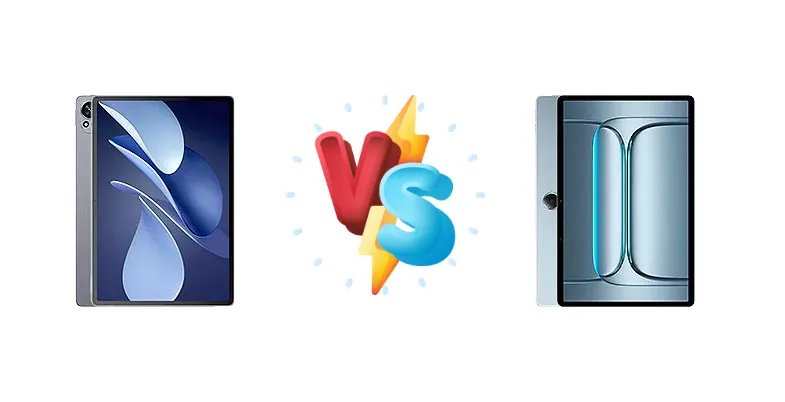
The tablet market is heating up with compelling options at various price points. We're pitting the Huawei MatePad Air (2025), a device focused on rapid charging and potentially a premium experience, against the OnePlus Pad Lite, a more budget-conscious offering powered by the Mediatek Helio G100. This comparison will dissect their key differences to help you determine which tablet best suits your needs.
🏆 Quick Verdict
For users prioritizing fast charging and a potentially smoother software experience (depending on Huawei's HarmonyOS implementation), the Huawei MatePad Air (2025) is the better choice. However, the OnePlus Pad Lite offers a compelling value proposition for those seeking a functional tablet without breaking the bank.
| Network |
|---|
| 2G bands | N/A | GSM 850 / 900 / 1800 / 1900 - cellular model only |
| 3G bands | N/A | HSDPA 850 / 900 / 2100 - cellular model only |
| 4G bands | N/A | LTE - cellular model only |
| EDGE | No | - |
| GPRS | No | - |
| Speed | - | HSPA, LTE - cellular model only |
| Technology | No cellular connectivity | GSM / HSPA / LTE |
| Launch |
|---|
| Announced | 2025, August 15 | 2025, July 08 |
| Status | Available. Released 2025, August 21 | Available. Released 2025, August 14 |
| Body |
|---|
| Build | Glass front, aluminum frame, aluminum back | - |
| Dimensions | 270 x 183 x 5.9 mm (10.63 x 7.20 x 0.23 in) | 254.9 x 166.5 x 7.4 mm (10.04 x 6.56 x 0.29 in) |
| SIM | No | Yes - cellular model only |
| Weight | 555 g (1.22 lb) | 530 g (1.17 lb) |
| Display |
|---|
| Resolution | 2800 x 1840 pixels, 3:2 ratio (~279 ppi density) | 1200 x 1920 pixels, 16:10 ratio (~207 ppi density) |
| Size | 12.0 inches, 426.4 cm2 (~86.3% screen-to-body ratio) | 11.0 inches, 347.5 cm2 (~81.9% screen-to-body ratio) |
| Type | IPS LCD, 144Hz, 1000 nits (peak), HDR Vivid | IPS LCD, 1B colors, 90Hz, 500 nits |
| Platform |
|---|
| CPU | - | Octa-core (2x2.2 GHz Cortex-A76 & 6x2.0 GHz Cortex-A55) |
| Chipset | - | Mediatek Helio G100 (6 nm) |
| GPU | - | Mali-G57 MC2 |
| OS | HarmonyOS 5.0 | Android 15, OxygenOS 15 |
| Memory |
|---|
| Card slot | No | Unspecified |
| Internal | 256GB 12GB RAM, 512GB 12GB RAM | 128GB 6GB RAM, 128GB 8GB RAM |
| Main Camera |
|---|
| Dual | 50 MP, f/1.8, (wide), PDAF
8 MP, f/2.2, (ultrawide) | - |
| Features | LED flash | - |
| Single | - | 5 MP |
| Video | 4K@30fps, 1080p@30fps | 1080p@30fps |
| Selfie camera |
|---|
| Single | 8 MP, f/2.2 | 5 MP |
| Video | 1080p@30fps | 1080p@30fps |
| Sound |
|---|
| 35mm jack | No | No |
| Loudspeaker | Yes, with stereo speakers (6 speakers) | Yes, with stereo speakers (4 speakers, Hi-Res audio) |
| Comms |
|---|
| Bluetooth | 5.2, A2DP, LE, L2HC | 5.2, A2DP, LE, aptX HD |
| NFC | No | No |
| Positioning | No | GPS, (cellular model only) - unconfirmed |
| Radio | No | No |
| USB | USB Type-C 3.1, OTG, magnetic accessory connector | USB Type-C 2.0 |
| WLAN | Wi-Fi 802.11 a/b/g/n/ac/6/7, dual-band | Wi-Fi 802.11 a/b/g/n/ac, dual-band |
| Features |
|---|
| Sensors | Accelerometer, gyro, proximity (accessories only) | Unspecified |
| Battery |
|---|
| Charging | 66W wired, UFCS, 100% in 85 min | 33W wired |
| Type | Li-Po 10100 mAh | Li-Po 9340 mAh |
| Misc |
|---|
| Colors | Pink, Green, White, Gray | Aero Blue |
| Models | LRT-W20, LRT-W30 | OPD2480 |
| Price | About 360 EUR | About 200 EUR |
Huawei MatePad Air (2025)
- Significantly faster 66W UFCS charging
- Potentially more powerful chipset (based on branding)
- Likely higher build quality and premium features
- Price likely to be higher than the OnePlus Pad Lite
- Chipset details currently unknown
OnePlus Pad Lite
- More affordable price point
- Decent performance for everyday tasks with the Helio G100
- Efficient 6nm processor
- Slower 33W charging
- Less powerful chipset compared to potential MatePad Air configuration
Display Comparison
Display specifications are currently unavailable for the Huawei MatePad Air (2025). However, given its 'Air' branding, we can anticipate a focus on portability and a high-quality display. The OnePlus Pad Lite, while not specified, likely utilizes an IPS LCD panel common in its price bracket. The charging difference suggests Huawei is targeting a more premium experience, which often extends to display quality. Without specific nit counts or panel technology details for the MatePad Air, it's difficult to definitively state a display advantage, but the 66W charging suggests a higher overall build quality that *could* translate to a superior screen.
Camera Comparison
Camera details are absent for both devices. Given the tablet form factor, camera quality is typically not a primary concern for most users. We anticipate both tablets will feature basic camera setups suitable for video calls and occasional snapshots. Without sensor size or aperture information, a meaningful comparison is impossible. It's likely both will prioritize functionality over photographic excellence.
Performance
The OnePlus Pad Lite is powered by the Mediatek Helio G100, a 6nm chipset featuring an octa-core configuration with 2x2.2 GHz Cortex-A76 and 6x2.0 GHz Cortex-A55 cores. This processor is geared towards providing a smooth experience for everyday tasks and light gaming. The Huawei MatePad Air (2025)'s chipset remains undisclosed. However, given the 66W charging and 'Air' branding, it's reasonable to expect a more powerful processor than the Helio G100, potentially offering better multitasking and more demanding gaming performance. The 6nm process node of the Helio G100 is efficient, but a more recent or higher-tier chipset in the MatePad Air would likely offer a noticeable performance boost.
Battery Life
The charging capabilities are a key differentiator. The Huawei MatePad Air (2025) boasts 66W wired charging with UFCS (Universal Fast Charging Standard), promising a full charge in just 85 minutes. The OnePlus Pad Lite, in contrast, offers 33W wired charging. This significant difference in charging speed means the MatePad Air will spend considerably less time tethered to a power outlet. While battery capacity is unknown for both devices, the faster charging of the MatePad Air mitigates the impact of a potentially smaller battery, making it more convenient for users on the go.
Buying Guide
Buy the Huawei MatePad Air (2025) if you need the fastest possible charging speeds and anticipate frequent use away from power outlets. Its 66W UFCS charging will minimize downtime. Buy the OnePlus Pad Lite if you prioritize affordability and a straightforward Android experience for casual tasks like media consumption and light productivity.
Frequently Asked Questions
❓ How much faster is the 66W charging on the Huawei MatePad Air (2025) compared to the 33W charging on the OnePlus Pad Lite in real-world usage?
While exact times depend on battery capacity, 66W charging will likely reduce a full charge time by at least 30-45 minutes compared to 33W. This is a substantial difference for users who frequently need to top up their tablet quickly.
❓ Is the Mediatek Helio G100 in the OnePlus Pad Lite sufficient for playing demanding games like PUBG or Genshin Impact?
The Helio G100 can handle PUBG at medium settings, but Genshin Impact may require lower graphics settings and potentially experience some frame rate drops. It's suitable for casual gaming but not ideal for hardcore mobile gamers.
❓ Does the Huawei MatePad Air (2025) support any form of stylus input or keyboard attachment?
While not confirmed, Huawei often includes stylus and keyboard support in its MatePad series. Given the 'Air' branding and focus on portability, it's highly probable the MatePad Air (2025) will offer these accessories, enhancing its productivity capabilities.