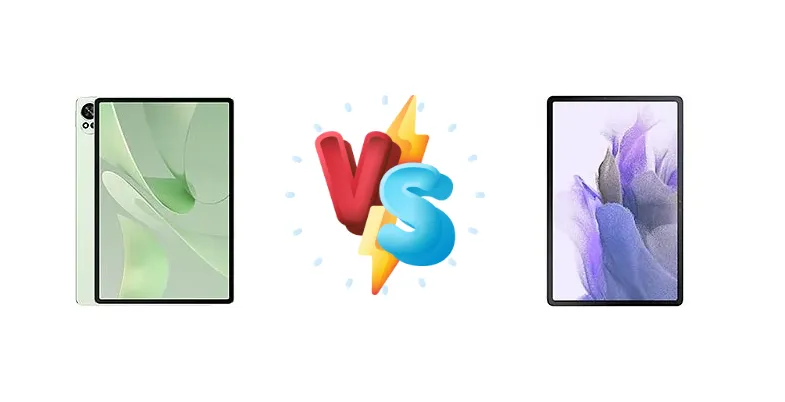
The Android tablet market is heating up, with Huawei's new MatePad Air (2024) challenging Samsung's well-established Galaxy Tab S7 FE. While the Tab S7 FE has been a popular choice for its balance of features and price, the MatePad Air aims to disrupt with its focus on speed and convenience. This comparison dives deep into the specifications and real-world implications to determine which tablet offers the best value.
🏆 Quick Verdict
For the average user prioritizing fast charging and a streamlined experience, the Huawei MatePad Air (2024) is the better choice. Its 66W charging significantly reduces downtime compared to the Tab S7 FE’s 45W, and while detailed chipset information is missing, Huawei’s recent silicon has been competitive. However, the Tab S7 FE remains a strong contender for those needing 5G connectivity and a proven track record.
| Network |
|---|
| 2G bands | N/A | GSM 850 / 900 / 1800 / 1900 |
| 3G bands | N/A | HSDPA 850 / 900 / 1700(AWS) / 1900 / 2100 |
| 4G bands | N/A | 1, 2, 3, 4, 5, 7, 8, 12, 13, 17, 20, 25, 26, 28, 32, 38, 40, 41, 66 |
| 5G bands | - | 1, 3, 5, 7, 8, 20, 28, 38, 40, 41, 77, 78 SA/NSA/Sub6 |
| EDGE | No | - |
| GPRS | No | - |
| Speed | - | HSPA, LTE, 5G - cellular model only |
| Technology | No cellular connectivity | GSM / HSPA / LTE / 5G |
| Launch |
|---|
| Announced | 2024, August 06 | 2021, May 25 |
| Status | Available. Released 2024, August 13 | Available. Released 2021, June 18 |
| Body |
|---|
| Build | - | Glass front, aluminum back, aluminum frame |
| Dimensions | 270 x 183 x 5.9 mm (10.63 x 7.20 x 0.23 in) | 284.8 x 185 x 6.3 mm (11.21 x 7.28 x 0.25 in) |
| SIM | No | Nano-SIM (cellular model only) |
| Weight | 555 g (1.22 lb) | 608 g (1.34 lb) |
| | - | Stylus support |
| Display |
|---|
| Resolution | 2800 x 1840 pixels, 3:2 ratio (~279 ppi density) | 1600 x 2560 pixels, 16:10 ratio (~243 ppi density) |
| Size | 12.0 inches, 426.4 cm2 (~86.3% screen-to-body ratio) | 12.4 inches, 445.8 cm2 (~84.6% screen-to-body ratio) |
| Type | IPS LCD, 144Hz, 1000 nits (peak) | TFT LCD |
| Platform |
|---|
| CPU | - | Octa-core (2x2.2 GHz Kryo 570 & 6x1.8 GHz Kryo 570) - 5G modelOcta-core (1x2.4 GHz Cortex-A78 & 3x2.2 GHz Cortex-A78 & 4x1.9 GHz Cortex-A55) - Wi-Fi model |
| Chipset | - | Qualcomm SM7225 Snapdragon 750G 5G (8 nm) - 5G modelQualcomm SM7325 Snapdragon 778G 5G (6 nm) - Wi-Fi model |
| GPU | - | Adreno 619 - 5G modelAdreno 642L - Wi-Fi model |
| OS | HarmonyOS 4.2 | Android 11, upgradable to Android 14, One UI 6 |
| Memory |
|---|
| Card slot | No | microSDXC (dedicated slot) |
| Internal | 256GB 8GB RAM, 256GB 12GB RAM, 512GB 12GB RAM | 64GB 4GB RAM, 128GB 6GB RAM, 256GB 8GB RAM |
| Main Camera |
|---|
| Dual | 13 MP, f/1.8, (wide), PDAF
8 MP, f/2.2, (ultrawide) | - |
| Features | LED flash | - |
| Single | - | 8 MP, AF |
| Video | 4K@30fps, 1080p@30fps | 1080p@30fps |
| Selfie camera |
|---|
| Single | 8 MP, f/2.2 | 5 MP |
| Video | 1080p@30fps | 1080p@30fps |
| Sound |
|---|
| 3.5mm jack | - | No |
| 35mm jack | No | No |
| Loudspeaker | Yes, with stereo speakers (6 speakers) | Yes, with stereo speakers |
| | - | Tuned by AKG |
| Comms |
|---|
| Bluetooth | 5.2, A2DP, LE | 5.2, A2DP, LE (Wi-Fi), 5.2, A2DP, LE (5G) |
| NFC | No | No |
| Positioning | GPS, GLONASS, BDS, GALILEO, QZSS | GPS, GLONASS, BDS, GALILEO - cellular model only |
| Radio | No | No |
| USB | USB Type-C 3.1, OTG, magnetic accessory connector | USB Type-C 3.2, magnetic connector |
| WLAN | Wi-Fi 802.11 a/b/g/n/ac/6, dual-band | Wi-Fi 802.11 a/b/g/n/ac/6 (Wi-Fi), Wi-Fi 802.11 a/b/g/n/ac (5G) |
| Features |
|---|
| Sensors | Accelerometer, gyro, compass, proximity (accessories only) | Accelerometer, proximity, compass, gyro (5G model only) |
| | - | Samsung DeX |
| Battery |
|---|
| Charging | 66W wired | 45W wired, 100% in 190 min |
| Type | Li-Po 10100 mAh | Li-Po 10090 mAh |
| Misc |
|---|
| Colors | Pink, Green, White, Gray | Mystic Black, Mystic Silver, Mystic Green, Mystic Pink |
| Models | - | SM-T730, SM-T733, SM-T736B, SM-T735 |
| Price | About 370 EUR | About 650 EUR |
| SAR EU | - | 1.15 W/kg (body) |
| Tests |
|---|
| Display | - | Contrast ratio: 1886:1 (nominal) |
| Loudspeaker | - | -27.2 LUFS (Good) |
| Performance | - | AnTuTu: 292530 (v8), 355430 (v9)
GeekBench: 1904 (v5.1)
GFXBench: 9.7fps (ES 3.1 onscreen) |
Huawei MatePad Air (2024)
- Significantly faster 66W charging
- Potentially more efficient chipset (pending specs)
- Modern and streamlined design
- Chipset specifications currently unknown
- Lack of 5G connectivity (likely)
Samsung Galaxy Tab S7 FE
- Available with 5G connectivity
- Proven Snapdragon 778G performance (Wi-Fi model)
- Established Samsung ecosystem and S Pen support
- Slower 45W charging (190 minutes to full)
- Older chipset compared to current flagship tablets
- LCD display technology
Display Comparison
Both tablets share a similar contrast ratio of 1886:1, suggesting comparable image quality in terms of black levels and color depth. The Samsung Galaxy Tab S7 FE boasts a measured peak brightness of 522 nits, a strong figure for outdoor visibility. Without comparable data for the MatePad Air, we can assume it will likely fall in a similar range, given its positioning as a premium mid-range device. The lack of information regarding panel technology (LTPO, OLED) for the MatePad Air is a key omission; the Tab S7 FE utilizes an LCD panel. Bezels are likely comparable, focusing on maximizing screen real estate within their respective form factors.
Camera Comparison
Camera performance is unlikely to be a deciding factor for most tablet buyers. Both devices likely feature modest camera setups geared towards video conferencing and casual snapshots. Without detailed specifications for the MatePad Air’s camera, it’s difficult to assess its capabilities. The Tab S7 FE’s camera specs are similarly unremarkable, suggesting a focus on functionality over photographic excellence. We can expect similar image processing styles, prioritizing natural colors and adequate detail in good lighting conditions.
Performance
The Samsung Galaxy Tab S7 FE offers two chipset options: the Qualcomm SM7225 Snapdragon 750G 5G (8nm) and the Qualcomm SM7325 Snapdragon 778G 5G (6nm). The 6nm Snapdragon 778G represents a significant step up in efficiency and performance over the 8nm 750G, thanks to its smaller transistor size and improved architecture. The Tab S7 FE’s CPU configuration varies accordingly, with the 778G featuring a more powerful Cortex-A78 prime core. The Huawei MatePad Air (2024) lacks publicly available chipset details, making a direct performance comparison difficult. However, Huawei’s Kirin chipsets have historically offered competitive performance in their respective price brackets. The Tab S7 FE’s LPDDR4X RAM is standard for its class, while the MatePad Air’s RAM configuration remains unknown.
Battery Life
The Samsung Galaxy Tab S7 FE takes 190 minutes to reach a 100% charge with its 45W wired charging. In contrast, the Huawei MatePad Air (2024) boasts a significantly faster 66W wired charging solution. This difference in charging speed translates to considerably less downtime for the MatePad Air, making it more convenient for users who need to quickly top up their battery. While the Tab S7 FE’s battery capacity is unknown, the faster charging of the MatePad Air mitigates any potential disadvantage in battery size.
Buying Guide
Buy the Huawei MatePad Air (2024) if you need a tablet that spends less time plugged into the wall and appreciate a modern, minimalist design. It’s ideal for users who frequently travel or rely on their tablet throughout the day. Buy the Samsung Galaxy Tab S7 FE if you prioritize 5G connectivity for on-the-go productivity, or if you prefer the Samsung ecosystem and the S Pen integration for note-taking and creative tasks.
Frequently Asked Questions
❓ Does the Samsung Galaxy Tab S7 FE’s Snapdragon 750G 5G chipset struggle with demanding games?
The Snapdragon 750G 5G is a capable mid-range chipset, but it may exhibit some frame drops or require reduced graphics settings in graphically intensive games. The Snapdragon 778G variant offers a noticeable performance improvement and is better suited for gaming.
❓ How does the Huawei MatePad Air (2024) handle multitasking with multiple apps open?
Without knowing the exact RAM configuration and chipset details, it’s difficult to definitively answer. However, Huawei typically optimizes its software for efficient multitasking, and a modern chipset should be capable of handling several apps simultaneously without significant slowdown.
❓ Is the S Pen a significant advantage for the Samsung Galaxy Tab S7 FE?
For users who frequently take notes, sketch, or annotate documents, the S Pen is a valuable addition. It offers a natural writing experience and precise control, making the Tab S7 FE a strong choice for students and creative professionals.
❓ What type of storage does the Samsung Galaxy Tab S7 FE use, and is it expandable?
The Samsung Galaxy Tab S7 FE uses UFS 2.1 storage, which is reasonably fast for everyday tasks. It also supports microSD card expansion, allowing you to increase storage capacity as needed.