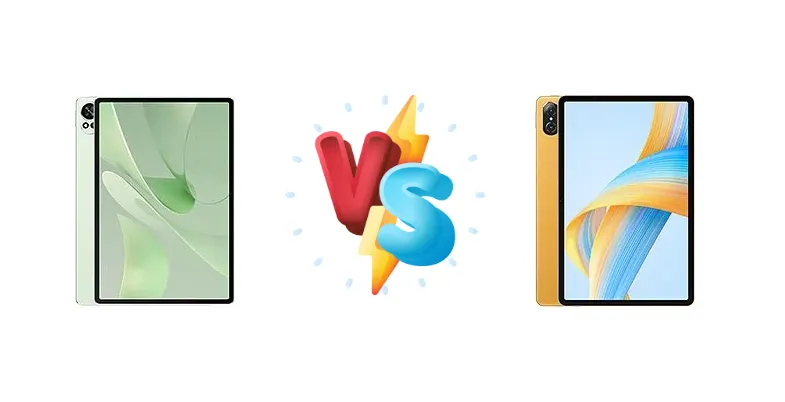
The Huawei MatePad Air (2024) and the Honor Pad V8 represent distinct approaches to the Android tablet market. The MatePad Air aims for a sleek, portable experience, while the Pad V8 prioritizes raw performance with its Mediatek Dimensity 8020 chipset. This comparison dissects their key differences to determine which tablet best suits your needs.
🏆 Quick Verdict
For the average user prioritizing responsiveness and multitasking, the Honor Pad V8 emerges as the stronger contender. Its Mediatek Dimensity 8020 chipset delivers significantly more processing power than the MatePad Air, making it ideal for demanding applications and gaming. However, the MatePad Air's 66W charging offers a convenience advantage.
| Network |
|---|
| 2G bands | N/A | N/A |
| 3G bands | N/A | N/A |
| 4G bands | N/A | N/A |
| EDGE | No | N/A |
| GPRS | No | N/A |
| Technology | No cellular connectivity | No cellular connectivity |
| Launch |
|---|
| Announced | 2024, August 06 | 2023, April 28 |
| Status | Available. Released 2024, August 13 | Available. Released 2023, May 08 |
| Body |
|---|
| Dimensions | 270 x 183 x 5.9 mm (10.63 x 7.20 x 0.23 in) | 252.1 x 163.6 x 7.4 mm (9.93 x 6.44 x 0.29 in) |
| SIM | No | No |
| Weight | 555 g (1.22 lb) | 485 g (1.07 lb) |
| | - | Honor Pencil 3 (15ms latency) |
| Display |
|---|
| Resolution | 2800 x 1840 pixels, 3:2 ratio (~279 ppi density) | 2560 x 1600 pixels, 16:10 ratio (~274 ppi density) |
| Size | 12.0 inches, 426.4 cm2 (~86.3% screen-to-body ratio) | 11.0 inches, 350.9 cm2 (~85.1% screen-to-body ratio) |
| Type | IPS LCD, 144Hz, 1000 nits (peak) | IPS LCD, 120Hz |
| Platform |
|---|
| CPU | - | Octa-core (4x2.6 GHz Cortex-A78 & 4x2.0 GHz Cortex-A55) |
| Chipset | - | Mediatek Dimensity 8020 (6 nm) |
| OS | HarmonyOS 4.2 | Android 12, MagicOS 6.1 |
| Memory |
|---|
| Card slot | No | microSDXC (dedicated slot) |
| Internal | 256GB 8GB RAM, 256GB 12GB RAM, 512GB 12GB RAM | 128GB 8GB RAM, 256GB 8GB RAM |
| Main Camera |
|---|
| Dual | 13 MP, f/1.8, (wide), PDAF
8 MP, f/2.2, (ultrawide) | 13 MP, f/1.8, (wide), 1/3.0", AF
2 MP (macro) |
| Features | LED flash | LED flash |
| Video | 4K@30fps, 1080p@30fps | 4K@30fps, 1080p@30fps |
| Selfie camera |
|---|
| Single | 8 MP, f/2.2 | 5 MP, f/2.2 |
| Video | 1080p@30fps | 1080p@30fps |
| Sound |
|---|
| 3.5mm jack | - | No |
| 35mm jack | No | No |
| Loudspeaker | Yes, with stereo speakers (6 speakers) | Yes, with stereo speakers (4 speakers) |
| Comms |
|---|
| Bluetooth | 5.2, A2DP, LE | 5.1, A2DP, LE |
| NFC | No | No |
| Positioning | GPS, GLONASS, BDS, GALILEO, QZSS | GPS, GLONASS, BDS |
| Radio | No | No |
| USB | USB Type-C 3.1, OTG, magnetic accessory connector | USB Type-C, magnetic connector |
| WLAN | Wi-Fi 802.11 a/b/g/n/ac/6, dual-band | Wi-Fi 802.11 a/b/g/n/ac/6, dual-band |
| Features |
|---|
| Sensors | Accelerometer, gyro, compass, proximity (accessories only) | Accelerometer, gyro, compass |
| Battery |
|---|
| Charging | 66W wired | 22.5W wired |
| Type | Li-Po 10100 mAh | Li-Po 7250 mAh |
| Misc |
|---|
| Colors | Pink, Green, White, Gray | Blue, Gold |
| Models | - | BRT-W09 |
| Price | About 370 EUR | About 240 EUR |
Huawei MatePad Air (2024)
- Significantly faster 66W charging
- Likely a more portable and lightweight design (based on 'Air' branding)
- Potentially more refined software experience (Huawei's HarmonyOS)
- Chipset performance is unknown and likely lower than the Dimensity 8020
- Limited information available on key specs like display resolution and battery capacity
Honor Pad V8
- Powerful Mediatek Dimensity 8020 chipset for superior performance
- Octa-core CPU configuration for efficient multitasking
- 6nm process node for improved power efficiency
- Slower 22.5W charging speed
- Potentially bulkier design compared to the MatePad Air
Display Comparison
Display specifications are currently unavailable for the Huawei MatePad Air (2024). However, given Huawei’s recent tablet releases, it likely features an LCD panel. The Honor Pad V8, while not boasting an OLED display, benefits from the processing power of the Dimensity 8020 to drive higher refresh rates if supported by the panel. The lack of detailed display specs for the MatePad Air makes a direct comparison difficult, but the Pad V8’s chipset provides headroom for smoother visuals in graphically intensive tasks.
Camera Comparison
Camera details for both tablets are limited. Without sensor size or aperture information, a meaningful comparison is challenging. It’s reasonable to assume both tablets feature basic camera setups geared towards video conferencing rather than photography. The absence of high-resolution sensors or advanced features suggests neither device is a strong choice for serious photography.
Performance
The Honor Pad V8’s Mediatek Dimensity 8020 (6nm) chipset is the clear performance leader. Its octa-core configuration, featuring four 2.6 GHz Cortex-A78 cores and four 2.0 GHz Cortex-A55 cores, provides a substantial advantage over the Huawei MatePad Air (2024), which lacks publicly available chipset details. The 6nm process node of the Dimensity 8020 also contributes to improved power efficiency compared to older nodes, potentially mitigating thermal throttling during extended use. Users who frequently engage in gaming or resource-intensive applications will experience a noticeable difference in responsiveness and smoothness with the Pad V8.
Battery Life
The Huawei MatePad Air (2024) boasts 66W wired charging, a significant advantage over the Honor Pad V8’s 22.5W charging. This translates to considerably faster charging times, allowing users to quickly replenish the battery. While the actual battery capacity of both devices is unknown, the faster charging speed of the MatePad Air provides a tangible benefit for users who prioritize convenience and minimal downtime. The Honor Pad V8’s slower charging may require longer periods plugged in, despite the potentially efficient Dimensity 8020 chipset.
Buying Guide
Buy the Huawei MatePad Air (2024) if you need an ultra-portable tablet with a focus on aesthetics and fast charging for quick top-ups. Buy the Honor Pad V8 if you prioritize performance for gaming, content creation, or heavy multitasking, and are willing to trade some charging speed for a more powerful processor.
Frequently Asked Questions
❓ Will the Mediatek Dimensity 8020 in the Honor Pad V8 handle demanding games like Genshin Impact at high settings?
Yes, the Dimensity 8020 is a capable chipset that should handle Genshin Impact and similar titles at high settings with playable frame rates. The 6nm process node also aids in thermal management, reducing the likelihood of significant throttling during extended gaming sessions.
❓ How long will it take to fully charge the Huawei MatePad Air (2024) with its 66W charging?
While the exact 0-100% charging time is unknown, 66W charging is significantly faster than the 22.5W on the Honor Pad V8. Expect a full charge in approximately 45-60 minutes, depending on battery capacity, offering a substantial convenience advantage.
❓ Does the Honor Pad V8 support external storage expansion via microSD card?
Unfortunately, information regarding microSD card support for the Honor Pad V8 is currently unavailable. It's best to check official Honor documentation or retailer listings for confirmation.