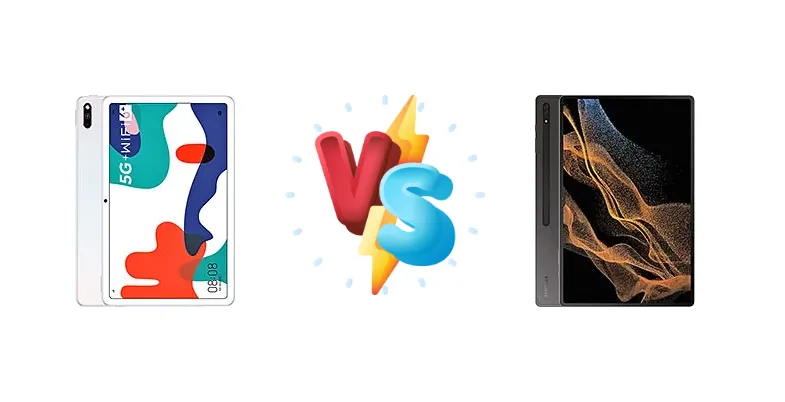
The tablet market offers a wide spectrum of choices, from budget-friendly options prioritizing connectivity to ultra-premium devices focused on raw power and features. This comparison pits the Huawei MatePad 5G, a compelling mid-range tablet with integrated 5G, against the Samsung Galaxy Tab S8 Ultra, a flagship boasting the latest Snapdragon processor and a stunning display. We'll dissect their strengths and weaknesses to help you determine which tablet best suits your needs.
🏆 Quick Verdict
For the average user prioritizing affordability and 5G connectivity, the Huawei MatePad 5G offers excellent value. However, the Samsung Galaxy Tab S8 Ultra is the clear winner for power users demanding top-tier performance, a larger, superior display, and faster charging, justifying its higher price tag.
| Network |
|---|
| 2G bands | GSM 850 / 900 / 1800 / 1900 | GSM 850 / 900 / 1800 / 1900 |
| 3G bands | HSDPA 850 / 900 / 1900 / 2100 | HSDPA 850 / 900 / 1700(AWS) / 1900 / 2100 |
| 4G bands | 1, 3, 5, 7, 8, 34, 38, 39, 40, 41 | LTE |
| 5G bands | 1, 3, 28, 38, 41, 77, 78, 79 | SA/NSA |
| Speed | HSPA, LTE, 5G | HSPA, LTE, 5G - cellular model only |
| Technology | GSM / HSPA / LTE / 5G | GSM / HSPA / LTE / 5G |
| Launch |
|---|
| Announced | 2020, September 16. Released 2020, October 13 | 2022, February 09 |
| Status | Discontinued | Available. Released 2022, April 30 |
| Body |
|---|
| Build | Glass front, aluminum back, aluminum frame | - |
| Dimensions | 245.2 x 155 x 7.5 mm (9.65 x 6.10 x 0.30 in) | 326.4 x 208.6 x 5.5 mm (12.85 x 8.21 x 0.22 in) |
| SIM | Nano-SIM | Nano-SIM (cellular model only) |
| Weight | 460 g (1.01 lb) | 726 g (Wi-Fi), 728 g (5G) (1.60 lb) |
| | Stylus support | Stylus, 2.8ms latency (Bluetooth integration, accelerometer, gyro) |
| Display |
|---|
| Protection | - | Corning Gorilla Glass 5 |
| Resolution | 1200 x 2000 pixels, 5:3 ratio (~224 ppi density) | 1848 x 2960 pixels, 16:10 ratio (~240 ppi density) |
| Size | 10.4 inches, 307.9 cm2 (~81.0% screen-to-body ratio) | 14.6 inches, 612.6 cm2 (~90.0% screen-to-body ratio) |
| Type | IPS LCD, 470 nits (typ) | Super AMOLED, 120Hz, HDR10+ |
| Platform |
|---|
| CPU | Octa-core (1x2.36 GHz Cortex-A76 & 3x2.22 GHz Cortex-A76 & 4x1.84 GHz Cortex-A55) | Octa-core (1x3.00 GHz Cortex-X2 & 3x2.50 GHz Cortex-A710 & 4x1.80 GHz Cortex-A510) |
| Chipset | Kirin 820 5G (7 nm) | Qualcomm SM8450 Snapdragon 8 Gen 1 (4 nm) |
| GPU | Mali-G57 (6-core) | Adreno 730 |
| OS | Android 10, EMUI 10.1, no Google Play Services | Android 12, up to 4 major Android upgrades, One UI 6.1.1 |
| Memory |
|---|
| Card slot | microSDXC | microSDXC (dedicated slot) |
| Internal | 128GB 6GB RAM | 128GB 8GB RAM, 256GB 8GB RAM, 256GB 12GB RAM, 256GB 16GB RAM, 512GB 12GB RAM, 512GB 16GB RAM |
| | - | UFS |
| Main Camera |
|---|
| Dual | - | 13 MP, f/2.0, 26mm (wide), 1/3.4", 1.0µm, AF
6 MP, f/2.2, (ultrawide) |
| Features | LED flash, HDR, panorama | LED flash, HDR, panorama |
| Single | 8 MP, AF | - |
| Video | 1080p@30fps | 4K@30/60fps, 1080p@30fps |
| Selfie camera |
|---|
| Dual | - | 12 MP, f/2.2, 26mm (wide)
12 MP, f/2.4, 120˚ (ultrawide) |
| Features | HDR | HDR |
| Single | 8 MP | - |
| Video | 1080p@30fps | 4K@30/60fps, 1080p@30fps |
| Sound |
|---|
| 3.5mm jack | No | No |
| 35mm jack | No | No |
| Loudspeaker | Yes, with stereo speakers (4 speakers) | Yes, with stereo speakers (4 speakers) |
| | Tuned by Harman Kardon | Tuned by AKG |
| Comms |
|---|
| Bluetooth | 5.1, A2DP, LE | 5.2, A2DP, LE |
| NFC | No | No |
| Positioning | GPS, GLONASS, GALILEO, BDS | GPS, GLONASS, BDS, GALILEO - cellular model only |
| Radio | No | No |
| USB | USB Type-C 2.0, OTG | USB Type-C 3.2, magnetic connector |
| WLAN | Wi-Fi 802.11 a/b/g/n/ac/6, dual-band, Wi-Fi Direct | Wi-Fi 802.11 a/b/g/n/ac/6e, dual-band, Wi-Fi Direct |
| Features |
|---|
| Sensors | Accelerometer, proximity, compass | Fingerprint (under display, optical), accelerometer, gyro, proximity, compass |
| | - | Wireless Samsung DeX |
| Battery |
|---|
| Charging | 22.5W wired | 45W wired, 100% in 82 min |
| Type | Li-Po 7250 mAh | Li-Po 11200 mAh |
| Misc |
|---|
| Colors | White, Dark Blue | Graphite |
| Models | BAH3-AN10 | SM-X900, SM-X906, SM-X906B, SM-X906U, SM-X906N |
| Price | About 400 EUR | About 1150 EUR |
| SAR EU | - | 0.69 W/kg (body) |
Huawei MatePad 5G
- Affordable price point
- Integrated 5G connectivity
- Good for everyday tasks
- Less powerful processor
- Slower charging speed
- Likely lower-quality display
Samsung Galaxy Tab S8 Ultra
- Exceptional performance with Snapdragon 8 Gen 1
- Stunning Super AMOLED display
- Fast 45W charging
- Significantly higher price
- Larger size may not be ideal for all users
- Potential for more heat under heavy load
Display Comparison
While specific display specs for the MatePad 5G are not provided, its market positioning suggests an LCD panel. This contrasts sharply with the Galaxy Tab S8 Ultra’s expansive 14.6-inch Super AMOLED display. The Snapdragon 8 Gen 1’s capabilities are best showcased on a high-quality display, and the Tab S8 Ultra delivers. The 4nm process allows for more efficient power delivery to the display, potentially contributing to better battery life despite the larger screen size. The Tab S8 Ultra’s AMOLED technology offers superior contrast and color accuracy, crucial for content creators and media consumers.
Camera Comparison
Given the context, a detailed camera comparison is limited. Both tablets likely feature multi-camera setups, but the Tab S8 Ultra, being a flagship, likely boasts superior image sensors and processing capabilities. The focus should be on video conferencing quality, where the Tab S8 Ultra’s higher-resolution front camera and image processing would provide a clearer and more professional experience. The MatePad 5G will likely suffice for casual snapshots, but won’t compete with the Tab S8 Ultra’s potential for higher-quality photos and videos.
Performance
The core difference lies in the chipsets. The Huawei MatePad 5G utilizes the Kirin 820 5G (7nm), a capable processor, but significantly less powerful than the Samsung Galaxy Tab S8 Ultra’s Qualcomm Snapdragon 8 Gen 1 (4nm). The Snapdragon 8 Gen 1’s Cortex-X2 prime core clocked at 3.00 GHz provides a substantial performance boost over the Kirin 820’s Cortex-A76 cores. Furthermore, the 4nm fabrication process of the Snapdragon 8 Gen 1 offers improved thermal efficiency, reducing throttling during sustained workloads like gaming or video rendering. The Tab S8 Ultra’s LPDDR5x RAM further enhances performance, providing faster data access compared to the likely LPDDR4x RAM in the MatePad 5G.
Battery Life
The Samsung Galaxy Tab S8 Ultra’s 45W wired charging, capable of reaching 100% in 82 minutes, significantly outperforms the Huawei MatePad 5G’s 22.5W charging. While the MatePad 5G’s battery capacity isn’t specified, the slower charging speed suggests a smaller battery. The Snapdragon 8 Gen 1’s 4nm process contributes to better power efficiency, potentially offsetting the larger display’s power draw. Users prioritizing minimal downtime will heavily favor the Tab S8 Ultra’s faster charging capabilities.
Buying Guide
Buy the Huawei MatePad 5G if you need a reliable tablet for everyday tasks, streaming, and light gaming, and 5G connectivity is a must-have for on-the-go productivity. It’s ideal for students or professionals who need constant access to the internet without relying on Wi-Fi. Buy the Samsung Galaxy Tab S8 Ultra if you prefer a desktop-like experience on a tablet, require demanding performance for creative tasks like video editing or graphic design, or are a serious mobile gamer who values a large, high-refresh-rate display and fast charging.
Frequently Asked Questions
❓ Does the Kirin 820 5G chip in the MatePad 5G struggle with demanding games like Genshin Impact?
While the Kirin 820 5G is a capable chip, it will likely require reduced graphics settings and may experience some frame drops in graphically intensive games like Genshin Impact. The Snapdragon 8 Gen 1 in the Tab S8 Ultra provides a much smoother gaming experience at higher settings.
❓ Is the 14.6-inch screen of the Tab S8 Ultra too large for comfortable portability?
The Tab S8 Ultra is undeniably a large tablet. While it offers an immersive experience, its size and weight (567g) may make it less convenient for extended one-handed use or carrying in a small bag. The MatePad 5G, with its likely smaller form factor, is more portable.
❓ How does the 5G connectivity on the MatePad 5G compare to using a mobile hotspot?
Integrated 5G offers a more streamlined and efficient connection than using a mobile hotspot. A hotspot drains your phone's battery and can be less stable. The MatePad 5G's dedicated 5G modem provides a direct connection to the network, resulting in faster speeds and better reliability.
❓ Does the Samsung Galaxy Tab S8 Ultra support DeX mode for a desktop-like experience?
Yes, the Samsung Galaxy Tab S8 Ultra fully supports DeX mode, allowing you to connect a keyboard, mouse, and external display for a desktop-like experience. This is a significant advantage for productivity users who want to use their tablet as a laptop replacement.