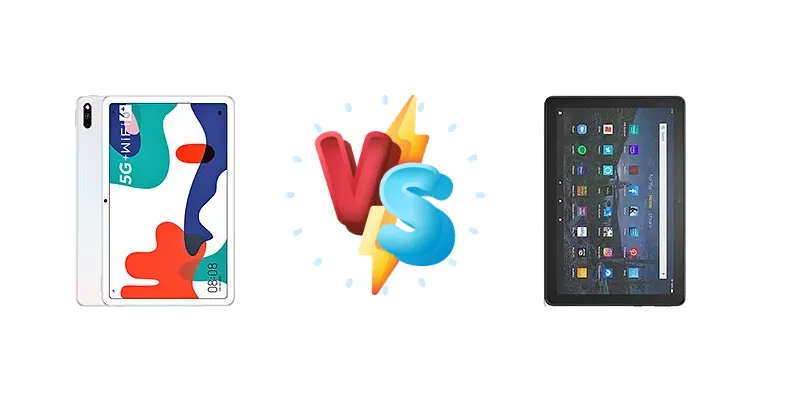
The tablet market offers a wide spectrum of choices, from entertainment-focused devices to productivity powerhouses. The Huawei MatePad 5G and Amazon Fire HD 10 Plus (2021) represent distinct approaches: the MatePad prioritizes connectivity and processing power with its 5G capabilities and Kirin chipset, while the Fire HD 10 Plus focuses on affordability and Amazon ecosystem integration, offering wireless charging as a key convenience feature. This comparison dissects their strengths and weaknesses to help you determine which tablet best suits your digital lifestyle.
🏆 Quick Verdict
For users prioritizing performance and future-proofing with 5G connectivity, the Huawei MatePad 5G is the clear winner. Its Kirin 820 5G chipset delivers significantly more processing power than the Fire HD 10 Plus’s Helio P60T. However, the Fire HD 10 Plus remains a compelling option for those deeply invested in the Amazon ecosystem and value wireless charging at a lower price point.
| Network |
|---|
| 2G bands | GSM 850 / 900 / 1800 / 1900 | N/A |
| 3G bands | HSDPA 850 / 900 / 1900 / 2100 | - |
| 4G bands | 1, 3, 5, 7, 8, 34, 38, 39, 40, 41 | - |
| 5G bands | 1, 3, 28, 38, 41, 77, 78, 79 | - |
| EDGE | - | No |
| GPRS | - | No |
| Speed | HSPA, LTE, 5G | - |
| Technology | GSM / HSPA / LTE / 5G | No cellular connectivity |
| Launch |
|---|
| Announced | 2020, September 16. Released 2020, October 13 | 2021, April 27. Released 2021, May 26 |
| Status | Discontinued | Discontinued |
| Body |
|---|
| Build | Glass front, aluminum back, aluminum frame | - |
| Dimensions | 245.2 x 155 x 7.5 mm (9.65 x 6.10 x 0.30 in) | 247 x 166 x 9.2 mm (9.72 x 6.54 x 0.36 in) |
| SIM | Nano-SIM | No |
| Weight | 460 g (1.01 lb) | 468 g (1.03 lb) |
| | Stylus support | - |
| Display |
|---|
| Protection | - | Aluminosilicate glass |
| Resolution | 1200 x 2000 pixels, 5:3 ratio (~224 ppi density) | 1920 x 1200 pixels, 16:10 ratio (~224 ppi density) |
| Size | 10.4 inches, 307.9 cm2 (~81.0% screen-to-body ratio) | 10.1 inches, 295.8 cm2 (~72.1% screen-to-body ratio) |
| Type | IPS LCD, 470 nits (typ) | IPS LCD |
| Platform |
|---|
| CPU | Octa-core (1x2.36 GHz Cortex-A76 & 3x2.22 GHz Cortex-A76 & 4x1.84 GHz Cortex-A55) | Octa-core (4x2.0 GHz Cortex-A73 & 4x2.0 GHz Cortex-A53) |
| Chipset | Kirin 820 5G (7 nm) | Mediatek MT8183 Helio P60T (12 nm) |
| GPU | Mali-G57 (6-core) | Mali-G72 MP3 |
| OS | Android 10, EMUI 10.1, no Google Play Services | Android 9.0 (Pie), Fire OS 7 |
| Memory |
|---|
| Card slot | microSDXC | microSDXC (dedicated slot) |
| Internal | 128GB 6GB RAM | 32GB 4GB RAM, 64GB 4GB RAM |
| | - | eMMC 5.1 |
| Main Camera |
|---|
| Features | LED flash, HDR, panorama | - |
| Single | 8 MP, AF | 5 MP |
| Video | 1080p@30fps | 720p |
| Selfie camera |
|---|
| Features | HDR | - |
| Single | 8 MP | 2 MP |
| Video | 1080p@30fps | 720p |
| Sound |
|---|
| 3.5mm jack | No | Yes |
| 35mm jack | No | Yes |
| Loudspeaker | Yes, with stereo speakers (4 speakers) | Yes, with stereo speakers |
| | Tuned by Harman Kardon | - |
| Comms |
|---|
| Bluetooth | 5.1, A2DP, LE | 5.0, A2DP, LE |
| NFC | No | No |
| Positioning | GPS, GLONASS, GALILEO, BDS | No |
| Radio | No | No |
| USB | USB Type-C 2.0, OTG | USB Type-C 2.0, OTG |
| WLAN | Wi-Fi 802.11 a/b/g/n/ac/6, dual-band, Wi-Fi Direct | Wi-Fi 802.11 a/b/g/n/ac, dual-band |
| Features |
|---|
| Sensors | Accelerometer, proximity, compass | Accelerometer |
| | - | Text-to-Speech English-language content reader |
| Battery |
|---|
| Charging | 22.5W wired | Wireless |
| Type | Li-Po 7250 mAh | Li-Ion |
| Misc |
|---|
| Colors | White, Dark Blue | Slate |
| Models | BAH3-AN10 | T76N2P |
| Price | About 400 EUR | About 150 EUR |
Huawei MatePad 5G
- Significantly faster processor (Kirin 820 5G)
- 5G connectivity for on-the-go access
- Potentially better thermal management due to 7nm process
- No wireless charging
- Potentially higher price
Amazon Fire HD 10 Plus (2021)
- Wireless charging for added convenience
- Lower price point
- Deep integration with Amazon ecosystem
- Slower processor (Helio P60T)
- Less capable for demanding tasks
Display Comparison
Neither device boasts a cutting-edge display. While specific display specs (resolution, panel type) are missing for both, the Fire HD 10 Plus’s focus on media consumption suggests a potentially more color-accurate panel optimized for video. However, the MatePad 5G’s chipset could drive a higher refresh rate display if supported, a feature absent on the Fire HD 10 Plus. Bezels are likely comparable, given both devices target the mid-range market. Without detailed display data, the comparison relies on inferred usage scenarios.
Camera Comparison
Camera performance is unlikely to be a deciding factor for either device. Both tablets are not known for their photographic capabilities. Given the context, it's safe to assume both feature modest camera setups geared towards video calls and casual snapshots. Without specific sensor details, it’s difficult to make a direct comparison, but the MatePad 5G’s more powerful ISP (integrated within the Kirin 820) may offer slightly better image processing.
Performance
The performance gap is substantial. The Huawei MatePad 5G’s Kirin 820 5G (7nm) is a significantly more advanced chipset than the Amazon Fire HD 10 Plus’s MediaTek MT8183 Helio P60T (12nm). The Kirin 820’s octa-core configuration, featuring Cortex-A76 cores, provides a considerable advantage in both single-core and multi-core performance compared to the Helio P60T’s Cortex-A73/A53 combination. The 7nm process node of the Kirin 820 also translates to better power efficiency and reduced thermal throttling during sustained workloads. This means the MatePad 5G will handle demanding apps and games with greater ease and consistency.
Battery Life
Battery life will depend heavily on usage patterns. The Fire HD 10 Plus’s inclusion of wireless charging is a significant convenience feature, allowing for cable-free top-ups. The MatePad 5G, with its 22.5W wired charging, will likely offer faster charging speeds when plugged in. However, the Kirin 820’s greater processing power could lead to faster battery drain during intensive tasks. Without knowing the battery capacities of each device, it’s difficult to definitively declare a winner; the trade-off is between convenience (wireless charging) and potentially faster wired charging.
Buying Guide
Buy the Huawei MatePad 5G if you need a tablet capable of handling demanding tasks like video editing, gaming, or frequent multitasking, and if 5G connectivity is a priority for on-the-go productivity. Buy the Amazon Fire HD 10 Plus (2021) if you primarily consume media, read ebooks, and rely heavily on Amazon services, and if wireless charging and a lower price are paramount.
Frequently Asked Questions
❓ Is the Huawei MatePad 5G’s 5G connectivity actually useful for a tablet?
For users who frequently travel or work remotely, the MatePad 5G’s 5G connectivity eliminates the need for Wi-Fi hotspots, providing a secure and reliable internet connection on the go. This is particularly beneficial for tasks like video conferencing, cloud-based work, and streaming high-resolution content.
❓ How well does the Amazon Fire HD 10 Plus handle multitasking with its Helio P60T chipset?
The Helio P60T is adequate for basic multitasking, such as switching between email, web browsing, and light social media apps. However, it may struggle with more demanding tasks like running multiple apps simultaneously or editing large files. Expect some lag and slowdowns when pushing the chipset to its limits.
❓ Can I easily install Google Play Store on the Huawei MatePad 5G?
Installing the Google Play Store on the MatePad 5G is not straightforward and requires sideloading, which can be complex for less tech-savvy users. While possible, it's not officially supported by Huawei and may require ongoing maintenance to ensure compatibility.