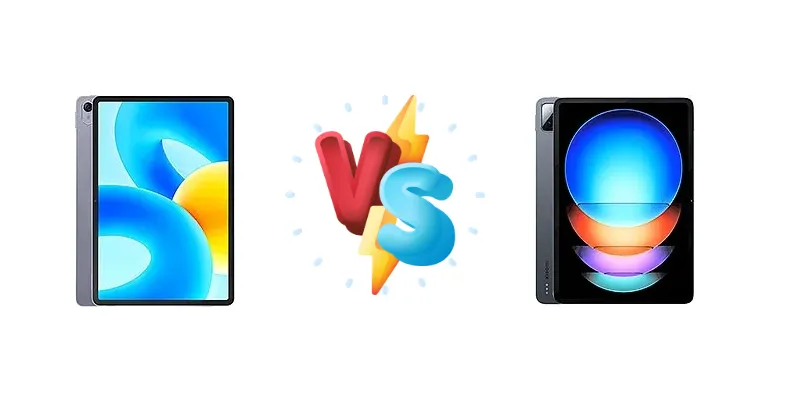
The Android tablet market is heating up, with both Huawei and Xiaomi offering compelling options. The Huawei MatePad 11.5, powered by the Snapdragon 7 Gen 1, aims for a balance of performance and affordability. Meanwhile, the Xiaomi Pad 6S Pro 12.4, boasting the flagship Snapdragon 8 Gen 2, targets users demanding uncompromising power and speed. This comparison dissects these tablets to determine which best suits your needs.
🏆 Quick Verdict
For the average user prioritizing raw performance and future-proofing, the Xiaomi Pad 6S Pro 12.4 is the clear winner. Its Snapdragon 8 Gen 2 chipset and blazing-fast 120W charging significantly outperform the MatePad 11.5, justifying the likely price premium. However, the MatePad 11.5 remains a viable option for budget-conscious users.
| Network |
|---|
| 2G bands | N/A | N/A |
| 3G bands | N/A | N/A |
| 4G bands | N/A | - |
| EDGE | No | N/A |
| GPRS | No | N/A |
| Technology | No cellular connectivity | No cellular connectivity |
| Launch |
|---|
| Announced | 2023, July 13 | 2024, February 22 |
| Status | Available. Released 2023, July 22 | Available. Released 2024, February 22 |
| Body |
|---|
| Build | Glass front, aluminum frame, aluminum back | Glass front (Gorilla Glass 5), aluminum frame, aluminum back |
| Dimensions | 260.9 x 176.8 x 6.9 mm (10.27 x 6.96 x 0.27 in) | 278.7 x 191.6 x 6.3 mm (10.97 x 7.54 x 0.25 in) |
| SIM | No | No |
| Weight | 499 g (1.10 lb) | 590 g (1.30 lb) |
| Display |
|---|
| Protection | - | Corning Gorilla Glass 5 |
| Resolution | 1440 x 2200 pixels, 3:2 ratio (~229 ppi density) | 2032 x 3048 pixels, 3:2 ratio (~295 ppi density) |
| Size | 11.5 inches, 391.0 cm2 (~84.8% screen-to-body ratio) | 12.4 inches, 457.8 cm2 (~85.7% screen-to-body ratio) |
| Type | TFT LCD, 120Hz | IPS LCD, 68B colors, 144Hz, HDR10, Dolby Vision, 900 nits (peak) |
| Platform |
|---|
| CPU | Octa-core (1x2.4 GHz Cortex-A710 & 3x2.36 GHz Cortex-A710 & 4x1.8 GHz Cortex-A510) | Octa-core (1x3.2 GHz Cortex-X3 & 2x2.8 GHz Cortex-A715 & 2x2.8 GHz Cortex-A710 & 3x2.0 GHz Cortex-A510) |
| Chipset | Qualcomm SM7450-AB Snapdragon 7 Gen 1 (4 nm) | Qualcomm SM8550-AB Snapdragon 8 Gen 2 (4 nm) |
| GPU | Adreno 644 | Adreno 740 |
| OS | Harmony OS 3.1 | Android 14, up to 3 major Android upgrades, HyperOS |
| Memory |
|---|
| Card slot | No | No |
| Internal | 128GB 6GB RAM, 128GB 8GB RAM, 256GB 8GB RAM | 256GB 8GB RAM, 256GB 12GB RAM, 512GB 12GB RAM, 1TB 16GB RAM |
| Main Camera |
|---|
| Dual | - | 50 MP, f/1.8, (wide), 1/2.76", 0.64µm, PDAF
Auxiliary lens |
| Features | - | LED flash, HDR, panorama |
| Single | 13 MP | - |
| Video | 1080p@30fps | 4K@30/60fps, 1080p@30/60fps |
| Selfie camera |
|---|
| Single | 8 MP, 105˚ (ultrawide) | 32 MP, f/2.2, (wide), 1/3.6", 0.61µm |
| Video | 1080p@30fps | 1080p@30fps |
| Sound |
|---|
| 35mm jack | No | No |
| Loudspeaker | Yes, with stereo speakers (4 speakers) | Yes, with stereo speakers (6 speakers) |
| Comms |
|---|
| Bluetooth | Yes | 5.3, A2DP, LE, LHDC |
| NFC | No | Yes (file transfer only) |
| Positioning | No | No |
| Radio | No | No |
| USB | USB Type-C, magnetic accessory connector | USB Type-C 3.2, accessory connector |
| WLAN | Wi-Fi 802.11 a/b/g/n/ac/6, dual-band | Wi-Fi 802.11 a/b/g/n/a/6/7, dual-band, Wi-Fi Direct |
| Features |
|---|
| Sensors | Accelerometer | Fingerprint (side-mounted), accelerometer, gyro, proximity (accessories only), compass |
| Battery |
|---|
| Charging | 22.5W wired | 120W wired, PD3.0, QC4, 45% in 10 min, 100% in 35 min |
| Type | Li-Po 7700 mAh | 10000 mAh |
| Misc |
|---|
| Colors | Space Gray | Black, Blue, Green |
| Models | BTKR-W09 | 24018RPACG |
| Price | About 290 EUR | About 700 EUR |
| SAR EU | - | 0.99 W/kg (body) |
Huawei MatePad 11.5
- More affordable price point
- Sufficient performance for everyday tasks
- Potentially lighter and more portable
- Significantly slower charging speed
- Less powerful processor for demanding tasks
- Likely lower display brightness and contrast
Xiaomi Pad 6S Pro 12.4
- Flagship Snapdragon 8 Gen 2 performance
- Ultra-fast 120W charging
- Brighter and higher contrast display
- Higher price tag
- Potentially heavier build
- May experience more heat under sustained load (though thermal management is improved)
Display Comparison
The Xiaomi Pad 6S Pro 12.4 boasts a significantly brighter display, reaching a measured 848 nits, compared to the MatePad 11.5 (brightness data unavailable, but likely lower given the chipset tier). This higher brightness translates to better outdoor visibility. The 1378:1 contrast ratio on the Xiaomi further enhances image quality. While both likely utilize IPS LCD panels, the Xiaomi’s superior brightness and contrast make it the better choice for media consumption. The larger 12.4-inch screen on the Xiaomi also provides more screen real estate for multitasking.
Camera Comparison
Camera performance is unlikely to be a primary concern for tablet users, but the Xiaomi Pad 6S Pro 12.4 likely holds an edge due to its more powerful ISP within the Snapdragon 8 Gen 2. While specific sensor details are unavailable for both devices, the Xiaomi’s chipset allows for more advanced image processing. The MatePad 11.5’s camera system is likely geared towards basic video conferencing and casual snapshots.
Performance
The core difference lies in the chipsets. The Xiaomi Pad 6S Pro 12.4’s Snapdragon 8 Gen 2 (4nm) is a substantial upgrade over the Huawei MatePad 11.5’s Snapdragon 7 Gen 1 (4nm). The 8 Gen 2 features a prime Cortex-X3 core clocked at 3.2 GHz, alongside higher-clocked Cortex-A715 and A710 cores, offering significantly improved CPU and GPU performance. The Snapdragon 8 Gen 2’s Adreno 740 GPU will deliver a far smoother gaming experience and faster rendering times. While both use a 4nm process, the architectural improvements in the 8 Gen 2 provide better thermal efficiency, minimizing throttling during sustained workloads. The Xiaomi’s likely use of faster LPDDR5x RAM further contributes to its performance advantage.
Battery Life
The Xiaomi Pad 6S Pro 12.4 delivers a compelling battery experience, achieving 11:14 hours of active use. Crucially, its 120W wired charging is a game-changer, reaching 45% charge in just 10 minutes and a full charge in 35 minutes. The Huawei MatePad 11.5’s 22.5W charging is considerably slower, requiring significantly longer to reach full capacity. While the MatePad 11.5’s battery capacity is unknown, the Xiaomi’s faster charging effectively mitigates any potential capacity disadvantage.
Buying Guide
Buy the Huawei MatePad 11.5 if you need a capable tablet for everyday tasks like browsing, streaming, and light productivity, and value affordability. Buy the Xiaomi Pad 6S Pro 12.4 if you prioritize demanding tasks like gaming, video editing, or running multiple apps simultaneously, and appreciate the convenience of incredibly fast charging and a brighter, more vibrant display.
Frequently Asked Questions
❓ Does the Snapdragon 8 Gen 2 in the Xiaomi Pad 6S Pro 12.4 get hot during extended gaming sessions?
While the Snapdragon 8 Gen 2 is a powerful chip, it benefits from improved thermal efficiency compared to previous generations. The Xiaomi Pad 6S Pro 12.4 likely incorporates effective cooling solutions to mitigate throttling during prolonged gaming, but some heat generation is expected. Expect slightly warmer temperatures during intensive tasks, but not to the point of significant performance degradation.
❓ Is the 22.5W charging on the Huawei MatePad 11.5 slow enough to be a major inconvenience?
Yes, the 22.5W charging on the MatePad 11.5 is considerably slower than the 120W charging on the Xiaomi Pad 6S Pro 12.4. It will take significantly longer to fully charge the device, potentially requiring overnight charging for a full day's use. This is a key area where the Xiaomi excels, offering a much more convenient charging experience.
❓ How does the Snapdragon 7 Gen 1 in the MatePad 11.5 handle multitasking compared to the Snapdragon 8 Gen 2?
The Snapdragon 7 Gen 1 is capable of handling moderate multitasking, but the Snapdragon 8 Gen 2 in the Xiaomi Pad 6S Pro 12.4 offers a far smoother experience with numerous apps open simultaneously. The 8 Gen 2’s more powerful CPU and GPU, combined with faster RAM, prevent slowdowns and ensure responsive performance even under heavy load.