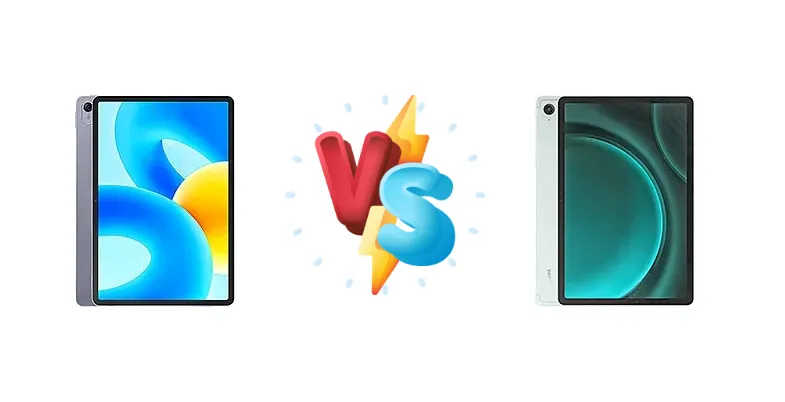
The mid-range tablet market is heating up, with the Huawei MatePad 11.5 and Samsung Galaxy Tab S9 FE vying for dominance. The MatePad 11.5 leverages Qualcomm’s Snapdragon 7 Gen 1, while the Tab S9 FE opts for Samsung’s in-house Exynos 1380. This comparison dissects these key differences, focusing on performance, battery life, and overall value to help you choose the right tablet for your workflow.
🏆 Quick Verdict
For the average user prioritizing all-around performance and faster charging, the Samsung Galaxy Tab S9 FE emerges as the winner. Its Exynos 1380, built on a 5nm process, offers a slight edge in efficiency and supports 45W charging, significantly reducing downtime compared to the MatePad 11.5’s 22.5W.
| Network |
|---|
| 2G bands | N/A | GSM 850 / 900 / 1800 / 1900 |
| 3G bands | N/A | HSDPA 850 / 900 / 1700(AWS) / 1900 / 2100 |
| 4G bands | N/A | 1, 2, 3, 4, 5, 7, 8, 12, 13, 17, 20, 26, 28, 32, 38, 40, 41, 66 |
| 5G bands | - | 1, 3, 5, 7, 8, 20, 28, 38, 40, 41, 66, 77, 78 SA/NSA/Sub6 |
| EDGE | No | - |
| GPRS | No | - |
| Speed | - | HSPA, LTE, 5G - cellular model only |
| Technology | No cellular connectivity | GSM / HSPA / LTE / 5G |
| Launch |
|---|
| Announced | 2023, July 13 | 2023, October 04 |
| Status | Available. Released 2023, July 22 | Available. Released 2023, October 16 |
| Body |
|---|
| Build | Glass front, aluminum frame, aluminum back | Glass front, aluminum back, aluminum frame |
| Dimensions | 260.9 x 176.8 x 6.9 mm (10.27 x 6.96 x 0.27 in) | 254.3 x 165.8 x 6.5 mm (10.01 x 6.53 x 0.26 in) |
| SIM | No | Nano-SIM + eSIM (cellular model only) |
| Weight | 499 g (1.10 lb) | 523 g or 524 g (1.15 lb) |
| Display |
|---|
| Resolution | 1440 x 2200 pixels, 3:2 ratio (~229 ppi density) | 1440 x 2304 pixels, 16:10 ratio (~249 ppi density) |
| Size | 11.5 inches, 391.0 cm2 (~84.8% screen-to-body ratio) | 10.9 inches, 344.5 cm2 (~81.7% screen-to-body ratio) |
| Type | TFT LCD, 120Hz | IPS LCD, 90Hz |
| Platform |
|---|
| CPU | Octa-core (1x2.4 GHz Cortex-A710 & 3x2.36 GHz Cortex-A710 & 4x1.8 GHz Cortex-A510) | Octa-core (4x2.4 GHz Cortex-A78 & 4x2.0 GHz Cortex-A55) |
| Chipset | Qualcomm SM7450-AB Snapdragon 7 Gen 1 (4 nm) | Exynos 1380 (5 nm) |
| GPU | Adreno 644 | Mali-G68 MP5 |
| OS | Harmony OS 3.1 | Android 13, up to 4 major Android upgrades, One UI 6 |
| Memory |
|---|
| Card slot | No | microSDXC (dedicated slot) |
| Internal | 128GB 6GB RAM, 128GB 8GB RAM, 256GB 8GB RAM | 128GB 6GB RAM, 128GB 8GB RAM, 256GB 8GB RAM |
| Main Camera |
|---|
| Single | 13 MP | 8 MP, (wide) |
| Video | 1080p@30fps | 4K@30fps, 1080p@30fps |
| Selfie camera |
|---|
| Single | 8 MP, 105˚ (ultrawide) | 12 MP, (ultrawide) |
| Video | 1080p@30fps | Yes |
| Sound |
|---|
| 35mm jack | No | No |
| Loudspeaker | Yes, with stereo speakers (4 speakers) | Yes, with stereo speakers |
| Comms |
|---|
| Bluetooth | Yes | 5.3, A2DP, LE |
| NFC | No | No |
| Positioning | No | GPS, GALILEO, GLONASS, BDS, QZSS - cellular model only |
| Radio | No | No |
| USB | USB Type-C, magnetic accessory connector | USB Type-C 2.0, magnetic connector |
| WLAN | Wi-Fi 802.11 a/b/g/n/ac/6, dual-band | Wi-Fi 802.11 a/b/g/n/ac/6, dual-band, Wi-Fi Direct |
| Features |
|---|
| Sensors | Accelerometer | Fingerprint (side-mounted), accelerometer, gyro, compass, proximity (accessories only) |
| Battery |
|---|
| Charging | 22.5W wired | 45W wired, QC2.0 |
| Type | Li-Po 7700 mAh | Li-Po 8000 mAh |
| Misc |
|---|
| Colors | Space Gray | Mint, Silver, Gray, Lavender |
| Models | BTKR-W09 | SM-X510, SM-X516B |
| Price | About 290 EUR | About 300 EUR |
| SAR | - | 1.55 W/kg (body) |
| SAR EU | - | 0.59 W/kg (body) |
Huawei MatePad 11.5
- Qualcomm Snapdragon 7 Gen 1 offers solid performance.
- Potentially optimized software experience with Qualcomm.
- Competitive price point.
- Slower 22.5W charging.
- Unusual CPU core configuration may impact sustained performance.
- Limited information on display quality.
Samsung Galaxy Tab S9 FE
- Faster 45W charging with QC2.0.
- More efficient Exynos 1380 (5nm) chipset.
- Balanced CPU architecture for multitasking.
- Samsung’s software can be resource-intensive.
- May not offer significant camera improvements over the MatePad.
- Potential for bloatware.
Display Comparison
While specific display specs (resolution, panel type) are missing, the core difference lies in the processing power driving the visuals. Both tablets likely utilize IPS LCD panels given their price points. However, the Exynos 1380’s image signal processor (ISP) could offer slightly better image processing for video playback. The lack of LTPO technology on either device suggests standard refresh rates, impacting smoothness compared to flagship tablets.
Camera Comparison
Without detailed camera specifications, a direct comparison is limited. However, given the market segment, both tablets likely feature modest camera setups. The focus should be on software processing rather than raw sensor size. Samsung’s image processing algorithms generally prioritize vibrant colors and detail enhancement, while Huawei often leans towards a more natural look. The absence of telephoto lenses on either device suggests a focus on general-purpose photography.
Performance
The Samsung Galaxy Tab S9 FE’s Exynos 1380 (5nm) holds a manufacturing process advantage over the Huawei MatePad 11.5’s Snapdragon 7 Gen 1 (4nm). While the 4nm node *typically* implies better efficiency, the Exynos 1380’s architecture – utilizing four Cortex-A78 cores versus the MatePad’s Cortex-A710 cores – provides a performance boost in multi-threaded tasks. The Snapdragon’s core configuration (1x A710, 3x A710, 4x A510) is unusual, potentially indicating a focus on sustained performance over peak bursts. The Tab S9 FE’s CPU architecture is more balanced, benefiting productivity and multitasking. The Exynos 1380 also benefits from Samsung’s software optimizations.
Battery Life
Battery capacity is not provided, but the charging wattage difference is significant. The Samsung Galaxy Tab S9 FE’s 45W wired charging with QC2.0 support drastically reduces charging times compared to the Huawei MatePad 11.5’s 22.5W. This is a crucial advantage for users who need to quickly top up their tablet throughout the day. While a larger battery capacity on the MatePad could offset the slower charging, the Exynos 1380’s 5nm process likely contributes to better power efficiency, potentially leading to comparable real-world battery life despite a potentially smaller cell.
Buying Guide
Buy the Huawei MatePad 11.5 if you prioritize a potentially smoother experience with Qualcomm’s optimized software integration and are comfortable with slower charging speeds. Buy the Samsung Galaxy Tab S9 FE if you prefer a more versatile tablet with faster charging, a wider ecosystem of accessories, and a slightly more efficient chipset for extended use.
Frequently Asked Questions
❓ Does the Exynos 1380 in the Tab S9 FE tend to overheat during prolonged gaming sessions?
The Exynos 1380’s 5nm process and Samsung’s thermal management solutions generally prevent significant overheating during gaming. While it may get warm, it’s unlikely to throttle performance severely unless subjected to extremely demanding titles for extended periods. The larger surface area of the Tab S9 FE also aids in heat dissipation.
❓ Is the 22.5W charging on the MatePad 11.5 a dealbreaker for users who frequently travel?
For frequent travelers, the 22.5W charging on the MatePad 11.5 could be inconvenient. It will take considerably longer to charge the device, potentially requiring overnight charging. The Tab S9 FE’s 45W charging is a significant advantage for those needing quick top-ups on the go.
❓ How does the software experience differ between Huawei’s EMUI and Samsung’s One UI?
EMUI, running on the MatePad 11.5, is known for its customization options and focus on efficiency. However, it lacks access to the full Google Play Store without workarounds. One UI on the Tab S9 FE offers a more familiar Android experience with full Google Play Store access, but can be perceived as more bloated with pre-installed apps and Samsung services.
❓ Which tablet is better suited for taking handwritten notes with a stylus?
Both tablets support styluses (sold separately). However, Samsung’s S Pen is generally considered more refined and offers lower latency. The Exynos 1380’s processing power may also contribute to a slightly smoother writing experience on the Tab S9 FE, though the difference is likely subtle.