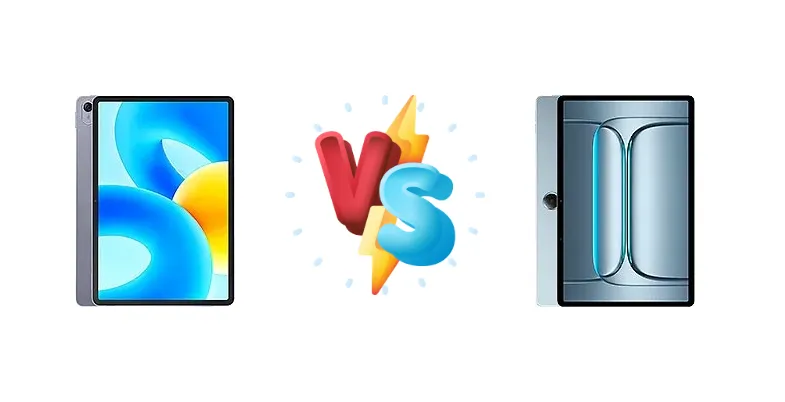
The tablet market is heating up with compelling options at various price points. We're pitting the Huawei MatePad 11.5, powered by Qualcomm's Snapdragon 7 Gen 1, against the OnePlus Pad Lite, featuring MediaTek's Helio G100. This comparison focuses on how these chipset choices translate into real-world performance and value for the user.
🏆 Quick Verdict
For users prioritizing sustained performance and a more efficient processor, the Huawei MatePad 11.5 is the better choice. Its Snapdragon 7 Gen 1, built on a 4nm process, offers a performance edge. However, the OnePlus Pad Lite delivers faster charging and represents a strong value proposition for casual users.
| Network |
|---|
| 2G bands | N/A | GSM 850 / 900 / 1800 / 1900 - cellular model only |
| 3G bands | N/A | HSDPA 850 / 900 / 2100 - cellular model only |
| 4G bands | N/A | LTE - cellular model only |
| EDGE | No | - |
| GPRS | No | - |
| Speed | - | HSPA, LTE - cellular model only |
| Technology | No cellular connectivity | GSM / HSPA / LTE |
| Launch |
|---|
| Announced | 2023, July 13 | 2025, July 08 |
| Status | Available. Released 2023, July 22 | Available. Released 2025, August 14 |
| Body |
|---|
| Build | Glass front, aluminum frame, aluminum back | - |
| Dimensions | 260.9 x 176.8 x 6.9 mm (10.27 x 6.96 x 0.27 in) | 254.9 x 166.5 x 7.4 mm (10.04 x 6.56 x 0.29 in) |
| SIM | No | Yes - cellular model only |
| Weight | 499 g (1.10 lb) | 530 g (1.17 lb) |
| Display |
|---|
| Resolution | 1440 x 2200 pixels, 3:2 ratio (~229 ppi density) | 1200 x 1920 pixels, 16:10 ratio (~207 ppi density) |
| Size | 11.5 inches, 391.0 cm2 (~84.8% screen-to-body ratio) | 11.0 inches, 347.5 cm2 (~81.9% screen-to-body ratio) |
| Type | TFT LCD, 120Hz | IPS LCD, 1B colors, 90Hz, 500 nits |
| Platform |
|---|
| CPU | Octa-core (1x2.4 GHz Cortex-A710 & 3x2.36 GHz Cortex-A710 & 4x1.8 GHz Cortex-A510) | Octa-core (2x2.2 GHz Cortex-A76 & 6x2.0 GHz Cortex-A55) |
| Chipset | Qualcomm SM7450-AB Snapdragon 7 Gen 1 (4 nm) | Mediatek Helio G100 (6 nm) |
| GPU | Adreno 644 | Mali-G57 MC2 |
| OS | Harmony OS 3.1 | Android 15, OxygenOS 15 |
| Memory |
|---|
| Card slot | No | Unspecified |
| Internal | 128GB 6GB RAM, 128GB 8GB RAM, 256GB 8GB RAM | 128GB 6GB RAM, 128GB 8GB RAM |
| Main Camera |
|---|
| Single | 13 MP | 5 MP |
| Video | 1080p@30fps | 1080p@30fps |
| Selfie camera |
|---|
| Single | 8 MP, 105˚ (ultrawide) | 5 MP |
| Video | 1080p@30fps | 1080p@30fps |
| Sound |
|---|
| 35mm jack | No | No |
| Loudspeaker | Yes, with stereo speakers (4 speakers) | Yes, with stereo speakers (4 speakers, Hi-Res audio) |
| Comms |
|---|
| Bluetooth | Yes | 5.2, A2DP, LE, aptX HD |
| NFC | No | No |
| Positioning | No | GPS, (cellular model only) - unconfirmed |
| Radio | No | No |
| USB | USB Type-C, magnetic accessory connector | USB Type-C 2.0 |
| WLAN | Wi-Fi 802.11 a/b/g/n/ac/6, dual-band | Wi-Fi 802.11 a/b/g/n/ac, dual-band |
| Features |
|---|
| Sensors | Accelerometer | Unspecified |
| Battery |
|---|
| Charging | 22.5W wired | 33W wired |
| Type | Li-Po 7700 mAh | Li-Po 9340 mAh |
| Misc |
|---|
| Colors | Space Gray | Aero Blue |
| Models | BTKR-W09 | OPD2480 |
| Price | About 290 EUR | About 200 EUR |
Huawei MatePad 11.5
- More powerful and efficient Snapdragon 7 Gen 1 chipset
- Potentially better display quality
- Superior thermal management for sustained performance
- Slower charging speed (22.5W)
- Likely higher price point
OnePlus Pad Lite
- Faster 33W wired charging
- More affordable price
- Adequate performance for everyday tasks
- Less powerful and efficient Helio G100 chipset
- Potential for throttling under heavy load
- Likely lower display quality
Display Comparison
Both tablets lack detailed display specifications in the provided data, making a direct comparison difficult. However, given the MatePad 11.5's positioning, it likely features a higher-quality panel with potentially better color accuracy and brightness. The OnePlus Pad Lite, aiming for a lower price point, may utilize a more cost-effective LCD panel. Bezels are also likely slimmer on the MatePad 11.5, reflecting its slightly higher tier.
Camera Comparison
Neither device is positioned as a photography powerhouse, and the provided data doesn't offer specifics beyond the chipsets. We can assume both will feature adequate cameras for video calls and casual snapshots. Without sensor size or aperture information, it's impossible to declare a clear winner. The image processing capabilities will likely be tied to the chipset, potentially giving the Snapdragon-powered MatePad 11.5 a slight edge in image quality.
Performance
The core difference lies in the chipsets. The Huawei MatePad 11.5’s Qualcomm Snapdragon 7 Gen 1 (4nm) boasts a more modern architecture – specifically, Cortex-A710 cores – and a smaller fabrication process. This 4nm process is significantly more efficient than the OnePlus Pad Lite’s MediaTek Helio G100 (6nm), translating to better thermal management and potentially less throttling during extended use. While the Helio G100’s Cortex-A76 cores are capable, they are an older generation. The Snapdragon’s CPU configuration (1x2.4 GHz Cortex-A710, 3x2.36 GHz Cortex-A710, 4x1.8 GHz Cortex-A510) provides a more balanced and powerful core arrangement than the Helio G100’s (2x2.2 GHz Cortex-A76 & 6x2.0 GHz Cortex-A55). This benefits multitasking and demanding applications.
Battery Life
The OnePlus Pad Lite’s 33W wired charging is a clear advantage over the MatePad 11.5’s 22.5W charging. This means significantly faster top-ups, crucial for users who rely on their tablets throughout the day. While battery capacity isn't specified, the more efficient Snapdragon 7 Gen 1 in the MatePad 11.5 could potentially offset the charging speed difference with longer overall battery life, but the faster charging of the Pad Lite provides a more convenient experience.
Buying Guide
Buy the Huawei MatePad 11.5 if you need a tablet capable of handling demanding multitasking, light gaming, and benefit from a more power-efficient processor for longer usage times. Buy the OnePlus Pad Lite if you prioritize quick charging, are primarily focused on media consumption, and want a more affordable tablet experience without sacrificing basic functionality.
Frequently Asked Questions
❓ Will the Helio G100 in the OnePlus Pad Lite struggle with graphically intensive games?
The Helio G100 is capable of handling many mobile games, but it will likely require lower graphics settings for smoother gameplay in demanding titles. The Snapdragon 7 Gen 1 in the MatePad 11.5 offers a more comfortable experience for gaming due to its superior GPU and thermal management.
❓ How much faster is the charging on the OnePlus Pad Lite compared to the Huawei MatePad 11.5 in real-world use?
The 33W charging on the OnePlus Pad Lite will noticeably reduce charging times. Expect a significantly faster 0-50% charge compared to the MatePad 11.5. While a full 0-100% time isn't specified, the difference will be substantial, potentially shaving off 30-60 minutes.
❓ Is the 4nm process of the Snapdragon 7 Gen 1 in the MatePad 11.5 noticeable in terms of battery life?
Yes, the 4nm process is more power-efficient than the 6nm process used in the Helio G100. This translates to lower power consumption for the same tasks, potentially resulting in longer battery life on the MatePad 11.5, especially during sustained use like video playback or multitasking.