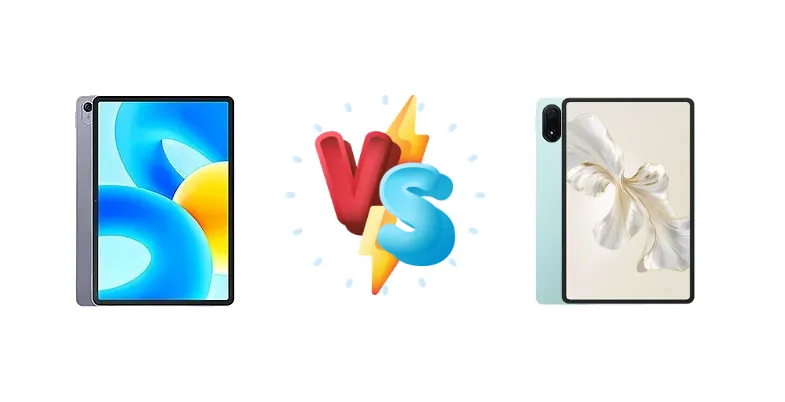
The mid-range tablet space is heating up, with both Huawei and Honor offering compelling options. The Huawei MatePad 11.5, powered by the Snapdragon 7 Gen 1, aims for a balance of efficiency and performance. Meanwhile, the Honor Pad 9 Pro leverages the MediaTek Dimensity 8100, promising a significant step up in processing power. This comparison dissects the key differences to determine which tablet best suits your needs.
🏆 Quick Verdict
For most users, the Honor Pad 9 Pro is the superior choice. Its MediaTek Dimensity 8100 chipset delivers noticeably faster performance than the Snapdragon 7 Gen 1 in the MatePad 11.5, and the 35W charging significantly reduces downtime. While the MatePad 11.5 remains a capable device, the Pad 9 Pro offers a more future-proof experience.
| Network |
|---|
| 2G bands | N/A | N/A |
| 3G bands | N/A | N/A |
| 4G bands | N/A | - |
| EDGE | No | No |
| GPRS | No | No |
| Technology | No cellular connectivity | No cellular connectivity |
| Launch |
|---|
| Announced | 2023, July 13 | 2024, July 12 |
| Status | Available. Released 2023, July 22 | Available. Released 2024, July 12 |
| Body |
|---|
| Build | Glass front, aluminum frame, aluminum back | Glass front, aluminum frame, aluminum back |
| Dimensions | 260.9 x 176.8 x 6.9 mm (10.27 x 6.96 x 0.27 in) | 277 x 179.9 x 6.6 mm (10.91 x 7.08 x 0.26 in) |
| SIM | No | No |
| Weight | 499 g (1.10 lb) | 589 g (1.30 lb) |
| Display |
|---|
| Resolution | 1440 x 2200 pixels, 3:2 ratio (~229 ppi density) | 1600 x 2560 pixels, 16:10 ratio (~249 ppi density) |
| Size | 11.5 inches, 391.0 cm2 (~84.8% screen-to-body ratio) | 12.1 inches, 424.5 cm2 (~85.2% screen-to-body ratio) |
| Type | TFT LCD, 120Hz | IPS LCD, 1B colors, 144Hz |
| Platform |
|---|
| CPU | Octa-core (1x2.4 GHz Cortex-A710 & 3x2.36 GHz Cortex-A710 & 4x1.8 GHz Cortex-A510) | Octa-core (4x2.85 GHz Cortex-A78 & 4x2.0 GHz Cortex-A55) |
| Chipset | Qualcomm SM7450-AB Snapdragon 7 Gen 1 (4 nm) | Mediatek Dimensity 8100 (5 nm) |
| GPU | Adreno 644 | Mali-G610 MC6 |
| OS | Harmony OS 3.1 | Android 14, Magic OS 8.1 |
| Memory |
|---|
| Card slot | No | No |
| Internal | 128GB 6GB RAM, 128GB 8GB RAM, 256GB 8GB RAM | 256GB 12GB RAM, 256GB 8GB RAM |
| Main Camera |
|---|
| Features | - | HDR |
| Single | 13 MP | 13 MP, f/2.0, (wide), AF |
| Video | 1080p@30fps | 4K@30fps, 1080p@30fps |
| Selfie camera |
|---|
| Single | 8 MP, 105˚ (ultrawide) | 5 MP, f/2.2, (wide) |
| Video | 1080p@30fps | 1080p@30fps |
| Sound |
|---|
| 35mm jack | No | No |
| Loudspeaker | Yes, with stereo speakers (4 speakers) | Yes, with stereo speakers (8 speakers) |
| Comms |
|---|
| Bluetooth | Yes | 5.2, A2DP, LE |
| NFC | No | No |
| Positioning | No | No |
| Radio | No | No |
| USB | USB Type-C, magnetic accessory connector | USB Type-C 2.0, OTG |
| WLAN | Wi-Fi 802.11 a/b/g/n/ac/6, dual-band | Wi-Fi 802.11 a/b/g/n/ac/6, dual-band, Wi-Fi Direct |
| Features |
|---|
| Sensors | Accelerometer | Accelerometer |
| Battery |
|---|
| Charging | 22.5W wired | 35W wired |
| Type | Li-Po 7700 mAh | Li-Po 10050 mAh |
| Misc |
|---|
| Colors | Space Gray | Sky Blue, Star Gray |
| Models | BTKR-W09 | - |
| Price | About 290 EUR | About 290 EUR |
Huawei MatePad 11.5
- Potentially more refined software experience within the Huawei ecosystem.
- 4nm chipset offers good power efficiency.
- Likely a more affordable price point.
- Less powerful chipset compared to the Dimensity 8100.
- Slower 22.5W charging.
- May experience more throttling under sustained load.
Honor Pad 9 Pro
- Significantly faster performance with the Dimensity 8100.
- Faster 35W wired charging.
- Better suited for demanding tasks like gaming and video editing.
- May be slightly more expensive.
- 5nm process, while efficient, may not match the 4nm node in absolute efficiency.
- Honor's software experience may not appeal to all users.
Display Comparison
Both tablets are expected to feature high-quality LCD panels, but detailed display specs (resolution, refresh rate, peak brightness) are not provided. However, the chipset differences suggest the Honor Pad 9 Pro is more capable of driving higher-resolution displays and smoother refresh rates. The absence of LTPO technology in either device means refresh rate adjustments will be less dynamic, impacting battery life during variable content viewing.
Camera Comparison
Without detailed camera specifications, a direct comparison is difficult. However, given the tablet market, we can assume both devices prioritize functionality over photographic excellence. The focus will likely be on adequate performance for video calls and casual snapshots. The absence of information regarding sensor size or optical image stabilization (OIS) suggests neither tablet will excel in low-light conditions. Any included macro cameras are likely to be low resolution and of limited practical use.
Performance
The core difference lies in the chipsets. The Honor Pad 9 Pro’s MediaTek Dimensity 8100, built on a 5nm process, boasts a more powerful CPU configuration (4x2.85 GHz Cortex-A78 & 4x2.0 GHz Cortex-A55) compared to the Huawei MatePad 11.5’s Qualcomm Snapdragon 7 Gen 1 (1x2.4 GHz Cortex-A710 & 3x2.36 GHz Cortex-A710 & 4x1.8 GHz Cortex-A510) fabricated on a 4nm node. While the 4nm node offers efficiency gains, the Dimensity 8100’s architectural advantages – specifically the higher-clocked Cortex-A78 cores – translate to superior multi-core and single-core performance. This benefits users engaged in demanding applications like video editing, 3D rendering, and graphically intensive games. The Pad 9 Pro will likely exhibit less throttling under sustained load.
Battery Life
The Honor Pad 9 Pro’s 35W wired charging is a clear advantage over the MatePad 11.5’s 22.5W charging. This translates to significantly faster top-up times, reducing downtime and increasing usability. While battery capacity isn’t specified, the more efficient Dimensity 8100 chipset in the Pad 9 Pro may offset a potentially smaller battery size, resulting in comparable real-world battery life. Users who frequently use their tablets on the go will greatly benefit from the Pad 9 Pro’s faster charging.
Buying Guide
Buy the Huawei MatePad 11.5 if you prioritize a streamlined, potentially more software-optimized experience within the Huawei ecosystem and are comfortable with its 22.5W charging. Buy the Honor Pad 9 Pro if you demand raw processing power for demanding tasks like gaming or video editing, and value faster charging speeds for minimal interruptions to your workflow.
Frequently Asked Questions
❓ Will the Dimensity 8100 in the Honor Pad 9 Pro overheat during extended gaming sessions?
While the Dimensity 8100 is a powerful chip, the Honor Pad 9 Pro is expected to have adequate thermal management to prevent significant overheating. The larger surface area of a tablet aids in heat dissipation compared to a smartphone. However, prolonged, high-intensity gaming will likely result in some thermal throttling, reducing peak performance slightly.
❓ Does the Huawei MatePad 11.5 support Huawei's M-Pencil, and is it included in the box?
The Huawei MatePad 11.5 is compatible with the Huawei M-Pencil (2nd Generation), but it is *not* included in the box and must be purchased separately. This adds to the overall cost if you intend to use the tablet for note-taking or creative tasks.
❓ What kind of storage options are available for both tablets, and is expandable storage supported?
Storage options are not explicitly stated in the provided data. However, based on market trends, both tablets are likely to offer configurations ranging from 128GB to 512GB. Expandable storage via microSD card is unlikely to be supported on either device, so choosing the appropriate storage capacity upfront is crucial.