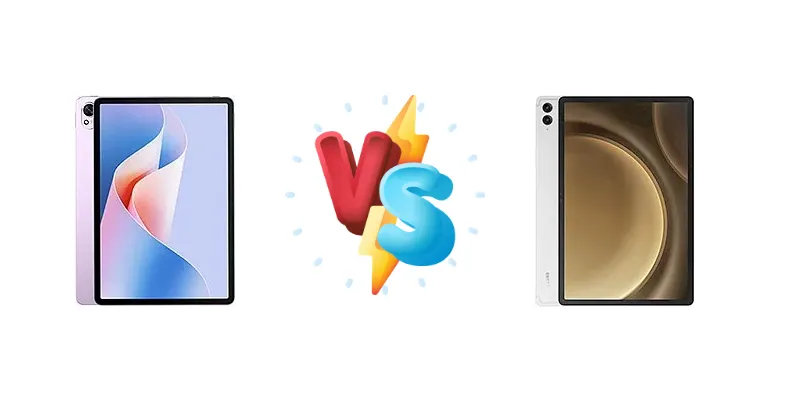
The mid-range tablet market is heating up, with both Huawei and Samsung offering compelling options. The Huawei MatePad 11.5 S aims for a balance of features and affordability, while the Samsung Galaxy Tab S9 FE+ steps up with a more powerful chipset and faster charging. This comparison dives deep into the specifics to determine which tablet delivers the best experience for your needs.
🏆 Quick Verdict
For the average user prioritizing performance and future-proofing, the Samsung Galaxy Tab S9 FE+ is the stronger choice. Its Exynos 1380 chipset provides a noticeable performance advantage, and the 45W charging significantly reduces downtime. However, the MatePad 11.5 S remains a viable option for those on a tighter budget.
| Network |
|---|
| 2G bands | N/A | GSM 850 / 900 / 1800 / 1900 |
| 3G bands | N/A | HSDPA 850 / 900 / 1700(AWS) / 1900 / 2100 |
| 4G bands | N/A | 1, 2, 3, 4, 5, 7, 8, 12, 13, 17, 20, 26, 28, 32, 38, 40, 41, 66 |
| 5G bands | - | 1, 3, 5, 7, 8, 20, 28, 38, 40, 41, 66, 77, 78 SA/NSA/Sub6 |
| EDGE | No | - |
| GPRS | No | - |
| Speed | - | HSPA, LTE, 5G - cellular model only |
| Technology | No cellular connectivity | GSM / HSPA / LTE / 5G |
| Launch |
|---|
| Announced | 2024, May 08 | 2023, October 04 |
| Status | Available. Released 2024, May | Available. Released 2023, October 16 |
| Body |
|---|
| Build | - | Glass front, aluminum back, aluminum frame |
| Dimensions | 261 x 177.2 x 6.2 mm (10.28 x 6.98 x 0.24 in) | 285.4 x 185.4 x 6.5 mm (11.24 x 7.30 x 0.26 in) |
| SIM | No | Nano-SIM + eSIM (cellular model only) |
| Weight | 510 g (1.12 lb) | 627 g or 628 g (1.38 lb) |
| Display |
|---|
| Resolution | 1840 x 2800 pixels, 3:2 ratio (~291 ppi density) | 1600 x 2560 pixels, 16:10 ratio (~243 ppi density) |
| Size | 11.5 inches, 391.6 cm2 (~84.7% screen-to-body ratio) | 12.4 inches, 445.8 cm2 (~84.3% screen-to-body ratio) |
| Type | TFT LCD, 144Hz | IPS LCD, 90Hz |
| Platform |
|---|
| CPU | Octa-core | Octa-core (4x2.4 GHz Cortex-A78 & 4x2.0 GHz Cortex-A55) |
| Chipset | - | Exynos 1380 (5 nm) |
| GPU | - | Mali-G68 MP5 |
| OS | Harmony OS 4.2 | Android 13, up to 4 major Android upgrades, One UI 6 |
| Memory |
|---|
| Card slot | No | microSDXC (dedicated slot) |
| Internal | 128GB 8GB RAM, 256GB 8GB RAM, 256GB 12GB RAM, 512GB 12GB RAM | 128GB 6GB RAM, 128GB 8GB RAM, 256GB 8GB RAM, 256GB 12GB RAM |
| Main Camera |
|---|
| Dual | - | 8 MP, (wide)
8 MP, (ultrawide) |
| Features | LED flash, panorama | - |
| Single | 13 MP, f/1.8, (wide), AF | - |
| Video | 1080p@30fps | 4K@30fps, 1080p@30fps |
| Selfie camera |
|---|
| Single | 8 MP, f/2.0 | 12 MP, (ultrawide) |
| Video | 1080p@30fps | Yes |
| Sound |
|---|
| 35mm jack | No | No |
| Loudspeaker | Yes, with stereo speakers (4 speakers) | Yes, with stereo speakers |
| Comms |
|---|
| Bluetooth | 5.2, A2DP, LE | 5.3, A2DP, LE |
| NFC | No | No |
| Positioning | No | GPS, GALILEO, GLONASS, BDS, QZSS - cellular model only |
| Radio | No | No |
| USB | USB Type-C 3.0, OTG, magnetic accessory connector | USB Type-C 2.0, magnetic connector |
| WLAN | Wi-Fi 802.11 a/b/g/n/ac/6, dual-band | Wi-Fi 802.11 a/b/g/n/ac/6, dual-band, Wi-Fi Direct |
| Features |
|---|
| Sensors | Accelerometer, proximity (accessories only), gyro | Fingerprint (side-mounted), accelerometer, gyro, compass, proximity (accessories only) |
| Battery |
|---|
| Charging | 22.5W wired
5W reverse wired | 45W wired, QC2.0 |
| Type | 8800 mAh | Li-Po 10090 mAh |
| Misc |
|---|
| Colors | Space Gray, Silver Frost, Violet | Mint, Silver, Gray, Lavender |
| Models | TGR-W09 | SM-X610, SM-X616B |
| Price | - | About 770 EUR |
| SAR | - | 0.77 W/kg (body) |
| SAR EU | - | 0.50 W/kg (body) |
Huawei MatePad 11.5 S
- Potentially lower price point
- Reverse wired charging capability
- Sufficient for basic tasks
- Less powerful processor
- Slower charging speed
- Likely inferior camera performance
Samsung Galaxy Tab S9 FE+
- More powerful Exynos 1380 chipset
- Faster 45W charging with QC2.0
- Likely better display quality
- Higher price tag
- May experience more thermal throttling under extreme load (though 5nm helps)
- No reverse wireless charging
Display Comparison
Both tablets lack detailed display specifications in the provided data, but considering their market positioning, we can infer differences. The Tab S9 FE+ likely benefits from Samsung’s display expertise, potentially offering slightly better color accuracy and brightness. The absence of LTPO technology on either suggests standard refresh rates, impacting smoothness compared to flagship tablets. Bezels are likely comparable, focusing on cost optimization in this segment.
Camera Comparison
Without detailed camera specifications, a direct comparison is limited. However, given Samsung’s history, the Tab S9 FE+ likely features a more refined camera system with better image processing. The MatePad 11.5 S likely prioritizes cost savings in this area. The absence of information regarding OIS or sensor size suggests both tablets are not geared towards serious photography.
Performance
The Samsung Galaxy Tab S9 FE+ boasts the Exynos 1380 (5nm), a significant advantage over the Huawei MatePad 11.5 S’s unspecified octa-core processor. The 5nm fabrication process of the Exynos 1380 translates to improved power efficiency and thermal management, allowing for sustained performance during demanding tasks. The Exynos 1380’s CPU configuration (4x2.4 GHz Cortex-A78 & 4x2.0 GHz Cortex-A55) provides a clear architectural advantage over a generic octa-core setup, particularly in multi-threaded applications. This benefits users engaged in video editing, gaming, or running multiple apps simultaneously.
Battery Life
While battery capacities are not provided, the charging speeds offer a clear differentiator. The Samsung Galaxy Tab S9 FE+ supports 45W wired charging with QC2.0, enabling significantly faster charging times compared to the Huawei MatePad 11.5 S’s 22.5W charging. This means less time tethered to an outlet and more time using the tablet. The 5W reverse wired charging on the MatePad 11.5 S is a niche feature, useful for topping up small accessories but unlikely to be a primary charging method.
Buying Guide
Buy the Huawei MatePad 11.5 S if you need a reliable tablet for basic productivity tasks like note-taking, web browsing, and media consumption, and prioritize a lower upfront cost. Buy the Samsung Galaxy Tab S9 FE+ if you prefer a smoother multitasking experience, enjoy mobile gaming, and value faster charging speeds for extended use, even if it means a higher investment.
Frequently Asked Questions
❓ Does the Exynos 1380 in the Tab S9 FE+ get hot during extended gaming sessions?
The Exynos 1380's 5nm process helps mitigate heat, but prolonged, graphically intensive gaming will inevitably generate warmth. However, it's expected to manage thermal throttling better than the MatePad 11.5 S's processor due to its more efficient architecture.
❓ How long does it realistically take to charge the Samsung Galaxy Tab S9 FE+ from 0% to 100%?
With 45W charging and QC2.0 support, the Tab S9 FE+ should reach a full charge in approximately 1 hour and 30 minutes to 2 hours, depending on usage during charging. This is significantly faster than the MatePad 11.5 S's 22.5W charging.
❓ Is the reverse wired charging on the MatePad 11.5 S useful for anything beyond emergencies?
The 5W reverse wired charging is primarily useful for topping up small accessories like earbuds or a smartwatch. It's not designed to significantly charge larger devices like smartphones and is best considered a convenience feature rather than a primary charging solution.
❓ Will the MatePad 11.5 S struggle with multitasking or running demanding apps?
The MatePad 11.5 S's unspecified processor is likely to show limitations when multitasking with numerous apps or running resource-intensive applications. The Tab S9 FE+'s Exynos 1380 offers a smoother experience in these scenarios.