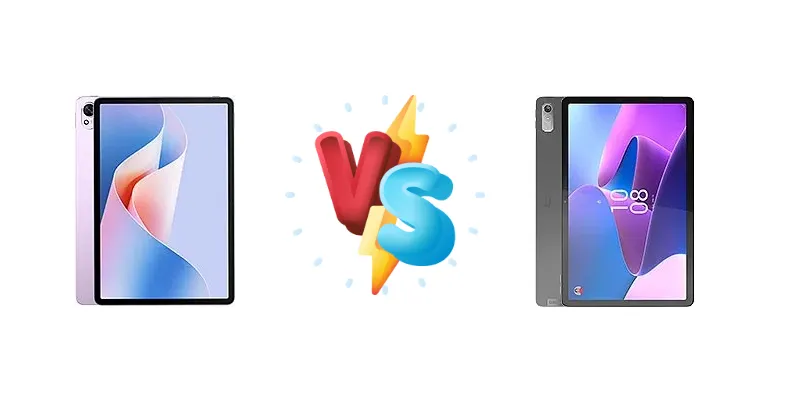
The mid-range Android tablet space is heating up, with both Huawei and Lenovo offering compelling options. The Huawei MatePad 11.5 S aims for a balance of portability and performance, while the Lenovo Tab P11 Pro Gen 2 focuses on delivering a more powerful experience with its Kompanio 1300T chipset. This comparison dives deep into the specifications and real-world implications to determine which tablet best suits your needs.
🏆 Quick Verdict
For the average user prioritizing raw performance and faster charging, the Lenovo Tab P11 Pro Gen 2 is the better choice. Its Mediatek Kompanio 1300T chipset provides a noticeable performance uplift, and the inclusion of QC3 fast charging offers quicker top-ups compared to the MatePad 11.5 S's 22.5W charging.
| Network |
|---|
| 2G bands | N/A | GSM 850 / 900 / 1800 / 1900 |
| 3G bands | N/A | HSDPA 850 / 900 / 1900 / 2100 |
| 4G bands | N/A | LTE |
| EDGE | No | - |
| GPRS | No | - |
| Speed | - | HSPA, LTE - cellular model only |
| Technology | No cellular connectivity | GSM / HSPA / LTE |
| Launch |
|---|
| Announced | 2024, May 08 | 2022, September 01 |
| Status | Available. Released 2024, May | Available. Released 2022, September 01 |
| Body |
|---|
| Build | - | Glass front, plastic back, plastic frame |
| Dimensions | 261 x 177.2 x 6.2 mm (10.28 x 6.98 x 0.24 in) | 263.7 x 166.7 x 6.8 mm (10.38 x 6.56 x 0.27 in) |
| SIM | No | Nano-SIM (cellular model only) |
| Weight | 510 g (1.12 lb) | 480 g (1.06 lb) |
| | - | Stylus support (magnetic) |
| Display |
|---|
| Resolution | 1840 x 2800 pixels, 3:2 ratio (~291 ppi density) | 1536 x 2560 pixels, 5:3 ratio (~267 ppi density) |
| Size | 11.5 inches, 391.6 cm2 (~84.7% screen-to-body ratio) | 11.2 inches, 357.0 cm2 (~81.2% screen-to-body ratio) |
| Type | TFT LCD, 144Hz | OLED, HDR10+, Dolby Vision, 120Hz, 420 nits (typ), 600 nits (peak) |
| Platform |
|---|
| CPU | Octa-core | Octa-core (4x2.6 GHz Cortex-A78 & 4x2.0 GHz Cortex-A55) |
| Chipset | - | Mediatek MT8797 Kompanio 1300T (6 nm) |
| GPU | - | Mali-G77 MC9 |
| OS | Harmony OS 4.2 | Android 12, upgradable to Android 13 |
| Memory |
|---|
| Card slot | No | microSDXC (dedicated slot) |
| Internal | 128GB 8GB RAM, 256GB 8GB RAM, 256GB 12GB RAM, 512GB 12GB RAM | 128GB 4GB RAM, 128GB 6GB RAM, 256GB 8GB RAM |
| | - | UFS 3.1 |
| Main Camera |
|---|
| Features | LED flash, panorama | LED flash |
| Single | 13 MP, f/1.8, (wide), AF | 13 MP, f/2.4, (wide), AF |
| Video | 1080p@30fps | 1080p@30fps |
| Selfie camera |
|---|
| Single | 8 MP, f/2.0 | 8 MP |
| Video | 1080p@30fps | 1080p@30fps |
| Sound |
|---|
| 3.5mm jack | - | No |
| 35mm jack | No | No |
| Loudspeaker | Yes, with stereo speakers (4 speakers) | Yes, with stereo speakers (4 speakers) |
| | - | Tuned by JBL |
| Comms |
|---|
| Bluetooth | 5.2, A2DP, LE | 5.1, A2DP, LE |
| NFC | No | No |
| Positioning | No | GPS, GLONASS - cellular model only |
| Radio | No | No |
| USB | USB Type-C 3.0, OTG, magnetic accessory connector | USB Type-C 3.0, OTG, magnetic connector, video output |
| WLAN | Wi-Fi 802.11 a/b/g/n/ac/6, dual-band | Wi-Fi 802.11 a/b/g/n/ac/6, dual-band, Wi-Fi Direct |
| Features |
|---|
| Sensors | Accelerometer, proximity (accessories only), gyro | Accelerometer, gyro, proximity, compass |
| Battery |
|---|
| Charging | 22.5W wired
5W reverse wired | 20W wired, QC3 |
| Type | 8800 mAh | Li-Po 8200 mAh |
| Misc |
|---|
| Colors | Space Gray, Silver Frost, Violet | Storm Grey, Oat |
| Models | TGR-W09 | ZAB50194GB, ZAB50043SE |
| Price | - | About 500 EUR |
| Tests |
|---|
| Performance | - |
AnTuTu: 616573 (v9)
GeekBench: 2827 (v5.1) |
Huawei MatePad 11.5 S
- Potentially lighter and more portable design.
- Huawei's ecosystem integration (for existing Huawei users).
- 5W reverse wired charging for topping up accessories.
- Less powerful processor compared to the Lenovo.
- Slower charging speeds without Quick Charge support.
Lenovo Tab P11 Pro Gen 2
- More powerful Mediatek Kompanio 1300T chipset.
- Faster 20W charging with QC3 support.
- Potentially better display quality based on Lenovo's track record.
- May be slightly heavier than the Huawei MatePad 11.5 S.
- Lenovo's software experience isn't always as refined as Huawei's.
Display Comparison
Neither Huawei nor Lenovo provided display specs beyond the basic existence of a display. Assuming both utilize IPS LCD panels common in this price bracket, the key differentiator will likely be color accuracy and peak brightness. Without specific nit ratings, it's difficult to declare a winner. However, given Lenovo's history with higher-quality displays in their Pro series, it's reasonable to expect a slightly more vibrant and accurate panel on the Tab P11 Pro Gen 2. Bezels are also likely comparable, focusing on maximizing screen real estate within the tablet form factor.
Camera Comparison
Given the context data, a detailed camera comparison is limited. Both tablets likely feature basic camera setups geared towards video calls and casual snapshots. Without sensor size or aperture information, it's difficult to assess image quality. It's safe to assume neither tablet will excel in low-light photography. The absence of details suggests cameras aren't a primary selling point for either device.
Performance
The Lenovo Tab P11 Pro Gen 2 boasts a significant advantage in processing power thanks to its Mediatek MT8797 Kompanio 1300T (6nm). This chipset features a combination of 4x2.6 GHz Cortex-A78 and 4x2.0 GHz Cortex-A55 cores, offering a substantial performance boost over the MatePad 11.5 S’s unspecified octa-core CPU. The 6nm process node of the Kompanio 1300T also translates to improved thermal efficiency, potentially leading to sustained performance during prolonged use. While both utilize an octa-core configuration, the architectural differences and process node give Lenovo a clear edge for users who demand responsiveness and multitasking capabilities.
Battery Life
Battery capacity isn't specified for either device. However, the Lenovo Tab P11 Pro Gen 2’s 20W wired charging with QC3 support offers a faster charging experience than the Huawei MatePad 11.5 S’s 22.5W wired charging. QC3 allows for dynamic voltage adjustment, optimizing charging speed and efficiency. While the MatePad 11.5 S has slightly higher wattage, the lack of Quick Charge support means it won't reach its full potential as quickly. The faster charging on the Lenovo is a significant benefit for users who need to quickly top up their tablet on the go.
Buying Guide
Buy the Huawei MatePad 11.5 S if you prioritize a lightweight and portable design for on-the-go productivity and media consumption, and aren't heavily reliant on demanding applications. Buy the Lenovo Tab P11 Pro Gen 2 if you need a tablet capable of handling more intensive tasks like video editing, gaming, or multitasking, and value faster charging speeds for extended use.
Frequently Asked Questions
❓ Will the Mediatek Kompanio 1300T in the Lenovo Tab P11 Pro Gen 2 handle demanding games like Genshin Impact?
The Kompanio 1300T is a capable chipset, and should be able to run Genshin Impact at medium settings with reasonable frame rates. However, don't expect flagship-level performance. The sustained performance will depend on the tablet's thermal management, but the 6nm process node should help mitigate throttling.
❓ Does the Huawei MatePad 11.5 S support the Huawei M-Pencil, and is it included in the box?
The Huawei MatePad 11.5 S is compatible with the 2nd generation Huawei M-Pencil, but it is *not* included in the box and must be purchased separately. This adds to the overall cost if you intend to use the tablet for note-taking or drawing.
❓ What kind of storage options are available for the Lenovo Tab P11 Pro Gen 2, and is it expandable?
The Lenovo Tab P11 Pro Gen 2 typically comes in configurations with 128GB or 256GB of internal storage. It also features a microSD card slot, allowing you to expand the storage capacity further, which is a significant advantage for users who store a lot of media or files.