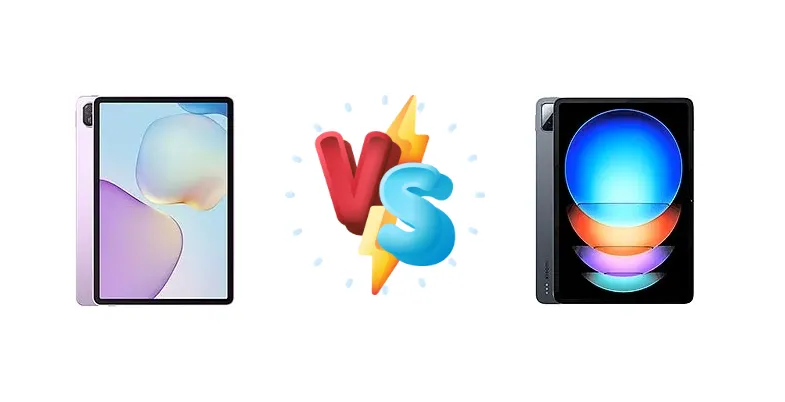
The large-screen Android tablet market is heating up. Huawei's MatePad 11.5 (2025) aims to deliver a balanced experience with its in-house Kirin T82B chipset, while Xiaomi's Pad 6S Pro 12.4 throws down the gauntlet with Qualcomm's flagship Snapdragon 8 Gen 2. This comparison dissects the key differences to determine which tablet reigns supreme for power users, creatives, and everyday consumers.
🏆 Quick Verdict
For users prioritizing raw performance and rapid charging, the Xiaomi Pad 6S Pro 12.4 is the clear winner. Its Snapdragon 8 Gen 2 chipset and 120W charging significantly outperform the Huawei MatePad 11.5 (2025). However, the MatePad 11.5 offers a compelling alternative for those seeking a potentially more efficient chipset and Huawei's ecosystem integration.
| Network |
|---|
| 2G bands | N/A | N/A |
| 3G bands | N/A | N/A |
| 4G bands | N/A | - |
| EDGE | No | N/A |
| GPRS | No | N/A |
| Technology | No cellular connectivity | No cellular connectivity |
| Launch |
|---|
| Announced | 2025, July 10 | 2024, February 22 |
| Status | Available. Released 2025, July | Available. Released 2024, February 22 |
| Body |
|---|
| Build | Glass front, aluminum frame, aluminum back | Glass front (Gorilla Glass 5), aluminum frame, aluminum back |
| Dimensions | 262.6 x 177.5 x 6.1 mm (10.34 x 6.99 x 0.24 in) | 278.7 x 191.6 x 6.3 mm (10.97 x 7.54 x 0.25 in) |
| SIM | No | No |
| Weight | 515 g (1.14 lb) | 590 g (1.30 lb) |
| Display |
|---|
| Protection | - | Corning Gorilla Glass 5 |
| Resolution | 1600 x 2456 pixels, 3:2 ratio (~256 ppi density) | 2032 x 3048 pixels, 3:2 ratio (~295 ppi density) |
| Size | 11.5 inches, 387.2 cm2 (~83.1% screen-to-body ratio) | 12.4 inches, 457.8 cm2 (~85.7% screen-to-body ratio) |
| Type | TFT LCD, 120Hz, 600 nits (peak) | IPS LCD, 68B colors, 144Hz, HDR10, Dolby Vision, 900 nits (peak) |
| Platform |
|---|
| CPU | 12-core (2x2.29 GHz & 6x2.05 GHz & 4x1.31 GHz) | Octa-core (1x3.2 GHz Cortex-X3 & 2x2.8 GHz Cortex-A715 & 2x2.8 GHz Cortex-A710 & 3x2.0 GHz Cortex-A510) |
| Chipset | Kirin T82B | Qualcomm SM8550-AB Snapdragon 8 Gen 2 (4 nm) |
| GPU | Maleoon 920c | Adreno 740 |
| OS | Harmony OS 4.3 | Android 14, up to 3 major Android upgrades, HyperOS |
| Memory |
|---|
| Card slot | No | No |
| Internal | 128GB 8GB RAM, 256GB 8GB RAM | 256GB 8GB RAM, 256GB 12GB RAM, 512GB 12GB RAM, 1TB 16GB RAM |
| Main Camera |
|---|
| Dual | - | 50 MP, f/1.8, (wide), 1/2.76", 0.64µm, PDAF
Auxiliary lens |
| Features | Panorama | LED flash, HDR, panorama |
| Single | 13 MP, f/1.8, (wide), AF | - |
| Video | 1080p@30fps | 4K@30/60fps, 1080p@30/60fps |
| Selfie camera |
|---|
| Single | 8 MP, f/2.0, 105˚ (ultrawide) | 32 MP, f/2.2, (wide), 1/3.6", 0.61µm |
| Video | 1080p@30fps | 1080p@30fps |
| Sound |
|---|
| 35mm jack | No | No |
| Loudspeaker | Yes, with stereo speakers (4 speakers) | Yes, with stereo speakers (6 speakers) |
| Comms |
|---|
| Bluetooth | 5.2, A2DP, LE | 5.3, A2DP, LE, LHDC |
| NFC | No | Yes (file transfer only) |
| Positioning | No | No |
| Radio | No | No |
| USB | USB Type-C 2.0, OTG, magnetic accessory connector | USB Type-C 3.2, accessory connector |
| WLAN | Wi-Fi 802.11 a/b/g/n/ac/6, dual-band | Wi-Fi 802.11 a/b/g/n/a/6/7, dual-band, Wi-Fi Direct |
| Features |
|---|
| Sensors | Accelerometer | Fingerprint (side-mounted), accelerometer, gyro, proximity (accessories only), compass |
| Battery |
|---|
| Charging | 40W wired
5W reverse wired | 120W wired, PD3.0, QC4, 45% in 10 min, 100% in 35 min |
| Type | 10100 mAh | 10000 mAh |
| Misc |
|---|
| Colors | Violet, Space Gray | Black, Blue, Green |
| Models | TXZ-W09 | 24018RPACG |
| Price | About 290 EUR | About 700 EUR |
| SAR EU | - | 0.99 W/kg (body) |
Huawei MatePad 11.5 (2025)
- Potentially better thermal management due to Kirin T82B's architecture.
- Huawei ecosystem integration for seamless device connectivity.
- 5W reverse wired charging for accessory top-ups.
- Significantly less powerful chipset compared to Snapdragon 8 Gen 2.
- Slower charging speed (40W) than the Xiaomi.
- Display specs currently unknown, potentially inferior to Xiaomi.
Xiaomi Pad 6S Pro 12.4
- Flagship Snapdragon 8 Gen 2 chipset for exceptional performance.
- Ultra-fast 120W charging (0-100% in 35 minutes).
- Bright and high-contrast 12.4-inch display (848 nits, 1378:1 contrast).
- Snapdragon 8 Gen 2 may run hotter under sustained load.
- Potentially higher price point.
- Xiaomi's software experience may not appeal to all users.
Display Comparison
The Xiaomi Pad 6S Pro 12.4 boasts a superior display, achieving a measured peak brightness of 848 nits and a 1378:1 contrast ratio. While the MatePad 11.5’s display specs are currently unknown, the contrast ratio and brightness of the Xiaomi panel will likely provide a more vibrant and immersive viewing experience, particularly in bright environments. The larger 12.4-inch screen on the Xiaomi also offers more screen real estate for multitasking and content creation. We anticipate the Xiaomi panel will also feature a higher refresh rate, contributing to smoother scrolling and animations.
Camera Comparison
Given the tablet form factor, camera performance isn't a primary concern for most users. However, the Xiaomi Pad 6S Pro 12.4 is likely to have a more capable camera system, leveraging the Snapdragon 8 Gen 2’s image signal processor. Without specific camera specs for the MatePad 11.5, it’s difficult to make a direct comparison, but Xiaomi typically prioritizes camera quality even in its tablet lineup. We expect the Xiaomi to offer better low-light performance and more detailed images.
Performance
The performance gap is substantial. The Xiaomi Pad 6S Pro 12.4’s Snapdragon 8 Gen 2 (4nm) is a flagship-tier chipset featuring a 1x3.2 GHz Cortex-X3 prime core, significantly outperforming the Huawei MatePad 11.5 (2025)’s Kirin T82B. The Kirin T82B’s 12-core configuration (2x2.29 GHz, 6x2.05 GHz, 4x1.31 GHz) suggests a focus on efficiency and multi-tasking, but it won’t match the raw processing power of the Snapdragon. The 4nm fabrication process of the Snapdragon also contributes to better thermal efficiency, minimizing throttling during extended gaming sessions. The Xiaomi’s LPDDR5x RAM will further enhance performance.
Battery Life
The Xiaomi Pad 6S Pro 12.4 excels in charging speed with its 120W wired charging, capable of reaching 45% charge in just 10 minutes and 100% in 35 minutes. This is a massive advantage over the Huawei MatePad 11.5 (2025)’s 40W wired charging. While the Xiaomi’s active use battery score of 11:14h is impressive, the faster charging mitigates concerns about battery life. The Huawei also offers 5W reverse wired charging, a niche feature for topping up accessories, but the Xiaomi’s charging speed is the dominant factor here.
Buying Guide
Buy the Huawei MatePad 11.5 (2025) if you prioritize a potentially more thermally efficient chipset for sustained workloads, are heavily invested in the Huawei ecosystem, and value a balanced feature set. Buy the Xiaomi Pad 6S Pro 12.4 if you demand the absolute best performance for gaming and demanding applications, need the fastest possible charging speeds, and appreciate a brighter, higher-contrast display.
Frequently Asked Questions
❓ Will the Kirin T82B in the Huawei MatePad 11.5 (2025) struggle with demanding games like Genshin Impact?
While the Kirin T82B is a capable chipset, it's unlikely to deliver the same level of performance as the Snapdragon 8 Gen 2 in the Xiaomi Pad 6S Pro 12.4 when running graphically intensive games. Expect to potentially lower graphics settings or experience some frame rate drops in demanding titles.
❓ How much faster is the 120W charging on the Xiaomi Pad 6S Pro 12.4 compared to the 40W charging on the Huawei MatePad 11.5 (2025) in real-world use?
The difference is substantial. The Xiaomi can go from 0% to 45% in 10 minutes and fully charge in 35 minutes. The Huawei will take significantly longer – likely over an hour to reach full charge. This makes the Xiaomi ideal for users who frequently need to quickly top up their tablet.
❓ Does the Xiaomi Pad 6S Pro 12.4 get excessively hot during prolonged gaming sessions?
The Snapdragon 8 Gen 2 is known to generate heat under sustained load. However, Xiaomi likely incorporates thermal management solutions to mitigate throttling. While some heat is expected, it shouldn't be a major issue for most gaming sessions. The larger chassis of the 12.4-inch tablet also helps with heat dissipation.