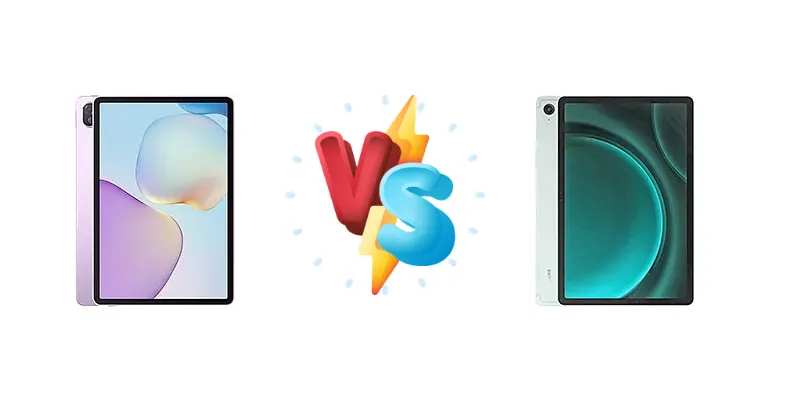
The mid-range tablet market is heating up, with both Huawei and Samsung offering compelling options. The newly released Huawei MatePad 11.5 (2025), powered by the Kirin T82B, aims to challenge the established Samsung Galaxy Tab S9 FE and its Exynos 1380 chipset. This comparison dissects the key differences to help you determine which tablet best suits your workflow and entertainment needs.
🏆 Quick Verdict
For the average user prioritizing all-around performance and established software support, the Samsung Galaxy Tab S9 FE emerges as the better choice. Its Exynos 1380, built on a more efficient 5nm process, delivers a smoother experience, while Samsung’s software ecosystem offers broader app compatibility and updates.
| Network |
|---|
| 2G bands | N/A | GSM 850 / 900 / 1800 / 1900 |
| 3G bands | N/A | HSDPA 850 / 900 / 1700(AWS) / 1900 / 2100 |
| 4G bands | N/A | 1, 2, 3, 4, 5, 7, 8, 12, 13, 17, 20, 26, 28, 32, 38, 40, 41, 66 |
| 5G bands | - | 1, 3, 5, 7, 8, 20, 28, 38, 40, 41, 66, 77, 78 SA/NSA/Sub6 |
| EDGE | No | - |
| GPRS | No | - |
| Speed | - | HSPA, LTE, 5G - cellular model only |
| Technology | No cellular connectivity | GSM / HSPA / LTE / 5G |
| Launch |
|---|
| Announced | 2025, July 10 | 2023, October 04 |
| Status | Available. Released 2025, July | Available. Released 2023, October 16 |
| Body |
|---|
| Build | Glass front, aluminum frame, aluminum back | Glass front, aluminum back, aluminum frame |
| Dimensions | 262.6 x 177.5 x 6.1 mm (10.34 x 6.99 x 0.24 in) | 254.3 x 165.8 x 6.5 mm (10.01 x 6.53 x 0.26 in) |
| SIM | No | Nano-SIM + eSIM (cellular model only) |
| Weight | 515 g (1.14 lb) | 523 g or 524 g (1.15 lb) |
| Display |
|---|
| Resolution | 1600 x 2456 pixels, 3:2 ratio (~256 ppi density) | 1440 x 2304 pixels, 16:10 ratio (~249 ppi density) |
| Size | 11.5 inches, 387.2 cm2 (~83.1% screen-to-body ratio) | 10.9 inches, 344.5 cm2 (~81.7% screen-to-body ratio) |
| Type | TFT LCD, 120Hz, 600 nits (peak) | IPS LCD, 90Hz |
| Platform |
|---|
| CPU | 12-core (2x2.29 GHz & 6x2.05 GHz & 4x1.31 GHz) | Octa-core (4x2.4 GHz Cortex-A78 & 4x2.0 GHz Cortex-A55) |
| Chipset | Kirin T82B | Exynos 1380 (5 nm) |
| GPU | Maleoon 920c | Mali-G68 MP5 |
| OS | Harmony OS 4.3 | Android 13, up to 4 major Android upgrades, One UI 6 |
| Memory |
|---|
| Card slot | No | microSDXC (dedicated slot) |
| Internal | 128GB 8GB RAM, 256GB 8GB RAM | 128GB 6GB RAM, 128GB 8GB RAM, 256GB 8GB RAM |
| Main Camera |
|---|
| Features | Panorama | - |
| Single | 13 MP, f/1.8, (wide), AF | 8 MP, (wide) |
| Video | 1080p@30fps | 4K@30fps, 1080p@30fps |
| Selfie camera |
|---|
| Single | 8 MP, f/2.0, 105˚ (ultrawide) | 12 MP, (ultrawide) |
| Video | 1080p@30fps | Yes |
| Sound |
|---|
| 35mm jack | No | No |
| Loudspeaker | Yes, with stereo speakers (4 speakers) | Yes, with stereo speakers |
| Comms |
|---|
| Bluetooth | 5.2, A2DP, LE | 5.3, A2DP, LE |
| NFC | No | No |
| Positioning | No | GPS, GALILEO, GLONASS, BDS, QZSS - cellular model only |
| Radio | No | No |
| USB | USB Type-C 2.0, OTG, magnetic accessory connector | USB Type-C 2.0, magnetic connector |
| WLAN | Wi-Fi 802.11 a/b/g/n/ac/6, dual-band | Wi-Fi 802.11 a/b/g/n/ac/6, dual-band, Wi-Fi Direct |
| Features |
|---|
| Sensors | Accelerometer | Fingerprint (side-mounted), accelerometer, gyro, compass, proximity (accessories only) |
| Battery |
|---|
| Charging | 40W wired
5W reverse wired | 45W wired, QC2.0 |
| Type | 10100 mAh | Li-Po 8000 mAh |
| Misc |
|---|
| Colors | Violet, Space Gray | Mint, Silver, Gray, Lavender |
| Models | TXZ-W09 | SM-X510, SM-X516B |
| Price | About 290 EUR | About 300 EUR |
| SAR | - | 1.55 W/kg (body) |
| SAR EU | - | 0.59 W/kg (body) |
Huawei MatePad 11.5 (2025)
- 40W wired charging with 5W reverse wired charging
- Potentially optimized software experience within Huawei's ecosystem
- 12-core CPU offers potential for multi-tasking
- Kirin T82B chipset may suffer from thermal throttling under sustained load
- Limited app availability due to Huawei Mobile Services (HMS)
Samsung Galaxy Tab S9 FE
- Exynos 1380 (5nm) offers superior power efficiency and performance
- Wider app compatibility and software support through Google Play Services
- 45W wired charging with QC2.0 for faster charging
- Samsung’s One UI can be resource-intensive
- May not offer the same level of software optimization as Huawei within its ecosystem
Display Comparison
While display specifications are missing for the MatePad 11.5, the Tab S9 FE boasts a large display. The Exynos 1380’s image signal processor (ISP) likely contributes to better color accuracy and dynamic range on the Samsung tablet. The 5nm fabrication process of the Exynos 1380 allows for more efficient display driving, potentially leading to slightly better battery life during video playback. The Tab S9 FE’s display is likely to have a higher peak brightness, making it more usable outdoors.
Camera Comparison
Camera details for the MatePad 11.5 are unavailable, making a direct comparison difficult. However, Samsung typically prioritizes camera quality in its tablets. The Tab S9 FE likely features a more capable main sensor and image processing algorithms, resulting in better photo and video quality, especially in low-light conditions. The absence of detailed camera specs for the MatePad 11.5 suggests it’s not a primary focus.
Performance
The core architectural difference lies in the chipset fabrication process. The Samsung Galaxy Tab S9 FE’s Exynos 1380, built on a 5nm node, inherently offers better power efficiency and thermal headroom compared to the Huawei MatePad 11.5’s Kirin T82B. While the MatePad 11.5 boasts a 12-core CPU, the Exynos 1380’s octa-core configuration utilizes more modern Cortex-A78 cores, offering superior single-core performance crucial for responsive UI and app loading. The Exynos 1380’s GPU is also likely to outperform the Kirin T82B’s integrated graphics, resulting in smoother gaming experiences. The Tab S9 FE’s LPDDR5 RAM further enhances performance.
Battery Life
Battery capacity is not specified for either device. However, the Exynos 1380’s 5nm process contributes to better power efficiency, potentially offsetting a smaller battery capacity in the Tab S9 FE. The Tab S9 FE’s 45W wired charging with QC2.0 support offers faster charging speeds compared to the MatePad 11.5’s 40W charging. The MatePad 11.5’s 5W reverse wired charging is a useful feature for topping up accessories, but the Tab S9 FE’s faster charging speeds are more impactful for daily use.
Buying Guide
Buy the Huawei MatePad 11.5 (2025) if you prioritize a potentially more optimized software experience within Huawei’s ecosystem and value the 40W charging with reverse wired capabilities. Buy the Samsung Galaxy Tab S9 FE if you prefer a more widely compatible Android experience, benefit from the 5nm Exynos 1380’s efficiency, and appreciate the broader app availability and established software support.
Frequently Asked Questions
❓ Does the Exynos 1380 in the Tab S9 FE tend to overheat during prolonged gaming sessions?
The Exynos 1380’s 5nm fabrication process and efficient thermal design minimize overheating. While some throttling is possible during extended, graphically demanding games, it’s unlikely to be a significant issue, providing a consistently smooth gaming experience.
❓ How does Huawei Mobile Services (HMS) on the MatePad 11.5 impact app availability compared to Google Play Services?
Huawei Mobile Services (HMS) offers a growing app ecosystem, but it’s still less comprehensive than Google Play Services. Some popular apps may not be natively available and require sideloading or using HMS alternatives, which can be less convenient.
❓ Is the 40W charging on the MatePad 11.5 significantly slower than the 45W charging on the Tab S9 FE in real-world usage?
Yes, the 45W charging on the Tab S9 FE, coupled with QC2.0 support, will result in noticeably faster charging times. Expect a quicker 0-100% charge on the Samsung tablet compared to the Huawei MatePad 11.5.