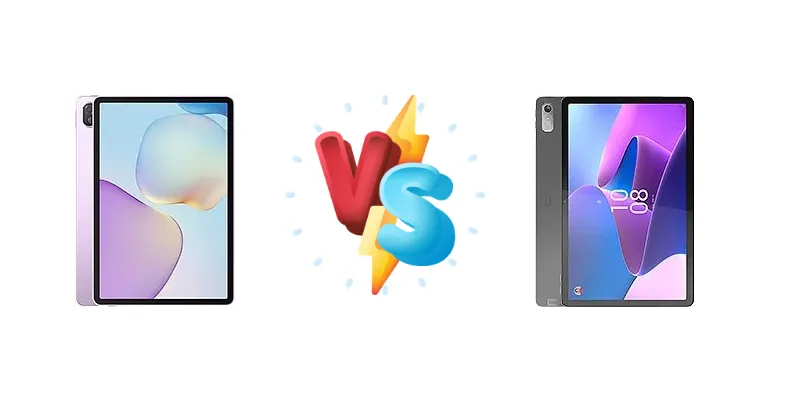
The mid-range Android tablet market is heating up. The Huawei MatePad 11.5 (2025), powered by the Kirin T82B, aims to deliver a premium experience, while the Lenovo Tab P11 Gen 2, with its MediaTek Helio G99, focuses on providing solid performance at a competitive price. This comparison dissects the key differences to help you determine which tablet best suits your needs.
🏆 Quick Verdict
For users prioritizing raw multi-core performance and potentially smoother multitasking, the Huawei MatePad 11.5 (2025) with its 12-core Kirin T82B is the better choice. However, the Lenovo Tab P11 Gen 2 offers a compelling value proposition with its efficient Helio G99, making it ideal for everyday tasks and media consumption.
| Network |
|---|
| 2G bands | N/A | GSM 850 / 900 / 1800 / 1900 |
| 3G bands | N/A | HSDPA 800 / 850 / 900 / 1700(AWS) / 1900 / 2100 |
| 4G bands | N/A | 1, 2, 3, 4, 5, 7, 8, 12, 13, 18, 19, 20, 25, 26, 28, 38, 40, 41, 66 |
| EDGE | No | - |
| GPRS | No | - |
| Speed | - | HSPA, LTE - cellular model only |
| Technology | No cellular connectivity | GSM / HSPA / LTE |
| Launch |
|---|
| Announced | 2025, July 10 | 2022, September 01 |
| Status | Available. Released 2025, July | Available. Released 2023, January |
| Body |
|---|
| Build | Glass front, aluminum frame, aluminum back | - |
| Dimensions | 262.6 x 177.5 x 6.1 mm (10.34 x 6.99 x 0.24 in) | 269.1 x 169.4 x 7.4 mm (10.59 x 6.67 x 0.29 in) |
| SIM | No | Nano-SIM (cellular model only) |
| Weight | 515 g (1.14 lb) | 520 g (1.15 lb) |
| | - | Stylus support |
| Display |
|---|
| Resolution | 1600 x 2456 pixels, 3:2 ratio (~256 ppi density) | 1200 x 2000 pixels, 5:3 ratio (~203 ppi density) |
| Size | 11.5 inches, 387.2 cm2 (~83.1% screen-to-body ratio) | 11.5 inches, 376.4 cm2 (~82.6% screen-to-body ratio) |
| Type | TFT LCD, 120Hz, 600 nits (peak) | IPS LCD, 120Hz, 400 nits (typ) |
| Platform |
|---|
| CPU | 12-core (2x2.29 GHz & 6x2.05 GHz & 4x1.31 GHz) | Octa-core (2x2.2 GHz Cortex-A76 & 6x2.0 GHz Cortex-A55) |
| Chipset | Kirin T82B | Mediatek Helio G99 (6 nm) |
| GPU | Maleoon 920c | Mali-G57 MC2 |
| OS | Harmony OS 4.3 | Android 12L |
| Memory |
|---|
| Card slot | No | microSDXC (dedicated slot) |
| Internal | 128GB 8GB RAM, 256GB 8GB RAM | 64GB 4GB RAM, 128GB 4GB RAM, 128GB 6GB RAM |
| Main Camera |
|---|
| Features | Panorama | LED flash |
| Single | 13 MP, f/1.8, (wide), AF | 13 MP, f/2.4, (wide), AF |
| Video | 1080p@30fps | 1080p@30fps |
| Selfie camera |
|---|
| Single | 8 MP, f/2.0, 105˚ (ultrawide) | 8 MP, f/2.0 |
| Video | 1080p@30fps | 1080p@30fps |
| Sound |
|---|
| 3.5mm jack | - | Yes |
| 35mm jack | No | Yes |
| Loudspeaker | Yes, with stereo speakers (4 speakers) | Yes, with stereo speakers (4 speakers) |
| Comms |
|---|
| Bluetooth | 5.2, A2DP, LE | 5.2, A2DP, LE |
| NFC | No | No |
| Positioning | No | GPS, GLONASS, BDS - cellular model only |
| Radio | No | No |
| USB | USB Type-C 2.0, OTG, magnetic accessory connector | USB Type-C 2.0, OTG, magnetic connector |
| WLAN | Wi-Fi 802.11 a/b/g/n/ac/6, dual-band | Wi-Fi 802.11 a/b/g/n/ac/6e, dual-band, Wi-Fi Direct |
| Features |
|---|
| Sensors | Accelerometer | Accelerometer, gyro, proximity |
| Battery |
|---|
| Charging | 40W wired
5W reverse wired | - |
| Type | 10100 mAh | Li-Po 7700 mAh |
| Misc |
|---|
| Colors | Violet, Space Gray | Storm Grey, Sage |
| Models | TXZ-W09 | TB350FU |
| Price | About 290 EUR | About 350 EUR |
Huawei MatePad 11.5 (2025)
- Potentially higher multi-core performance with Kirin T82B
- Faster 40W wired charging
- 5W reverse wired charging capability
- Potentially lower battery life due to less efficient chipset
- Higher price point expected
Lenovo Tab P11 Gen 2
- More power-efficient MediaTek Helio G99
- Likely longer battery life
- More affordable price
- Lower multi-core performance compared to Kirin T82B
- Slower charging speeds
Display Comparison
While display specifications are missing for both devices, the MatePad line historically focuses on high-resolution panels. The Lenovo Tab P11 Gen 2 likely utilizes an IPS LCD, common in its price bracket. The Kirin T82B’s processing power *could* support a higher refresh rate display, but this is unconfirmed. The Helio G99’s efficiency suggests a focus on maximizing battery life rather than pushing display capabilities. Color accuracy and peak brightness will be key differentiators, but require further testing.
Camera Comparison
Camera details are absent for both tablets. Given the market segment, we can expect both to feature modest camera setups primarily for video calls and casual snapshots. The presence of OIS (Optical Image Stabilization) would be a significant advantage, but is unlikely on either device. Image processing capabilities will likely be more important than sensor size, and Huawei’s history suggests a more aggressive image enhancement algorithm.
Performance
The core difference lies in the chipsets. Huawei’s Kirin T82B boasts a 12-core configuration (2x2.29 GHz, 6x2.05 GHz, 4x1.31 GHz), suggesting a focus on multi-threaded performance. This architecture, while complex, aims to handle numerous tasks concurrently. Conversely, the Lenovo Tab P11 Gen 2’s MediaTek Helio G99 is an octa-core processor (2x2.2 GHz Cortex-A76 & 6x2.0 GHz Cortex-A55) built on a more efficient 6nm process. The 6nm node of the Helio G99 translates to better power efficiency and potentially less thermal throttling during sustained loads, despite having fewer cores. The Kirin T82B’s higher core count *could* lead to faster processing in heavily parallelized tasks, but real-world performance will depend on software optimization.
Battery Life
Battery capacity is unspecified for both devices. However, the Helio G99’s 6nm process efficiency gives the Lenovo Tab P11 Gen 2 an advantage in battery life, especially during typical usage scenarios. The Huawei MatePad 11.5 (2025) offers 40W wired charging, significantly faster than what’s typically found in this price range, and 5W reverse wired charging. This faster charging mitigates the impact of potentially lower battery life, allowing for quicker top-ups. The Lenovo Tab P11 Gen 2’s charging speed is likely slower, prioritizing efficiency over rapid charging.
Buying Guide
Buy the Huawei MatePad 11.5 (2025) if you frequently engage in demanding tasks like video editing, complex spreadsheets, or running multiple apps simultaneously, and appreciate the potential for higher sustained performance. Buy the Lenovo Tab P11 Gen 2 if you prioritize affordability, long battery life for casual use, and a streamlined experience for streaming, browsing, and light gaming.
Frequently Asked Questions
❓ Will the Kirin T82B in the MatePad 11.5 (2025) struggle with demanding games like Genshin Impact?
While the Kirin T82B has a high core count, its GPU performance is unknown. Demanding games may require reduced graphics settings for smooth gameplay. The Helio G99 in the Lenovo Tab P11 Gen 2 is optimized for gaming, but may also require settings adjustments.
❓ How does the 6nm process of the Helio G99 impact real-world battery life compared to the Kirin T82B?
The 6nm process allows the Helio G99 to operate more efficiently, consuming less power for the same level of performance. This translates to longer battery life during typical usage, such as web browsing, video streaming, and social media, compared to the Kirin T82B.
❓ Is the 40W charging on the Huawei MatePad 11.5 (2025) a significant advantage?
Yes, 40W charging is considerably faster than the charging speeds typically found in tablets within this price range. It allows for a quicker top-up, minimizing downtime, even if the overall battery capacity is smaller.