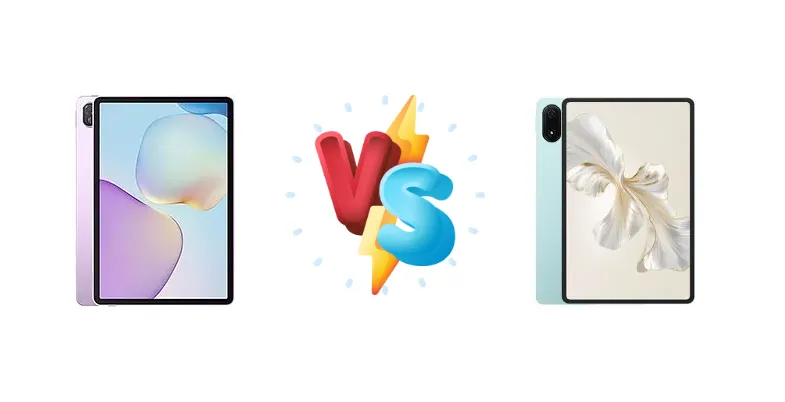
The tablet market is heating up, with both Huawei and Honor offering compelling options. The Huawei MatePad 11.5 (2025) arrives with Huawei’s in-house Kirin T82B chipset, while the Honor Pad 9 Pro leverages the proven MediaTek Dimensity 8100. This comparison dissects these two devices, focusing on performance, charging, and the user experience to determine which tablet delivers the best value.
🏆 Quick Verdict
For the average user prioritizing sustained performance and efficiency, the Honor Pad 9 Pro is the stronger choice. Its Dimensity 8100, built on a 5nm process, offers a clear advantage over the Kirin T82B in demanding tasks and gaming, despite the MatePad 11.5’s slightly faster peak CPU clock speeds.
| Network |
|---|
| 2G bands | N/A | N/A |
| 3G bands | N/A | N/A |
| 4G bands | N/A | - |
| EDGE | No | No |
| GPRS | No | No |
| Technology | No cellular connectivity | No cellular connectivity |
| Launch |
|---|
| Announced | 2025, July 10 | 2024, July 12 |
| Status | Available. Released 2025, July | Available. Released 2024, July 12 |
| Body |
|---|
| Build | Glass front, aluminum frame, aluminum back | Glass front, aluminum frame, aluminum back |
| Dimensions | 262.6 x 177.5 x 6.1 mm (10.34 x 6.99 x 0.24 in) | 277 x 179.9 x 6.6 mm (10.91 x 7.08 x 0.26 in) |
| SIM | No | No |
| Weight | 515 g (1.14 lb) | 589 g (1.30 lb) |
| Display |
|---|
| Resolution | 1600 x 2456 pixels, 3:2 ratio (~256 ppi density) | 1600 x 2560 pixels, 16:10 ratio (~249 ppi density) |
| Size | 11.5 inches, 387.2 cm2 (~83.1% screen-to-body ratio) | 12.1 inches, 424.5 cm2 (~85.2% screen-to-body ratio) |
| Type | TFT LCD, 120Hz, 600 nits (peak) | IPS LCD, 1B colors, 144Hz |
| Platform |
|---|
| CPU | 12-core (2x2.29 GHz & 6x2.05 GHz & 4x1.31 GHz) | Octa-core (4x2.85 GHz Cortex-A78 & 4x2.0 GHz Cortex-A55) |
| Chipset | Kirin T82B | Mediatek Dimensity 8100 (5 nm) |
| GPU | Maleoon 920c | Mali-G610 MC6 |
| OS | Harmony OS 4.3 | Android 14, Magic OS 8.1 |
| Memory |
|---|
| Card slot | No | No |
| Internal | 128GB 8GB RAM, 256GB 8GB RAM | 256GB 12GB RAM, 256GB 8GB RAM |
| Main Camera |
|---|
| Features | Panorama | HDR |
| Single | 13 MP, f/1.8, (wide), AF | 13 MP, f/2.0, (wide), AF |
| Video | 1080p@30fps | 4K@30fps, 1080p@30fps |
| Selfie camera |
|---|
| Single | 8 MP, f/2.0, 105˚ (ultrawide) | 5 MP, f/2.2, (wide) |
| Video | 1080p@30fps | 1080p@30fps |
| Sound |
|---|
| 35mm jack | No | No |
| Loudspeaker | Yes, with stereo speakers (4 speakers) | Yes, with stereo speakers (8 speakers) |
| Comms |
|---|
| Bluetooth | 5.2, A2DP, LE | 5.2, A2DP, LE |
| NFC | No | No |
| Positioning | No | No |
| Radio | No | No |
| USB | USB Type-C 2.0, OTG, magnetic accessory connector | USB Type-C 2.0, OTG |
| WLAN | Wi-Fi 802.11 a/b/g/n/ac/6, dual-band | Wi-Fi 802.11 a/b/g/n/ac/6, dual-band, Wi-Fi Direct |
| Features |
|---|
| Sensors | Accelerometer | Accelerometer |
| Battery |
|---|
| Charging | 40W wired
5W reverse wired | 35W wired |
| Type | 10100 mAh | Li-Po 10050 mAh |
| Misc |
|---|
| Colors | Violet, Space Gray | Sky Blue, Star Gray |
| Models | TXZ-W09 | - |
| Price | About 290 EUR | About 290 EUR |
Huawei MatePad 11.5 (2025)
- Faster 40W wired charging
- 5W reverse wired charging
- Potential HarmonyOS software optimizations
- Kirin T82B chipset less efficient than Dimensity 8100
- Potentially limited app ecosystem compared to GMS devices
Honor Pad 9 Pro
- More efficient Dimensity 8100 chipset
- Google Mobile Services support
- Likely better sustained performance
- Slightly slower 35W wired charging
- No reverse wireless charging
Display Comparison
While display specifications are missing for the MatePad 11.5, both tablets likely target a similar resolution and size class given their positioning. However, the core difference lies beneath the surface. The Dimensity 8100 in the Honor Pad 9 Pro has a dedicated display engine that can handle higher refresh rates and more complex visual processing. This translates to smoother animations and potentially better HDR performance. Without knowing the panel technology of the MatePad 11.5, it's difficult to assess its color accuracy or peak brightness, but the Honor Pad 9 Pro’s chipset gives it an edge in display capabilities.
Camera Comparison
Camera details are absent for both devices, making a direct comparison impossible. However, given the market segment, we can expect both tablets to feature capable, but not flagship-level, camera systems. The focus will likely be on video conferencing and casual photography. Without knowing sensor sizes or aperture values, it’s difficult to assess image quality. The presence of OIS (Optical Image Stabilization) would be a significant advantage, but this information is currently unavailable for either device.
Performance
The chipset is where the most significant divergence occurs. The Honor Pad 9 Pro’s MediaTek Dimensity 8100 (5nm) utilizes a more efficient architecture than the Huawei MatePad 11.5’s Kirin T82B. While the Kirin T82B boasts a 12-core configuration with higher peak clock speeds (2x2.29 GHz), the Dimensity 8100’s 4x2.85 GHz Cortex-A78 cores are based on a more advanced design. The 5nm fabrication process of the Dimensity 8100 also contributes to better thermal management, reducing the likelihood of performance throttling during extended gaming or demanding tasks. This means the Honor Pad 9 Pro will likely maintain higher sustained performance levels. The Kirin T82B’s multi-core approach may excel in heavily multi-threaded workloads, but the Dimensity 8100’s superior single-core performance and efficiency will be more noticeable in everyday use.
Battery Life
The Honor Pad 9 Pro’s 35W wired charging is slightly slower than the Huawei MatePad 11.5’s 40W wired charging. However, the Dimensity 8100’s superior power efficiency means the Honor Pad 9 Pro will likely achieve comparable, or even longer, battery life despite the lower charging wattage. The MatePad 11.5’s 5W reverse wired charging is a useful feature for topping up accessories, but the overall impact on daily usage is minimal. The efficiency of the Dimensity 8100 will likely offset the charging speed difference, providing a more consistent user experience.
Buying Guide
Buy the Huawei MatePad 11.5 (2025) if you are deeply embedded in the Huawei ecosystem and prioritize the HarmonyOS experience, potentially benefiting from optimized software features. Buy the Honor Pad 9 Pro if you prioritize raw performance, efficient power consumption for longer gaming sessions, and a more open Android experience with Google Mobile Services.
Frequently Asked Questions
❓ Will the Kirin T82B chipset struggle with graphically intensive games like Genshin Impact?
The Kirin T82B will likely be able to run Genshin Impact, but the Dimensity 8100 in the Honor Pad 9 Pro will provide a smoother experience with higher, more stable frame rates due to its more efficient architecture and superior GPU performance. Expect more noticeable throttling on the MatePad 11.5 during prolonged gaming sessions.
❓ Does the Honor Pad 9 Pro support stylus input and keyboard accessories?
Yes, the Honor Pad 9 Pro is compatible with Honor’s Magic-Pen stylus and Bluetooth keyboards, enhancing its productivity capabilities. While the MatePad 11.5 also supports styluses and keyboards, the Honor Pad 9 Pro’s overall performance advantage makes it a more compelling platform for creative tasks and multitasking.
❓ How does the lack of Google Mobile Services (GMS) on the Huawei MatePad 11.5 affect app availability?
The Huawei MatePad 11.5 relies on Huawei’s AppGallery and the ability to sideload apps. While AppGallery has grown, it still lacks some popular apps readily available on the Google Play Store. Sideloading can be cumbersome and may not always be reliable. The Honor Pad 9 Pro, with full GMS support, offers seamless access to the vast Android app ecosystem.