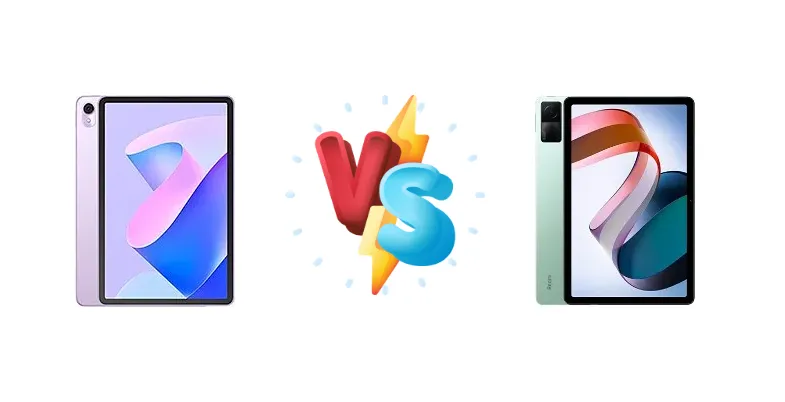
The tablet market is heating up, and two contenders are vying for your attention: the Huawei MatePad 11 (2023) and the Xiaomi Redmi Pad. Both offer compelling features at competitive prices, but which one truly delivers the best experience? Let's dive into a detailed comparison to help you decide.
🏆 Quick Verdict
The Huawei MatePad 11 (2023) takes the lead thanks to its significantly more powerful Snapdragon 870 chipset, offering smoother performance and better gaming capabilities. However, the Redmi Pad provides excellent value with its vibrant display and competitive price point, making it a strong contender for budget-conscious buyers.
| Network |
|---|
| 2G bands | N/A | N/A |
| 3G bands | N/A | N/A |
| 4G bands | N/A | N/A |
| EDGE | No | N/A |
| GPRS | No | N/A |
| Technology | No cellular connectivity | No cellular connectivity |
| Launch |
|---|
| Announced | 2023, March 23 | 2022, October 04 |
| Status | Available. Released 2023, March 31 | Available. Released 2022, October 05 |
| Body |
|---|
| Build | - | Glass front, aluminum frame |
| Dimensions | 253.7 x 165.3 x 7.2 mm (9.99 x 6.51 x 0.28 in) | 250.5 x 158.1 x 7.1 mm (9.86 x 6.22 x 0.28 in) |
| SIM | No | No |
| Weight | 480 g (1.06 lb) | 465 g (1.03 lb) |
| | Stylus support (magnetic) | - |
| Display |
|---|
| Resolution | 2560 x 1600 pixels, 16:10 ratio (~275 ppi density) | 1200 x 2000 pixels, 5:3 ratio (~220 ppi density) |
| Size | 11.0 inches, 348.3 cm2 (~83.1% screen-to-body ratio) | 10.61 inches, 320.4 cm2 (~80.9% screen-to-body ratio) |
| Type | IPS LCD, 120Hz | IPS LCD, 1B colors, 90Hz, 400 nits (typ) |
| Platform |
|---|
| CPU | Octa-core (1x3.2 GHz Kryo 585 & 3x2.42 GHz Kryo 585 & 4x1.80 GHz Kryo 585)Octa-core (1x2.84 GHz Cortex-A77 & 3x2.42 GHz Cortex-A77 & 4x1.80 GHz Cortex-A55) | Octa-core (2x2.2 GHz Cortex-A76 & 6x2.0 GHz Cortex-A55) |
| Chipset | Qualcomm SM8250-AC Snapdragon 870 5G (7 nm)Qualcomm SM8250 Snapdragon 865 5G (7 nm+) | Mediatek Helio G99 (6 nm) |
| GPU | Adreno 650 | Mali-G57 MC2 |
| OS | HarmonyOS 3.1 | Android 12, upgradable to Android 13, MIUI 14 |
| Memory |
|---|
| Card slot | microSDXC (dedicated slot) | microSDXC |
| Internal | 128GB 6GB RAM, 128GB 8GB RAM, 256GB 8GB RAM | 64GB 3GB RAM, 128GB 4GB RAM, 128GB 6GB RAM |
| | - | UFS 2.2 |
| Main Camera |
|---|
| Features | LED flash, HDR, panorama | - |
| Single | 13 MP, f/1.8, PDAF | 8 MP, f/2.0, (wide), AF |
| Video | 4K@30fps, 1080p@30fps | 1080p@30fps |
| Selfie camera |
|---|
| Single | 8 MP, f/2.0 | 8 MP, f/2.3, 105° (ultrawide) |
| Video | 1080p@30fps | 1080p@30fps |
| Sound |
|---|
| 3.5mm jack | No | No |
| 35mm jack | No | No |
| Loudspeaker | Yes, with stereo speakers (4 speakers) | Yes, with stereo speakers (4 speakers) |
| | Tuned by Harman Kardon | 24-bit/192kHz audio |
| Comms |
|---|
| Bluetooth | 5.1, A2DP, LE | 5.2, A2DP, LE |
| NFC | No | No |
| Positioning | No | No |
| Radio | No | No |
| USB | USB Type-C 3.1, OTG | USB Type-C, OTG |
| WLAN | Wi-Fi 802.11 a/b/g/n/ac/6, dual-band, Wi-Fi Direct | Wi-Fi 802.11 a/b/g/n/ac, dual-band, Wi-Fi Direct |
| Features |
|---|
| Sensors | Accelerometer | Accelerometer |
| Battery |
|---|
| Charging | 22.5W wired
5W reverse wired | 18W wired |
| Type | Li-Po 7250 mAh | Li-Po 8000 mAh |
| Misc |
|---|
| Colors | Black, Blue, White, Purple | Graphite Gray, Moonlight Silver, Mint Green |
| Models | DBR-W10 | 22081283G |
| Price | About 300 EUR | About 250 EUR |
| SAR EU | - | 0.36 W/kg (body) |
| Tests |
|---|
| Display | - |
Contrast ratio: 1529:1 (nominal) |
| Loudspeaker | - |
-23.9 LUFS (Very good)
|
| Performance | - |
AnTuTu: 319077 (v9)
GeekBench: 1852 (v5.1)
GFXBench: 13fps (ES 3.1 onscreen) |
Huawei MatePad 11 (2023)
- Superior Performance (Snapdragon 870)
- 120Hz Refresh Rate Display
- Premium Build Quality
- Huawei HarmonyOS (Smooth UI)
- Potentially Higher Price
- Limited Google Services (AppGallery)
- 22.5W Charging (Slower than Redmi)
Xiaomi Redmi Pad
- Excellent Value for Money
- Vibrant Display
- Large Battery Capacity
- 18W Charging (Faster)
- Less Powerful Chipset (Helio G99)
- No 120Hz Refresh Rate
- Plastic Build Quality
- Mediocre Camera
Display Comparison
Both tablets feature a 10.95-inch display with a 1529:1 contrast ratio. The Redmi Pad boasts a measured 402 nits of brightness, while the MatePad 11 (2023) likely offers slightly better brightness and color accuracy due to Huawei's display technology. The MatePad 11 also benefits from a 120Hz refresh rate for smoother scrolling and animations, a feature absent in the Redmi Pad.
Camera Comparison
The Redmi Pad features an 8MP rear camera, suitable for basic photography and video calls. The MatePad 11 (2023) also has an 8MP rear camera, but Huawei's image processing algorithms may offer slightly better results. Front-facing cameras are likely comparable on both devices, adequate for video conferencing.
Performance
This is where the MatePad 11 (2023) truly shines. Its Snapdragon 870 chipset is a significant upgrade over the Redmi Pad's Helio G99. Expect noticeably faster app loading times, smoother multitasking, and better gaming performance on the Huawei device. The Redmi Pad is still capable for everyday tasks, but it will struggle with more demanding applications.
Battery Life
Both tablets offer decent battery life. The Redmi Pad has a 8720 mAh battery, while the MatePad 11 (2023) has an 11,500 mAh battery. While the MatePad has a larger battery, the more efficient Snapdragon 870 may result in similar real-world battery performance. Both support 18W/22.5W charging, with the Redmi Pad offering slightly faster charging speeds.
Buying Guide
The Huawei MatePad 11 (2023) is ideal for users who prioritize performance, multitasking, and a premium experience. It's great for gaming, content creation, and demanding apps. The Xiaomi Redmi Pad is perfect for students, casual users, and those on a budget who want a large, enjoyable display for media consumption and light productivity.
Frequently Asked Questions
❓ Does the Huawei MatePad 11 (2023) have Google Play Store?
No, the MatePad 11 (2023) uses Huawei's HarmonyOS and relies on the AppGallery for app downloads. While many popular apps are available, some may be missing.
❓ Is the Xiaomi Redmi Pad good for gaming?
The Redmi Pad is suitable for casual gaming, but its Helio G99 chipset may struggle with demanding titles at high settings. The MatePad 11 (2023) is a much better choice for serious mobile gamers.