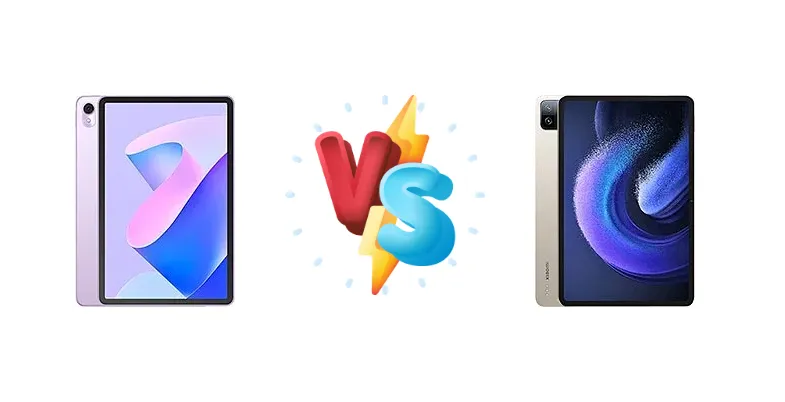
The Android tablet market is heating up, and two contenders are vying for your attention: the Huawei MatePad 11 (2023) and the Xiaomi Pad 6 Pro. Both offer compelling features and performance, but cater to slightly different needs. Let's dive into a detailed comparison to help you choose the perfect tablet.
🏆 Quick Verdict
The Xiaomi Pad 6 Pro takes the crown with its significantly faster Snapdragon 8+ Gen 1 chip, blazing-fast 67W charging, and brighter display. However, the MatePad 11 (2023) offers a more refined software experience and potentially better stylus integration for creative users.
| Network |
|---|
| 2G bands | N/A | N/A |
| 3G bands | N/A | N/A |
| 4G bands | N/A | - |
| EDGE | No | N/A |
| GPRS | No | N/A |
| Technology | No cellular connectivity | No cellular connectivity |
| Launch |
|---|
| Announced | 2023, March 23 | 2023, April 18 |
| Status | Available. Released 2023, March 31 | Available. Released 2023, April 30 |
| Body |
|---|
| Build | - | Glass front (Gorilla Glass 3), aluminum frame, aluminum back |
| Dimensions | 253.7 x 165.3 x 7.2 mm (9.99 x 6.51 x 0.28 in) | 254 x 165.2 x 6.5 mm (10.0 x 6.50 x 0.26 in) |
| SIM | No | No |
| Weight | 480 g (1.06 lb) | 490 g (1.08 lb) |
| | Stylus support (magnetic) | Stylus support (magnetic) |
| Display |
|---|
| Protection | - | Corning Gorilla Glass 3 |
| Resolution | 2560 x 1600 pixels, 16:10 ratio (~275 ppi density) | 1800 x 2880 pixels, 16:10 ratio (~309 ppi density) |
| Size | 11.0 inches, 348.3 cm2 (~83.1% screen-to-body ratio) | 11.0 inches, 350.9 cm2 (~83.6% screen-to-body ratio) |
| Type | IPS LCD, 120Hz | IPS LCD, 1B colors, 144Hz, HDR10, Dolby Vision, 550 nits |
| Platform |
|---|
| CPU | Octa-core (1x3.2 GHz Kryo 585 & 3x2.42 GHz Kryo 585 & 4x1.80 GHz Kryo 585)Octa-core (1x2.84 GHz Cortex-A77 & 3x2.42 GHz Cortex-A77 & 4x1.80 GHz Cortex-A55) | Octa-core (1x3.19 GHz Cortex-X2 & 3x2.75 GHz Cortex-A710 & 4x1.80 GHz Cortex-A510) |
| Chipset | Qualcomm SM8250-AC Snapdragon 870 5G (7 nm)Qualcomm SM8250 Snapdragon 865 5G (7 nm+) | Qualcomm SM8475 Snapdragon 8+ Gen 1 (4 nm) |
| GPU | Adreno 650 | Adreno 730 |
| OS | HarmonyOS 3.1 | Android 13, MIUI 14 |
| Memory |
|---|
| Card slot | microSDXC (dedicated slot) | No |
| Internal | 128GB 6GB RAM, 128GB 8GB RAM, 256GB 8GB RAM | 128GB 8GB RAM, 256GB 8GB RAM, 256GB 12GB RAM, 512GB 12GB RAM |
| | - | UFS 3.1 |
| Main Camera |
|---|
| Dual | - | 50 MP, f/1.8, (wide), 1/2.76", 0.64µm, PDAF
Auxiliary lens |
| Features | LED flash, HDR, panorama | Dual-LED flash, HDR, panorama |
| Single | 13 MP, f/1.8, PDAF | - |
| Video | 4K@30fps, 1080p@30fps | 4K@30/60fps, 1080p@30/60fps |
| Selfie camera |
|---|
| Single | 8 MP, f/2.0 | 20 MP, f/2.2, (wide), 1/3.4", 0.8µm |
| Video | 1080p@30fps | 1080p@30/60fps |
| Sound |
|---|
| 3.5mm jack | No | No |
| 35mm jack | No | No |
| Loudspeaker | Yes, with stereo speakers (4 speakers) | Yes, with stereo speakers (4 speakers) |
| | Tuned by Harman Kardon | 24-bit/192kHz audio |
| Comms |
|---|
| Bluetooth | 5.1, A2DP, LE | 5.3, A2DP, LE |
| NFC | No | No |
| Positioning | No | No |
| Radio | No | No |
| USB | USB Type-C 3.1, OTG | USB Type-C 3.2, accessory connector |
| WLAN | Wi-Fi 802.11 a/b/g/n/ac/6, dual-band, Wi-Fi Direct | Wi-Fi 802.11 a/b/g/n/a/6e, dual-band, Wi-Fi Direct |
| Features |
|---|
| Sensors | Accelerometer | Accelerometer, gyro, proximity (accessories only) |
| Battery |
|---|
| Charging | 22.5W wired
5W reverse wired | 67W wired, PD3.0, QC4, 100% in 1 hour |
| Type | Li-Po 7250 mAh | Li-Po 8600 mAh |
| Misc |
|---|
| Colors | Black, Blue, White, Purple | Black, Blue, Gold |
| Models | DBR-W10 | 23046RP50C |
| Price | About 300 EUR | About 330 EUR |
Huawei MatePad 11 (2023)
- Smooth HarmonyOS experience
- Good stylus integration (with optional stylus)
- Solid build quality
- Decent performance
- Slower charging speed
- Less powerful chipset than Xiaomi Pad 6 Pro
- Limited app availability compared to Google Play Store
Xiaomi Pad 6 Pro
- Blazing-fast Snapdragon 8+ Gen 1 chipset
- Ultra-fast 67W charging
- Bright and smooth 144Hz display
- Excellent value for money
- MIUI can be a bit bloated
- Stylus support is less integrated than Huawei
- No Google Play Store (relies on Xiaomi's app store)
Display Comparison
Both tablets feature excellent 11-inch displays. The Xiaomi Pad 6 Pro boasts a brighter 144Hz LCD panel, offering smoother visuals and a more immersive experience, particularly for gaming. The MatePad 11 (2023) has a 120Hz LCD, which is still very good, but lacks the peak brightness of the Xiaomi. Color accuracy is generally good on both.
Camera Comparison
Camera performance is generally not a primary concern for tablets. Both devices offer decent cameras for video calls and casual snapshots. The Xiaomi Pad 6 Pro likely has a slight edge in image quality due to its newer hardware, but the difference is minimal. Expect 13MP rear cameras on both.
Performance
The Xiaomi Pad 6 Pro's Snapdragon 8+ Gen 1 is a clear winner here. It delivers significantly faster processing speeds and handles demanding tasks and games with ease. The MatePad 11 (2023)'s Snapdragon 870/865 is still capable, but noticeably slower in comparison. Expect smoother multitasking and quicker app loading on the Xiaomi.
Battery Life
The Xiaomi Pad 6 Pro's 67W charging is a game-changer, allowing for a full charge in under an hour. The MatePad 11 (2023)'s 22.5W charging is considerably slower. Battery capacity is similar (around 8840mAh), so the Xiaomi's faster charging gives it a significant advantage in real-world usage.
Buying Guide
The Huawei MatePad 11 (2023) is ideal for users who prioritize a smooth, streamlined software experience, appreciate Huawei's ecosystem, and value stylus integration for note-taking and drawing. The Xiaomi Pad 6 Pro is the better choice for those seeking raw performance, rapid charging, and a vibrant display, especially for media consumption and gaming.
Frequently Asked Questions
❓ Does the Huawei MatePad 11 (2023) have Google Play Store?
No, the Huawei MatePad 11 (2023) uses Huawei's AppGallery and Huawei Mobile Services. While many popular apps are available, it doesn't have full Google Play Store compatibility.
❓ What is the difference between the Snapdragon 870 and Snapdragon 8+ Gen 1?
The Snapdragon 8+ Gen 1 is a significantly faster and more efficient chipset than the Snapdragon 870. It offers improved CPU and GPU performance, resulting in a smoother and more responsive user experience.