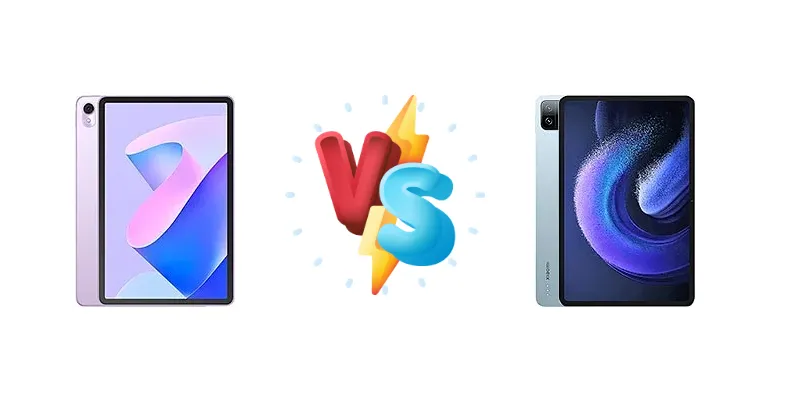
The Android tablet market is heating up, and two contenders are vying for your attention: the Huawei MatePad 11 (2023) and the Xiaomi Pad 6. Both offer impressive specs and features, but which one truly delivers the best experience? Let's dive into a detailed comparison to help you make the right choice.
🏆 Quick Verdict
The Xiaomi Pad 6 edges out the MatePad 11 (2023) thanks to its faster charging, slightly better display brightness, and competitive price. However, the MatePad 11's HarmonyOS and potential stylus integration offer a unique appeal for some users.
| Network |
|---|
| 2G bands | N/A | N/A |
| 3G bands | N/A | N/A |
| 4G bands | N/A | - |
| EDGE | No | N/A |
| GPRS | No | N/A |
| Technology | No cellular connectivity | No cellular connectivity |
| Launch |
|---|
| Announced | 2023, March 23 | 2023, April 18 |
| Status | Available. Released 2023, March 31 | Available. Released 2023, April 18 |
| Body |
|---|
| Build | - | Glass front (Gorilla Glass 3), aluminum frame, aluminum back |
| Dimensions | 253.7 x 165.3 x 7.2 mm (9.99 x 6.51 x 0.28 in) | 254 x 165.2 x 6.5 mm (10.0 x 6.50 x 0.26 in) |
| SIM | No | No |
| Weight | 480 g (1.06 lb) | 490 g (1.08 lb) |
| | Stylus support (magnetic) | Stylus support (magnetic) |
| Display |
|---|
| Protection | - | Corning Gorilla Glass 3 |
| Resolution | 2560 x 1600 pixels, 16:10 ratio (~275 ppi density) | 1800 x 2880 pixels, 16:10 ratio (~309 ppi density) |
| Size | 11.0 inches, 348.3 cm2 (~83.1% screen-to-body ratio) | 11.0 inches, 350.9 cm2 (~83.6% screen-to-body ratio) |
| Type | IPS LCD, 120Hz | IPS LCD, 1B colors, 144Hz, HDR10, Dolby Vision, 550 nits |
| Platform |
|---|
| CPU | Octa-core (1x3.2 GHz Kryo 585 & 3x2.42 GHz Kryo 585 & 4x1.80 GHz Kryo 585)Octa-core (1x2.84 GHz Cortex-A77 & 3x2.42 GHz Cortex-A77 & 4x1.80 GHz Cortex-A55) | Octa-core (1x3.2 GHz Kryo 585 & 3x2.42 GHz Kryo 585 & 4x1.80 GHz Kryo 585) |
| Chipset | Qualcomm SM8250-AC Snapdragon 870 5G (7 nm)Qualcomm SM8250 Snapdragon 865 5G (7 nm+) | Qualcomm SM8250-AC Snapdragon 870 5G (7 nm) |
| GPU | Adreno 650 | Adreno 650 |
| OS | HarmonyOS 3.1 | Android 13, MIUI Pad 14 |
| Memory |
|---|
| Card slot | microSDXC (dedicated slot) | No |
| Internal | 128GB 6GB RAM, 128GB 8GB RAM, 256GB 8GB RAM | 128GB 6GB RAM, 128GB 8GB RAM, 256GB 8GB RAM |
| | - | UFS 3.1 |
| Main Camera |
|---|
| Features | LED flash, HDR, panorama | Dual-LED flash, HDR, panorama |
| Single | 13 MP, f/1.8, PDAF | 13 MP, f/2.2, PDAF |
| Video | 4K@30fps, 1080p@30fps | 4K@30fps, 1080p@30/60fps |
| Selfie camera |
|---|
| Single | 8 MP, f/2.0 | 8 MP, f/2.2, 1/4.0", 1.12µm |
| Video | 1080p@30fps | 1080p@30fps |
| Sound |
|---|
| 3.5mm jack | No | No |
| 35mm jack | No | No |
| Loudspeaker | Yes, with stereo speakers (4 speakers) | Yes, with stereo speakers (4 speakers) |
| | Tuned by Harman Kardon | 24-bit/192kHz audio |
| Comms |
|---|
| Bluetooth | 5.1, A2DP, LE | 5.2, A2DP, LE |
| NFC | No | No |
| Positioning | No | Unspecified |
| Radio | No | No |
| USB | USB Type-C 3.1, OTG | USB Type-C 3.2, accessory connector |
| WLAN | Wi-Fi 802.11 a/b/g/n/ac/6, dual-band, Wi-Fi Direct | Wi-Fi 802.11 a/b/g/n/a/6, dual-band, Wi-Fi Direct |
| Features |
|---|
| Sensors | Accelerometer | Accelerometer, gyro, proximity (accessories only) |
| Battery |
|---|
| Charging | 22.5W wired
5W reverse wired | 33W wired, PD3.0, QC4 |
| Type | Li-Po 7250 mAh | Li-Po 8840 mAh |
| Misc |
|---|
| Colors | Black, Blue, White, Purple | Black, Blue, Gold |
| Models | DBR-W10 | 23043RP34C, 23043RP34G, 23043RP34I |
| Price | About 300 EUR | About 400 EUR |
Huawei MatePad 11 (2023)
- HarmonyOS offers unique features
- Potential stylus support (sold separately)
- Good performance with Snapdragon 870
- Sleek design
- Slower charging speed
- Limited app availability compared to Google Play Store
- Price can be higher than Xiaomi Pad 6
Xiaomi Pad 6
- Faster 33W charging
- Brighter and more vibrant display
- Competitive price
- Excellent performance with Snapdragon 870
- MIUI can be a bit bloated
- Stylus support not included
- Less integrated ecosystem compared to Huawei
Display Comparison
Both tablets feature 11-inch LCD displays with a 120Hz refresh rate, offering smooth visuals. The Xiaomi Pad 6 boasts a measured 500 nits of brightness and a 1060:1 contrast ratio, slightly exceeding the MatePad 11's reported specs. While both are good, the Xiaomi Pad 6 has a slight edge in visual fidelity.
Camera Comparison
Camera quality is often secondary on tablets. The MatePad 11 (2023) typically features a 13MP rear camera and a 8MP front camera. The Xiaomi Pad 6 generally has a 13MP rear camera and an 8MP front camera. Image quality is comparable, suitable for casual snapshots and video calls.
Performance
Both devices are powered by the Snapdragon 870 5G chipset, ensuring snappy performance for everyday tasks and gaming. The MatePad 11 (2023) has two CPU variants, one with Cortex-A77 cores and the other with Kryo 585 cores. Both offer similar performance. Expect smooth multitasking and responsive app loading on both.
Battery Life
The Xiaomi Pad 6 shines in this category, boasting an active use score of 9:39 hours. The MatePad 11 (2023) offers good battery life, but falls slightly short. The Xiaomi Pad 6's 33W fast charging is also a significant advantage over the MatePad 11's 22.5W charging.
Buying Guide
The Huawei MatePad 11 (2023) is ideal for users deeply invested in the Huawei ecosystem, those who value stylus support (sold separately), and appreciate HarmonyOS. The Xiaomi Pad 6 is a great choice for those seeking a well-rounded, high-performance tablet at a competitive price, prioritizing fast charging and a vibrant display.
Frequently Asked Questions
❓ Does the Huawei MatePad 11 (2023) support a stylus?
Yes, it supports the Huawei M-Pencil (sold separately), offering a natural writing and drawing experience.
❓ Is the Xiaomi Pad 6 compatible with Google Play Store?
Yes, the Xiaomi Pad 6 runs MIUI, which is based on Android and supports Google Play Store.