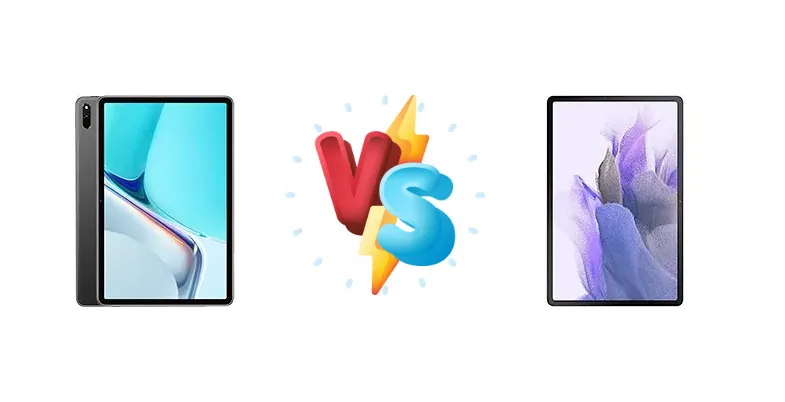
The mid-range tablet market is fiercely competitive, and the Huawei MatePad 11 (2021) and Samsung Galaxy Tab S7 FE represent compelling options. The MatePad 11, powered by the Snapdragon 865, aims for near-flagship performance, while the Tab S7 FE prioritizes a larger display and broader feature set, available in both 5G and Wi-Fi variants. This comparison dissects their strengths and weaknesses to determine which tablet delivers the best value.
🏆 Quick Verdict
For users prioritizing raw performance and a smoother 120Hz display, the Huawei MatePad 11 is the clear winner. However, the Samsung Galaxy Tab S7 FE offers a larger screen, faster charging, and the convenience of 5G connectivity (on select models), making it a better all-rounder for casual users and those needing mobile data.
| Network |
|---|
| 2G bands | N/A | GSM 850 / 900 / 1800 / 1900 |
| 3G bands | N/A | HSDPA 850 / 900 / 1700(AWS) / 1900 / 2100 |
| 4G bands | N/A | 1, 2, 3, 4, 5, 7, 8, 12, 13, 17, 20, 25, 26, 28, 32, 38, 40, 41, 66 |
| 5G bands | - | 1, 3, 5, 7, 8, 20, 28, 38, 40, 41, 77, 78 SA/NSA/Sub6 |
| EDGE | No | - |
| GPRS | No | - |
| Speed | - | HSPA, LTE, 5G - cellular model only |
| Technology | No cellular connectivity | GSM / HSPA / LTE / 5G |
| Launch |
|---|
| Announced | 2021, June 02 | 2021, May 25 |
| Status | Available. Released 2021, July 13 | Available. Released 2021, June 18 |
| Body |
|---|
| Build | - | Glass front, aluminum back, aluminum frame |
| Dimensions | 253.8 x 165.3 x 7.3 mm (9.99 x 6.51 x 0.29 in) | 284.8 x 185 x 6.3 mm (11.21 x 7.28 x 0.25 in) |
| SIM | No | Nano-SIM (cellular model only) |
| Weight | 485 g (1.07 lb) | 608 g (1.34 lb) |
| | Stylus support (magnetic) | Stylus support |
| Display |
|---|
| Resolution | 2560 x 1600 pixels, 16:10 ratio (~276 ppi density) | 1600 x 2560 pixels, 16:10 ratio (~243 ppi density) |
| Size | 10.95 inches, 347.7 cm2 (~82.9% screen-to-body ratio) | 12.4 inches, 445.8 cm2 (~84.6% screen-to-body ratio) |
| Type | IPS LCD, 120Hz | TFT LCD |
| Platform |
|---|
| CPU | Octa-core (1x2.84 GHz Cortex-A77 & 3x2.42 GHz Cortex-A77 & 4x1.80 GHz Cortex-A55) | Octa-core (2x2.2 GHz Kryo 570 & 6x1.8 GHz Kryo 570) - 5G modelOcta-core (1x2.4 GHz Cortex-A78 & 3x2.2 GHz Cortex-A78 & 4x1.9 GHz Cortex-A55) - Wi-Fi model |
| Chipset | Qualcomm SM8250 Snapdragon 865 (7 nm+) | Qualcomm SM7225 Snapdragon 750G 5G (8 nm) - 5G modelQualcomm SM7325 Snapdragon 778G 5G (6 nm) - Wi-Fi model |
| GPU | Adreno 650 | Adreno 619 - 5G modelAdreno 642L - Wi-Fi model |
| OS | HarmonyOS 2.0, upgradable to 3.0 | Android 11, upgradable to Android 14, One UI 6 |
| Memory |
|---|
| Card slot | microSDXC (dedicated slot) | microSDXC (dedicated slot) |
| Internal | 64GB 6GB RAM, 128GB 6GB RAM, 128GB 8GB RAM, 256GB 6GB RAM, 256GB 8GB RAM | 64GB 4GB RAM, 128GB 6GB RAM, 256GB 8GB RAM |
| Main Camera |
|---|
| Features | LED flash, HDR, panorama | - |
| Single | 13 MP, f/1.8, PDAF | 8 MP, AF |
| Video | 4K@30fps, 1080p@30fps | 1080p@30fps |
| Selfie camera |
|---|
| Single | 8 MP, f/2.0 | 5 MP |
| Video | 1080p@30fps | 1080p@30fps |
| Sound |
|---|
| 3.5mm jack | No | No |
| 35mm jack | No | No |
| Loudspeaker | Yes, with stereo speakers (4 speakers) | Yes, with stereo speakers |
| | Tuned by Harman Kardon | Tuned by AKG |
| Comms |
|---|
| Bluetooth | 5.1, A2DP, LE | 5.2, A2DP, LE (Wi-Fi), 5.2, A2DP, LE (5G) |
| NFC | No | No |
| Positioning | GPS | GPS, GLONASS, BDS, GALILEO - cellular model only |
| Radio | No | No |
| USB | USB Type-C 3.1, OTG | USB Type-C 3.2, magnetic connector |
| WLAN | Wi-Fi 802.11 a/b/g/n/ac/6, dual-band, Wi-Fi Direct | Wi-Fi 802.11 a/b/g/n/ac/6 (Wi-Fi), Wi-Fi 802.11 a/b/g/n/ac (5G) |
| Features |
|---|
| Sensors | Accelerometer, gyro, proximity, compass | Accelerometer, proximity, compass, gyro (5G model only) |
| | - | Samsung DeX |
| Battery |
|---|
| Charging | 22.5W wired
5W reverse wired | 45W wired, 100% in 190 min |
| Type | Li-Po 7250 mAh | Li-Po 10090 mAh |
| Misc |
|---|
| Colors | Matte Gray | Mystic Black, Mystic Silver, Mystic Green, Mystic Pink |
| Models | DBY-W09 | SM-T730, SM-T733, SM-T736B, SM-T735 |
| Price | About 400 EUR | About 650 EUR |
| SAR EU | - | 1.15 W/kg (body) |
| Tests |
|---|
| Display |
Contrast ratio: 1200:1 | Contrast ratio: 1886:1 (nominal) |
| Loudspeaker |
-21.1 LUFS (Excellent)
| -27.2 LUFS (Good) |
| Performance | - | AnTuTu: 292530 (v8), 355430 (v9)
GeekBench: 1904 (v5.1)
GFXBench: 9.7fps (ES 3.1 onscreen) |
Huawei MatePad 11 (2021)
- Superior processing power with Snapdragon 865
- Smoother 120Hz display for enhanced responsiveness
- More capable for demanding games and applications
- Slower charging speed (22.5W)
- Lower display contrast ratio
- Limited camera capabilities
Samsung Galaxy Tab S7 FE
- Larger display for immersive media consumption
- Faster 45W charging for quicker top-ups
- Available with 5G connectivity (select models)
- Less powerful processor (Snapdragon 750G/778G)
- Lower display contrast ratio
- Performance throttling under sustained load
Display Comparison
Both tablets feature LCD panels, but differ significantly in contrast and brightness. The Samsung Galaxy Tab S7 FE boasts a measured peak brightness of 522 nits, slightly exceeding the MatePad 11’s 497 nits, offering a marginally brighter viewing experience. However, the Tab S7 FE’s 1886:1 contrast ratio is notably higher than the MatePad 11’s 1200:1, resulting in deeper blacks and a more vibrant image. The Tab S7 FE’s larger screen size is also a significant advantage for multitasking and media consumption. While neither display utilizes advanced technologies like LTPO, the Tab S7 FE’s superior contrast provides a more visually appealing experience.
Camera Comparison
Neither tablet excels in the camera department, but the Tab S7 FE’s camera setup is slightly more versatile. While detailed sensor information is limited, the Tab S7 FE’s inclusion of a wider range of lenses (often including an ultrawide) provides more shooting options. The MatePad 11’s camera is adequate for basic video calls and casual snapshots, but it won’t compete with dedicated cameras. Focusing on the primary sensor, the Tab S7 FE likely benefits from Samsung’s image processing algorithms, resulting in more pleasing images in various lighting conditions. The presence of OIS (Optical Image Stabilization) on the Tab S7 FE, if equipped, would further enhance image quality.
Performance
The performance gap is the most significant differentiator. The Huawei MatePad 11 utilizes the Qualcomm Snapdragon 865 (7nm+), a flagship-level chipset from 2020, featuring an octa-core CPU with a prime Cortex-A77 core clocked at 2.84 GHz. The Samsung Galaxy Tab S7 FE, conversely, comes in two configurations: a 5G model with the Snapdragon 750G (8nm) and a Wi-Fi model with the Snapdragon 778G (6nm). The Snapdragon 778G in the Wi-Fi Tab S7 FE offers a substantial improvement over the 750G, but still falls short of the 865’s raw processing power. The 6nm process node of the 778G provides better efficiency, but the 865’s architecture and higher clock speeds give the MatePad 11 a clear edge in demanding applications. The MatePad 11 will exhibit less throttling during sustained workloads.
Battery Life
The Samsung Galaxy Tab S7 FE’s 45W wired charging is a significant advantage, achieving a full charge in approximately 190 minutes. The Huawei MatePad 11 is limited to 22.5W charging, resulting in a considerably longer charging time. While battery capacity isn’t specified, the Tab S7 FE’s larger size likely accommodates a larger battery. The Snapdragon 778G’s efficiency in the Wi-Fi Tab S7 FE also contributes to better battery life compared to the more power-hungry Snapdragon 865 in the MatePad 11. The MatePad 11 does offer 5W reverse wired charging, a niche feature for topping up accessories, but the Tab S7 FE’s faster charging is more impactful for everyday use.
Buying Guide
Buy the Huawei MatePad 11 (2021) if you need a tablet capable of handling demanding tasks like gaming and video editing, and value a responsive 120Hz display. Buy the Samsung Galaxy Tab S7 FE if you prefer a larger screen for media consumption and note-taking, require 5G connectivity for on-the-go productivity, or prioritize faster charging speeds over peak performance.
Frequently Asked Questions
❓ Does the Snapdragon 778G in the Wi-Fi Tab S7 FE offer a significant performance boost over the 750G in the 5G model?
Yes, the Snapdragon 778G represents a substantial upgrade over the 750G. It features a more powerful CPU and GPU, resulting in noticeably smoother performance in games and demanding applications. While still not matching the Snapdragon 865 in the MatePad 11, the 778G provides a much more enjoyable experience than the 750G.
❓ Is the 120Hz display on the Huawei MatePad 11 noticeable in everyday use?
Absolutely. The 120Hz refresh rate makes scrolling, animations, and gaming feel significantly smoother and more responsive compared to the standard 60Hz display on the Tab S7 FE. This is particularly noticeable when browsing the web, playing fast-paced games, or using the tablet for creative tasks.
❓ How does the lack of Google Mobile Services (GMS) on the Huawei MatePad 11 affect the user experience?
The MatePad 11 runs on Huawei’s HarmonyOS and lacks native GMS support. This means you won’t have direct access to the Google Play Store and apps like Gmail, YouTube, and Google Maps. However, Huawei’s AppGallery offers a growing selection of apps, and workarounds like using the Aurora Store or sideloading apps are available, though they may require some technical expertise.