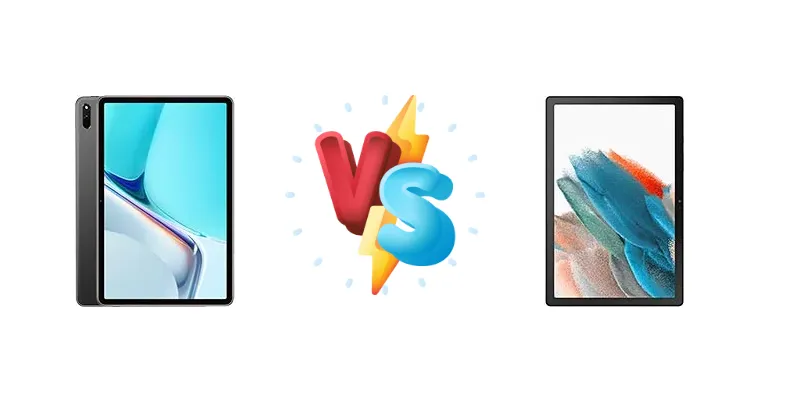
The tablet market offers a wide range of options, but finding the right balance between price and performance can be challenging. We pit the Huawei MatePad 11 (2021), powered by a flagship-tier Snapdragon 865, against the more affordable Samsung Galaxy Tab A8 10.5 (2021) with its Unisoc Tiger T618 chipset. This comparison will dissect their key differences to help you determine which tablet best suits your needs.
🏆 Quick Verdict
For users prioritizing performance and a superior display, the Huawei MatePad 11 is the clear winner. Its Snapdragon 865 chipset delivers a significantly smoother experience for demanding tasks and gaming. While the Galaxy Tab A8 offers a more budget-friendly entry point, it compromises heavily on processing power.
| Network |
|---|
| 2G bands | N/A | GSM 850 / 900 / 1800 / 1900 |
| 3G bands | N/A | HSDPA 850 / 900 / 1700(AWS) / 1900 / 2100 |
| 4G bands | N/A | 1, 2, 3, 4, 5, 7, 8, 12, 17, 20, 28, 38, 40, 41, 66 |
| EDGE | No | - |
| GPRS | No | - |
| Speed | - | HSPA, LTE - cellular model only |
| Technology | No cellular connectivity | GSM / HSPA / LTE |
| Launch |
|---|
| Announced | 2021, June 02 | 2021, December 15 |
| Status | Available. Released 2021, July 13 | Available. Released 2022, January 17 |
| Body |
|---|
| Dimensions | 253.8 x 165.3 x 7.3 mm (9.99 x 6.51 x 0.29 in) | 246.8 x 161.9 x 6.9 mm (9.72 x 6.37 x 0.27 in) |
| SIM | No | Nano-SIM (cellular model only) |
| Weight | 485 g (1.07 lb) | 508 g (1.12 lb) |
| | Stylus support (magnetic) | - |
| Display |
|---|
| Resolution | 2560 x 1600 pixels, 16:10 ratio (~276 ppi density) | 1200 x 1920 pixels, 16:10 ratio (~216 ppi density) |
| Size | 10.95 inches, 347.7 cm2 (~82.9% screen-to-body ratio) | 10.5 inches, 319.7 cm2 (~80.0% screen-to-body ratio) |
| Type | IPS LCD, 120Hz | TFT LCD |
| Platform |
|---|
| CPU | Octa-core (1x2.84 GHz Cortex-A77 & 3x2.42 GHz Cortex-A77 & 4x1.80 GHz Cortex-A55) | Octa-core (2x2.0 GHz Cortex-A75 & 6x2.0 GHz Cortex-A55) |
| Chipset | Qualcomm SM8250 Snapdragon 865 (7 nm+) | Unisoc Tiger T618 (12 nm) |
| GPU | Adreno 650 | Mali G52 MP2 |
| OS | HarmonyOS 2.0, upgradable to 3.0 | Android 11, upgradable to Android 14, One UI 6 |
| Memory |
|---|
| Card slot | microSDXC (dedicated slot) | microSDXC (dedicated slot) |
| Internal | 64GB 6GB RAM, 128GB 6GB RAM, 128GB 8GB RAM, 256GB 6GB RAM, 256GB 8GB RAM | 32GB 2GB RAM, 32GB 3GB RAM, 64GB 2GB RAM, 64GB 3GB RAM, 64GB 4GB RAM, 128GB 3GB RAM, 128GB 4GB RAM |
| Main Camera |
|---|
| Features | LED flash, HDR, panorama | - |
| Single | 13 MP, f/1.8, PDAF | 8 MP, AF |
| Video | 4K@30fps, 1080p@30fps | 1080p@30fps |
| Selfie camera |
|---|
| Single | 8 MP, f/2.0 | 5 MP |
| Video | 1080p@30fps | 1080p@30fps |
| Sound |
|---|
| 3.5mm jack | No | Yes |
| 35mm jack | No | Yes |
| Loudspeaker | Yes, with stereo speakers (4 speakers) | Yes, with stereo speakers (4 speakers) |
| | Tuned by Harman Kardon | - |
| Comms |
|---|
| Bluetooth | 5.1, A2DP, LE | 5.0, A2DP, LE |
| NFC | No | No |
| Positioning | GPS | GPS, GLONASS, BDS, GALILEO, QZSS - cellular model only |
| Radio | No | No |
| USB | USB Type-C 3.1, OTG | USB Type-C 2.0 |
| WLAN | Wi-Fi 802.11 a/b/g/n/ac/6, dual-band, Wi-Fi Direct | Wi-Fi 802.11 a/b/g/n/ac, dual-band, Wi-Fi Direct |
| Features |
|---|
| Sensors | Accelerometer, gyro, proximity, compass | Accelerometer, gyro, proximity, compass |
| Battery |
|---|
| Charging | 22.5W wired
5W reverse wired | 15W wired |
| Type | Li-Po 7250 mAh | Li-Po 7040 mAh |
| Misc |
|---|
| Colors | Matte Gray | Gray, Silver, Pink Gold |
| Models | DBY-W09 | SM-X200, SM-X205 |
| Price | About 400 EUR | About 230 EUR |
| SAR EU | - | 0.92 W/kg (body) |
| Tests |
|---|
| Display |
Contrast ratio: 1200:1 | - |
| Loudspeaker |
-21.1 LUFS (Excellent)
| - |
Huawei MatePad 11 (2021)
- Significantly faster processor for demanding tasks
- Brighter and higher contrast display for better viewing
- Faster charging speeds (22.5W)
- Reverse wired charging capability
- Potentially higher price point
- Huawei Mobile Services (HMS) ecosystem instead of Google Play Services (may require sideloading)
Samsung Galaxy Tab A8 10.5 (2021)
- More affordable price
- Familiar Android experience with Google Play Services
- Lightweight and portable design
- Decent battery life for basic tasks
- Significantly slower processor
- Lower display quality (brightness and contrast)
- Slower charging speeds (15W)
- Limited multitasking capabilities
Display Comparison
The Huawei MatePad 11 boasts a superior display experience, starting with its measured peak brightness of 497 nits, which will provide better visibility in brighter environments compared to the Tab A8 (brightness data unavailable). While both tablets feature a 10.5-inch display size, the MatePad 11’s 1200:1 contrast ratio suggests deeper blacks and more vibrant colors. The Tab A8’s display specifications are less detailed, indicating a likely lower contrast ratio and potentially less accurate color reproduction. The absence of refresh rate information for the Tab A8 further highlights the MatePad 11’s advantage, as a smoother display contributes to a more fluid user experience.
Camera Comparison
Camera performance isn't a primary focus for most tablet users, but the MatePad 11 likely holds an advantage due to its more powerful image signal processor (ISP) integrated within the Snapdragon 865. While specific camera specs are unavailable for both devices, the processing power of the Snapdragon 865 will allow for better image noise reduction and dynamic range. The Tab A8’s Unisoc chipset lacks the advanced imaging capabilities of Qualcomm’s offering. It's reasonable to assume both tablets feature basic camera setups suitable for casual snapshots and video calls.
Performance
The core difference between these tablets lies in their chipsets. The Huawei MatePad 11’s Qualcomm Snapdragon 865 (7nm+) is a flagship-level processor from 2020, featuring an octa-core configuration with a prime Cortex-A77 core clocked at 2.84 GHz. This is a substantial leap over the Samsung Galaxy Tab A8’s Unisoc Tiger T618 (12nm). The T618, while an octa-core processor, utilizes less powerful Cortex-A75 cores clocked at 2.0 GHz. The 7nm manufacturing process of the Snapdragon 865 also provides better power efficiency and thermal performance, meaning the MatePad 11 is less likely to throttle under sustained load. This translates to a significantly faster and more responsive experience for the MatePad 11, especially in demanding applications and games.
Battery Life
The Huawei MatePad 11 supports 22.5W wired charging, alongside 5W reverse wired charging, offering faster replenishment compared to the Galaxy Tab A8’s 15W wired charging. While battery capacity isn’t specified for either device, the more efficient Snapdragon 865 in the MatePad 11 could potentially offset a smaller battery capacity, providing comparable or even better real-world battery life. The faster charging speed of the MatePad 11 is a significant convenience factor for users who rely on their tablet throughout the day.
Buying Guide
Buy the Huawei MatePad 11 (2021) if you need a tablet capable of handling demanding applications, multitasking, and gaming without slowdowns. It’s ideal for professionals who require a portable workstation or users who enjoy graphically intensive games. Buy the Samsung Galaxy Tab A8 10.5 (2021) if you prioritize affordability and primarily need a tablet for basic tasks like web browsing, video streaming, and light productivity – accepting a noticeable performance trade-off.
Frequently Asked Questions
❓ Does the Huawei MatePad 11's lack of Google Play Services significantly impact usability?
The MatePad 11 utilizes Huawei Mobile Services (HMS) instead of Google Play Services. While HMS has a growing app ecosystem, some Google apps may require sideloading or using web versions. Huawei provides solutions like the AppGallery and Petal Search to help users find and install apps, but the experience isn't identical to a standard Android tablet.
❓ Is the Unisoc Tiger T618 in the Galaxy Tab A8 sufficient for everyday tasks like email and web browsing?
Yes, the Unisoc Tiger T618 is adequate for basic tasks like email, web browsing, and video streaming. However, it will struggle with demanding applications, multitasking, and graphically intensive games. Expect noticeable slowdowns and lag when running multiple apps simultaneously.
❓ How does the Snapdragon 865 in the MatePad 11 handle gaming?
The Snapdragon 865 provides a smooth gaming experience on the MatePad 11, capable of running most popular mobile games at high settings. While it's not the latest flagship chipset, it still offers substantial processing power and a capable GPU for enjoyable gaming sessions.
❓ What is reverse wired charging and how useful is the 5W capability on the MatePad 11?
Reverse wired charging allows the MatePad 11 to act as a power bank for other devices, like smartphones or earbuds, using the USB-C port. The 5W output is relatively slow, so it's best suited for emergency top-ups rather than fully charging another device. It's a convenient feature to have, but not a primary reason to purchase the tablet.