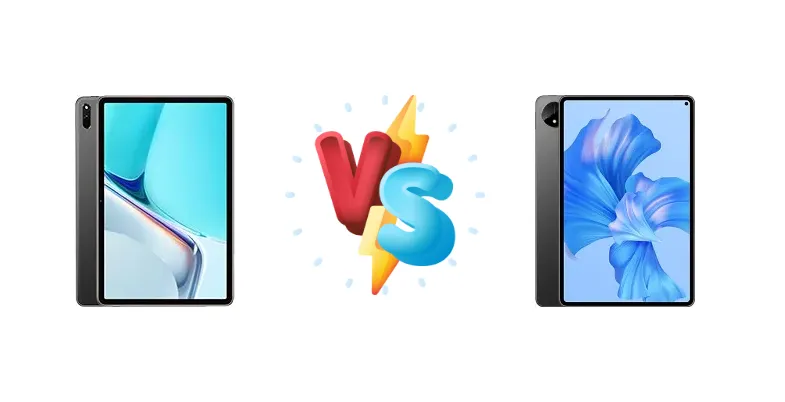
The Huawei MatePad series has consistently delivered impressive Android tablets, but the 2021 MatePad 11 and the 2022 MatePad Pro 11 offer distinct upgrades. Choosing between them can be tricky. This comprehensive comparison will dissect their features, performance, and value to help you make the right decision.
🏆 Quick Verdict
The MatePad Pro 11 (2022) generally wins thanks to its brighter display, faster chipset options (especially the 888 variant), significantly faster charging, and potentially improved camera system. However, the MatePad 11 (2021) remains a compelling option for budget-conscious buyers seeking solid performance and a great screen.
| Network |
|---|
| 2G bands | N/A | GSM 850 / 900 / 1800 / 1900 |
| 3G bands | N/A | HSDPA 800 / 850 / 900 / 1700(AWS) / 1900 / 2100 |
| 4G bands | N/A | LTE |
| EDGE | No | - |
| GPRS | No | - |
| Speed | - | HSPA, LTE - cellular model only |
| Technology | No cellular connectivity | GSM / HSPA / LTE |
| Launch |
|---|
| Announced | 2021, June 02 | 2022, July 27 |
| Status | Available. Released 2021, July 13 | Available. Released 2022, August 10 |
| Body |
|---|
| Dimensions | 253.8 x 165.3 x 7.3 mm (9.99 x 6.51 x 0.29 in) | 249.2 x 160.4 x 5.9 mm (9.81 x 6.31 x 0.23 in) |
| SIM | No | Nano-SIM (cellular model only) |
| Weight | 485 g (1.07 lb) | 449 g (455 g cellular model) (15.84 oz) |
| | Stylus support (magnetic) | Stylus support |
| Display |
|---|
| Resolution | 2560 x 1600 pixels, 16:10 ratio (~276 ppi density) | 2560 x 1600 pixels, 16:10 ratio (~274 ppi density) |
| Size | 10.95 inches, 347.7 cm2 (~82.9% screen-to-body ratio) | 11.0 inches, 350.9 cm2 (~87.8% screen-to-body ratio) |
| Type | IPS LCD, 120Hz | OLED, 1B colors, 120Hz, 600 nits (typ) |
| Platform |
|---|
| CPU | Octa-core (1x2.84 GHz Cortex-A77 & 3x2.42 GHz Cortex-A77 & 4x1.80 GHz Cortex-A55) | Octa-core (1x3.2 GHz Kryo 585 & 3x2.42 GHz Kryo 585 & 4x1.80 GHz Kryo 585) - GOT-W29Octa-core (1x2.84 GHz Cortex-X1 & 3x2.42 GHz Cortex-A78 & 4x1.80 GHz Cortex-A55) - GOT-W09, GOT-AL09, GOT-AL19 |
| Chipset | Qualcomm SM8250 Snapdragon 865 (7 nm+) | Qualcomm SM8250-AC Snapdragon 870 5G (7 nm) - GOT-W29Qualcomm SM8350 Snapdragon 888 (5 nm) - GOT-W09, GOT-AL09, GOT-AL19 |
| GPU | Adreno 650 | Adreno 650 - GOT-W29Adreno 660 - GOT-W09, GOT-AL09, GOT-AL19 |
| OS | HarmonyOS 2.0, upgradable to 3.0 | HarmonyOS 3.0 |
| Memory |
|---|
| Card slot | microSDXC (dedicated slot) | No |
| Internal | 64GB 6GB RAM, 128GB 6GB RAM, 128GB 8GB RAM, 256GB 6GB RAM, 256GB 8GB RAM | 128GB 8GB RAM, 256GB 8GB RAM, 512GB 12GB RAM |
| | - | UFS 3.1 |
| Main Camera |
|---|
| Dual | - | 13 MP, f/1.8, (wide), PDAF
8 MP, f/2.2, (ultrawide) |
| Features | LED flash, HDR, panorama | LED flash, HDR, panorama |
| Single | 13 MP, f/1.8, PDAF | 16 MP, f/2.2 |
| Video | 4K@30fps, 1080p@30fps | 4K@30fps, 1080p@30fps |
| Selfie camera |
|---|
| Single | 8 MP, f/2.0 | 16 MP, f/2.2 |
| Video | 1080p@30fps | 1080p@30fps |
| Sound |
|---|
| 3.5mm jack | No | No |
| 35mm jack | No | No |
| Loudspeaker | Yes, with stereo speakers (4 speakers) | Yes, with stereo speakers (6 speakers) |
| | Tuned by Harman Kardon | - |
| Comms |
|---|
| Bluetooth | 5.1, A2DP, LE | 5.2, (5.1 for GOT-W29), A2DP, LE |
| NFC | No | No |
| Positioning | GPS | GPS, GLONASS, BDS, GALILEO, QZSS - cellular model only |
| Radio | No | No |
| USB | USB Type-C 3.1, OTG | USB Type-C 3.1, OTG |
| WLAN | Wi-Fi 802.11 a/b/g/n/ac/6, dual-band, Wi-Fi Direct | Wi-Fi 802.11 a/b/g/n/ac/6, tri-band (dual-band for GOT-W29), Wi-Fi Direct |
| Features |
|---|
| Sensors | Accelerometer, gyro, proximity, compass | Accelerometer, gyro, proximity, compass |
| Battery |
|---|
| Charging | 22.5W wired
5W reverse wired | 66W wired (GOT-W09, GOT-AL09, GOT-AL19)
40W wired (GOT-W29)
Reverse wired |
| Type | Li-Po 7250 mAh | Li-Po 8300 mAh |
| Misc |
|---|
| Colors | Matte Gray | Golden Black, Galaxy Blue, Crystal White, Brocade White |
| Models | DBY-W09 | GOT-W09, GOT-W29, GOT-AL09, GOT-AL19 |
| Price | About 400 EUR | About 500 EUR |
| Tests |
|---|
| Display |
Contrast ratio: 1200:1 |
Contrast ratio: Infinite (nominal) |
| Loudspeaker |
-21.1 LUFS (Excellent)
|
-23.5 LUFS (Very good)
|
| Performance | - |
AnTuTu: 780161 (v9)
GeekBench: 3685 (v5.1)
GFXBench: 37fps (ES 3.1 onscreen) |
Huawei MatePad 11 (2021)
- Excellent display
- Solid performance (Snapdragon 865)
- Good value for money
- Compact and lightweight
- Slower charging
- Less bright display than Pro
- Camera not as advanced
Huawei MatePad Pro 11 (2022)
- Brighter, more vibrant display
- Faster performance (Snapdragon 870/888)
- Significantly faster charging (66W)
- Potentially better camera system
- Higher price
- Some variants have slower 40W charging
- Software experience can be limited due to Huawei's ecosystem
Display Comparison
The MatePad Pro 11 (2022) boasts a significant advantage with a measured 591 nits of brightness compared to the MatePad 11 (2021)'s 497 nits. While both offer excellent 1200:1 contrast ratios, the Pro's higher brightness makes it more usable outdoors and in brightly lit environments. The Pro also advertises an 'infinite' contrast ratio, suggesting superior black levels. Both tablets feature excellent color accuracy and sharpness.
Camera Comparison
While both tablets feature rear and front-facing cameras, the MatePad Pro 11 (2022) generally has a more advanced camera system. Expect improved image quality, better low-light performance, and potentially additional features like improved video stabilization. Specific megapixel counts and aperture values are not consistently available across all Pro 11 variants, but the overall system is expected to be superior.
Performance
The MatePad 11 (2021) utilizes the Snapdragon 865, a powerful chipset. However, the MatePad Pro 11 (2022) offers two chipset options: the Snapdragon 870 5G and the Snapdragon 888. The 870 provides a noticeable performance boost over the 865, while the 888 delivers flagship-level performance, excelling in gaming and demanding applications. RAM configurations are similar, but the Pro's newer chipsets offer better efficiency.
Battery Life
The MatePad 11 (2021) has a decent battery life, but the MatePad Pro 11 (2022) takes a significant lead with its 66W wired charging (on some variants). This allows for incredibly fast charging times, a major convenience. Battery capacity is similar, but the faster charging makes a noticeable difference in real-world usage.
Buying Guide
Who should buy the Huawei MatePad 11 (2021)? Users seeking a reliable, mid-range Android tablet for everyday tasks, media consumption, and light productivity, without breaking the bank. Who should buy the Huawei MatePad Pro 11 (2022)? Users prioritizing a premium experience with a brighter, more vibrant display, faster performance for demanding apps and games, and quicker charging speeds.
Frequently Asked Questions
❓ Does the MatePad Pro 11 (2022) have Google Play Services?
No, Huawei tablets do not come with Google Play Services. They use Huawei's AppGallery and Huawei Mobile Services, which offer alternative apps and services. However, sideloading is possible.
❓ What is the difference between the GOT-W29 and GOT-W09/AL09/AL19 models of the MatePad Pro 11 (2022)?
The GOT-W29 variant has a slightly slower 40W charging speed compared to the GOT-W09, GOT-AL09, and GOT-AL19 models, which support 66W fast charging. The chipset also differs, with the W29 using the Snapdragon 870 and the others using the Snapdragon 888.