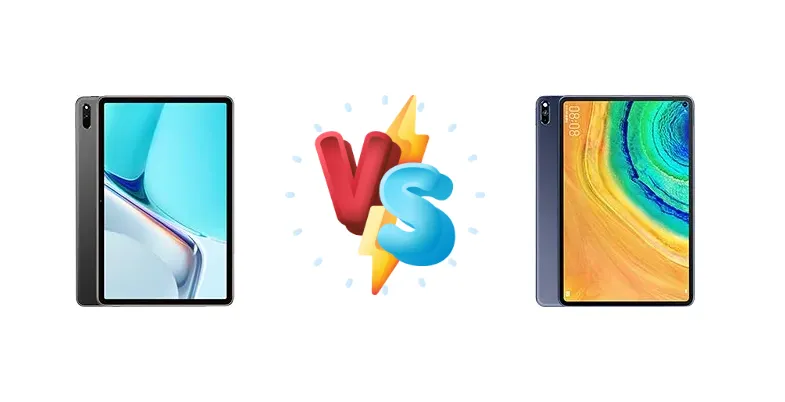
Huawei's MatePad line offers compelling tablets for productivity and entertainment. But with two generations to choose from, deciding between the MatePad 11 (2021) and the MatePad Pro 10.8 (2019) can be tricky. This comprehensive comparison will help you determine which tablet best suits your needs.
🏆 Quick Verdict
The MatePad 11 (2021) offers a brighter display and a more modern Snapdragon 865 chipset, providing a performance edge. However, the MatePad Pro 10.8 boasts faster 40W charging and wireless charging capabilities. Overall, the 11 is the better choice for most users.
| Network |
|---|
| 2G bands | N/A | GSM 850 / 900 / 1800 / 1900 |
| 3G bands | N/A | HSDPA 850 / 900 / 1900 / 2100 |
| 4G bands | N/A | 1, 3, 4, 5, 8, 19, 34, 38, 39, 40, 41 |
| EDGE | No | - |
| GPRS | No | - |
| Speed | - | HSPA, LTE - cellular model only |
| Technology | No cellular connectivity | GSM / HSPA / LTE |
| Launch |
|---|
| Announced | 2021, June 02 | 2019, November 25. Released 2019, December 12 |
| Status | Available. Released 2021, July 13 | Discontinued |
| Body |
|---|
| Build | - | Glass front, aluminum back, aluminum frame |
| Dimensions | 253.8 x 165.3 x 7.3 mm (9.99 x 6.51 x 0.29 in) | 246 x 159 x 7.2 mm (9.69 x 6.26 x 0.28 in) |
| SIM | No | Nano-SIM (cellular model only) |
| Weight | 485 g (1.07 lb) | 460 g (1.01 lb) |
| | Stylus support (magnetic) | Stylus support (magnetic) |
| Display |
|---|
| Resolution | 2560 x 1600 pixels, 16:10 ratio (~276 ppi density) | 2560 x 1600 pixels, 16:10 ratio (~280 ppi density) |
| Size | 10.95 inches, 347.7 cm2 (~82.9% screen-to-body ratio) | 10.8 inches, 338.2 cm2 (~86.5% screen-to-body ratio) |
| Type | IPS LCD, 120Hz | IPS LCD, 540 nits (typ) |
| Platform |
|---|
| CPU | Octa-core (1x2.84 GHz Cortex-A77 & 3x2.42 GHz Cortex-A77 & 4x1.80 GHz Cortex-A55) | Octa-core (2x2.86 GHz Cortex-A76 & 2x2.09 GHz Cortex-A76 & 4x1.86 GHz Cortex-A55) |
| Chipset | Qualcomm SM8250 Snapdragon 865 (7 nm+) | Kirin 990 (7 nm+) |
| GPU | Adreno 650 | Mali-G76 MP16 |
| OS | HarmonyOS 2.0, upgradable to 3.0 | Android 10, EMUI 10, no Google Play Services |
| Memory |
|---|
| Card slot | microSDXC (dedicated slot) | Nano Memory (dedicated slot) |
| Internal | 64GB 6GB RAM, 128GB 6GB RAM, 128GB 8GB RAM, 256GB 6GB RAM, 256GB 8GB RAM | 128GB 6GB RAM, 256GB 8GB RAM, 512GB 8GB RAM |
| | - | UFS 3.0 |
| Main Camera |
|---|
| Features | LED flash, HDR, panorama | LED flash, HDR, panorama |
| Single | 13 MP, f/1.8, PDAF | 13 MP, f/1.8, PDAF |
| Video | 4K@30fps, 1080p@30fps | 4K@30fps, 1080p@30fps |
| Selfie camera |
|---|
| Features | - | HDR |
| Single | 8 MP, f/2.0 | 8 MP, f/2.0 |
| Video | 1080p@30fps | 1080p@30fps |
| Sound |
|---|
| 3.5mm jack | No | No |
| 35mm jack | No | No |
| Loudspeaker | Yes, with stereo speakers (4 speakers) | Yes, with stereo speakers (4 speakers) |
| | Tuned by Harman Kardon | Tuned by Harman Kardon |
| Comms |
|---|
| Bluetooth | 5.1, A2DP, LE | 5.1, A2DP, LE |
| NFC | No | No |
| Positioning | GPS | GPS, GLONASS, GALILEO, BDS, QZSS - cellular model only |
| Radio | No | No |
| USB | USB Type-C 3.1, OTG | USB Type-C 3.1, OTG |
| WLAN | Wi-Fi 802.11 a/b/g/n/ac/6, dual-band, Wi-Fi Direct | Wi-Fi 802.11 a/b/g/n/ac, dual-band, Wi-Fi Direct |
| Features |
|---|
| Sensors | Accelerometer, gyro, proximity, compass | Accelerometer, gyro, proximity, compass |
| Battery |
|---|
| Charging | 22.5W wired
5W reverse wired | 40W wired
15W wireless
7.5W reverse wireless |
| Type | Li-Po 7250 mAh | Li-Po 7250 mAh, non-removable |
| Misc |
|---|
| Colors | Matte Gray | Gray, White, Green, Orange |
| Models | DBY-W09 | MRX-AL09, MRX-AL19, MRX-W09, MRX-W19 |
| Price | About 400 EUR | About 450 EUR |
| Tests |
|---|
| Display |
Contrast ratio: 1200:1 | - |
| Loudspeaker |
-21.1 LUFS (Excellent)
| - |
Huawei MatePad 11 (2021)
- Brighter Display
- Faster Processor (Snapdragon 865)
- Modern Design
- Slightly better camera processing
- Slower Charging than Pro 10.8
- No Wireless Charging
Huawei MatePad Pro 10.8 (2019)
- Faster Charging (40W)
- Wireless Charging
- Premium Design
- Reverse Wireless Charging
- Older Processor (Kirin 990)
- Less Bright Display
- Slightly dated design
Display Comparison
The MatePad 11 (2021) features a 1200:1 contrast ratio and a measured 497 nits of brightness, making it noticeably brighter than the Pro 10.8. Both tablets have excellent color accuracy and sharpness, but the 11's higher brightness provides better visibility in outdoor conditions. The Pro 10.8's display is still very good, but the 11 takes the edge.
Camera Comparison
Both tablets feature decent front and rear cameras suitable for video calls and casual photography. Image quality is comparable between the two, with neither excelling in low-light conditions. The MatePad 11 might have a slight edge in processing due to its newer chipset.
Performance
The MatePad 11 (2021) utilizes the Snapdragon 865, a significant upgrade over the Kirin 990 in the Pro 10.8. This translates to faster app loading times, smoother multitasking, and better gaming performance. While the Kirin 990 is still capable, the 865 offers a more future-proof experience.
Battery Life
The MatePad Pro 10.8 (2019) has a clear advantage in charging speed with 40W wired charging, 15W wireless charging, and 7.5W reverse wireless charging. The MatePad 11 (2021) offers 22.5W wired and 5W reverse wired charging. While battery capacity is similar, the Pro 10.8 charges significantly faster.
Buying Guide
The Huawei MatePad 11 (2021) is ideal for users prioritizing a vibrant display, smooth performance for everyday tasks and gaming, and a more recent processor. The Huawei MatePad Pro 10.8 (2019) is a good option for those who value fast charging, wireless charging, and a slightly more premium design, especially if found at a significantly discounted price.
Frequently Asked Questions
❓ Is the Snapdragon 865 in the MatePad 11 significantly faster than the Kirin 990?
Yes, the Snapdragon 865 offers a noticeable performance boost over the Kirin 990, particularly in demanding tasks like gaming and multitasking.
❓ Does the MatePad 11 support Huawei's M-Pencil and Smart Keyboard?
Yes, both tablets support Huawei's M-Pencil and Smart Keyboard, offering a seamless note-taking and productivity experience.