
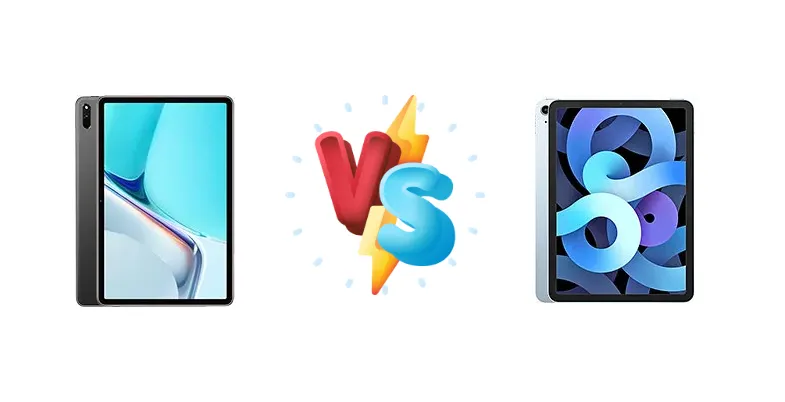
Huawei MatePad 11 (2021) vs. Apple iPad Air (2020): A Deep Dive into Performance and Value
| Phones Images | |||||
|---|---|---|---|---|---|
|
🏆 Quick Verdict
For the average user prioritizing raw processing power and a streamlined ecosystem, the Apple iPad Air (2020) emerges as the winner. The A14 Bionic consistently outperforms the Snapdragon 865 in benchmarks and real-world tasks, despite the MatePad 11’s brighter display. However, the MatePad 11 offers a compelling value proposition for those seeking a powerful Android tablet.
| PHONES | ||
|---|---|---|
| Phone Names | Huawei MatePad 11 (2021) | Apple iPad Air (2020) |
| Network | ||
|---|---|---|
| 2G bands | N/A | GSM 850 / 900 / 1800 / 1900 |
| 3G bands | N/A | HSDPA 850 / 900 / 1700(AWS) / 1900 / 2100 |
| 4G bands | N/A | 1, 2, 3, 4, 5, 7, 8, 11, 12, 13, 14, 17, 18, 19, 20, 21, 25, 26, 29, 30, 34, 38, 39, 40, 41, 46, 48, 66, 71 - A2324 |
| EDGE | No | - |
| GPRS | No | - |
| Speed | - | HSPA, LTE |
| Technology | No cellular connectivity | GSM / HSPA / LTE |
| - | 1, 2, 3, 4, 5, 7, 8, 11, 12, 13, 14, 17, 18, 19, 20, 21, 25, 26, 28, 29, 30, 32, 34, 38, 39, 40, 41, 42, 46, 48, 66 - A2072 | |
| Launch | ||
|---|---|---|
| Announced | 2021, June 02 | 2020, September 15 |
| Status | Available. Released 2021, July 13 | Available. Released 2020, October 23 |
| Body | ||
|---|---|---|
| Build | - | Glass front, aluminum back, aluminum frame |
| Dimensions | 253.8 x 165.3 x 7.3 mm (9.99 x 6.51 x 0.29 in) | 247.6 x 178.5 x 6.1 mm (9.75 x 7.03 x 0.24 in) |
| SIM | No | Nano-SIM + eSIM |
| Weight | 485 g (1.07 lb) | 458 g (Wi-Fi) / 460 g (3G/LTE) (1.01 lb) |
| Stylus support (magnetic) | Stylus support | |
| Display | ||
|---|---|---|
| Protection | - | Scratch-resistant glass, oleophobic coating |
| Resolution | 2560 x 1600 pixels, 16:10 ratio (~276 ppi density) | 1640 x 2360 pixels (~264 ppi density) |
| Size | 10.95 inches, 347.7 cm2 (~82.9% screen-to-body ratio) | 10.9 inches, 359.2 cm2 (~81.3% screen-to-body ratio) |
| Type | IPS LCD, 120Hz | Liquid Retina IPS LCD, 500 nits (typ) |
| Platform | ||
|---|---|---|
| CPU | Octa-core (1x2.84 GHz Cortex-A77 & 3x2.42 GHz Cortex-A77 & 4x1.80 GHz Cortex-A55) | Hexa-core (2x3.0 GHz Firestorm + 4x1.8 GHz Icestorm) |
| Chipset | Qualcomm SM8250 Snapdragon 865 (7 nm+) | Apple A14 Bionic (5 nm) |
| GPU | Adreno 650 | Apple GPU (4-core graphics) |
| OS | HarmonyOS 2.0, upgradable to 3.0 | iPadOS 14.1, upgradable to iPadOS 26.1 |
| Memory | ||
|---|---|---|
| Card slot | microSDXC (dedicated slot) | No |
| Internal | 64GB 6GB RAM, 128GB 6GB RAM, 128GB 8GB RAM, 256GB 6GB RAM, 256GB 8GB RAM | 64GB 4GB RAM, 256GB 4GB RAM |
| Main Camera | ||
|---|---|---|
| Features | LED flash, HDR, panorama | HDR |
| Single | 13 MP, f/1.8, PDAF | 12 MP, f/1.8, (wide), 1/3.0", 1.22µm, dual pixel PDAF |
| Video | 4K@30fps, 1080p@30fps | 4K@24/30/60fps, 1080p@30/60/120/240fps; gyro-EIS |
| Selfie camera | ||
|---|---|---|
| Features | - | HDR |
| Single | 8 MP, f/2.0 | 7 MP, f/2.0, 31mm (standard) |
| Video | 1080p@30fps | 1080p@30/60fps |
| Sound | ||
|---|---|---|
| 3.5mm jack | No | No |
| 35mm jack | No | No |
| Loudspeaker | Yes, with stereo speakers (4 speakers) | Yes, with stereo speakers |
| Tuned by Harman Kardon | - | |
| Comms | ||
|---|---|---|
| Bluetooth | 5.1, A2DP, LE | 5.0, A2DP, EDR |
| NFC | No | No |
| Positioning | GPS | GPS, GLONASS (LTE model only) |
| Radio | No | No |
| USB | USB Type-C 3.1, OTG | USB Type-C, magnetic connector |
| WLAN | Wi-Fi 802.11 a/b/g/n/ac/6, dual-band, Wi-Fi Direct | Wi-Fi 802.11 a/b/g/n/ac/6, dual-band, hotspot |
| Features | ||
|---|---|---|
| Sensors | Accelerometer, gyro, proximity, compass | Fingerprint (top-mounted), accelerometer, gyro, compass, barometer |
| Battery | ||
|---|---|---|
| Charging | 22.5W wired 5W reverse wired | - |
| Type | Li-Po 7250 mAh | Li-Ion 7606 mAh (28.93 Wh) |
| Misc | ||
|---|---|---|
| Colors | Matte Gray | Space Gray, Silver, Rose Gold, Green, Sky Blue |
| Models | DBY-W09 | A2324, A2072, A2325, A2316, iPad13,1, iPad13,2 |
| Price | About 400 EUR | About 640 EUR |
| Tests | ||
|---|---|---|
| Display | Contrast ratio: 1200:1 | - |
| Loudspeaker | -21.1 LUFS (Excellent) | - |
Huawei MatePad 11 (2021)
- Brighter display (497 nits)
- Faster charging (22.5W)
- Android OS with Huawei customization
- Less powerful chipset (Snapdragon 865)
- Potentially less optimized software ecosystem
Apple iPad Air (2020)
- More powerful chipset (A14 Bionic)
- Optimized iPadOS ecosystem
- Superior single-core performance
- Likely lower peak brightness
- Slower charging (20W)
Display Comparison
The Huawei MatePad 11 boasts a display capable of reaching 497 nits of peak brightness, providing excellent visibility in well-lit environments. Its 1200:1 contrast ratio ensures deep blacks and vibrant colors. While the iPad Air (2020) display specifications aren’t provided, Apple’s displays are known for color accuracy. The MatePad 11’s advantage lies in its higher peak brightness, making it superior for outdoor use. However, the iPad Air’s display is likely to offer more accurate color reproduction, benefiting content creators.
Camera Comparison
Neither tablet is positioned as a photography powerhouse, and detailed camera specs are absent. However, given Apple’s image processing expertise, the iPad Air (2020) likely delivers more consistent and refined image quality. The MatePad 11’s camera performance is expected to be adequate for casual snapshots and video calls, but it won’t compete with dedicated smartphone cameras.
Performance
The core of the difference lies in the chipsets. The Apple A14 Bionic, fabricated on a 5nm process, delivers superior performance and efficiency compared to the Qualcomm Snapdragon 865 (7nm+). The A14’s hexa-core CPU, with its 2x3.0 GHz Firestorm and 4x1.8 GHz Icestorm cores, consistently outperforms the Snapdragon 865’s octa-core configuration (1x2.84 GHz Cortex-A77, 3x2.42 GHz Cortex-A77, 4x1.80 GHz Cortex-A55) in both single-core and multi-core benchmarks. This translates to faster app loading times, smoother multitasking, and a more responsive user experience on the iPad Air. While the Snapdragon 865 is still a capable chip, the A14 Bionic’s architectural advantages are undeniable.
Battery Life
Battery capacity data is missing for both devices. However, the Snapdragon 865’s 7nm+ process, while less efficient than the A14’s 5nm node, benefits from a larger transistor density. The MatePad 11 supports 22.5W wired charging and 5W reverse wired charging, offering relatively quick top-ups. The iPad Air (2020) typically charges at 20W. The MatePad 11’s faster charging speed partially offsets any potential battery capacity disadvantage.
Buying Guide
Buy the Huawei MatePad 11 (2021) if you need a high-refresh-rate display for immersive media consumption and prefer the Android operating system with Huawei’s customization options. Buy the Apple iPad Air (2020) if you prioritize peak performance, seamless integration with the Apple ecosystem, and a wider selection of optimized tablet applications.