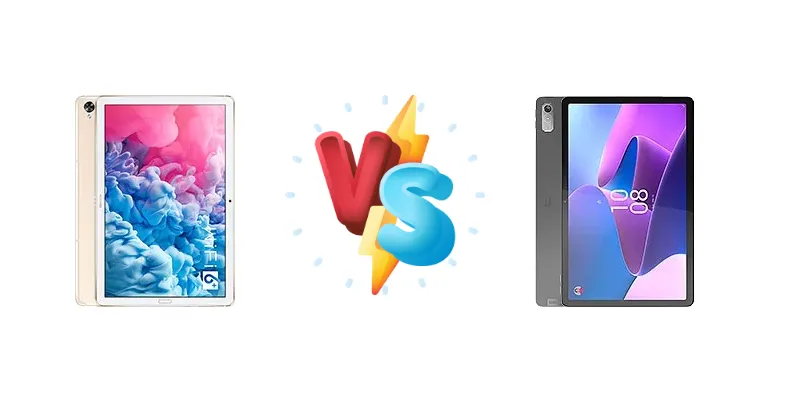
The mid-range tablet market is heating up, with the Huawei MatePad 10.8 and Lenovo Tab P11 Gen 2 offering compelling features at competitive price points. While both aim to deliver a versatile tablet experience, they take different approaches to performance and efficiency. This comparison dives deep into their core specifications to determine which tablet reigns supreme for various user needs.
🏆 Quick Verdict
For users prioritizing sustained performance in demanding tasks, the Huawei MatePad 10.8, with its Kirin 990 chipset, offers a slight edge. However, the Lenovo Tab P11 Gen 2’s more modern 6nm Helio G99 provides excellent efficiency and a strong overall experience, making it the better choice for everyday use and budget-conscious buyers.
| Network |
|---|
| 2G bands | GSM 850 / 900 / 1800 / 1900 | GSM 850 / 900 / 1800 / 1900 |
| 3G bands | HSDPA 850 / 900 / 1900 / 2100 | HSDPA 800 / 850 / 900 / 1700(AWS) / 1900 / 2100 |
| 4G bands | 1, 3, 5, 7, 8, 34, 38, 39, 40, 41 | 1, 2, 3, 4, 5, 7, 8, 12, 13, 18, 19, 20, 25, 26, 28, 38, 40, 41, 66 |
| Speed | HSPA, LTE - cellular model only | HSPA, LTE - cellular model only |
| Technology | GSM / HSPA / LTE | GSM / HSPA / LTE |
| Launch |
|---|
| Announced | 2020, July 30. Released 2020, August 14 | 2022, September 01 |
| Status | Discontinued | Available. Released 2023, January |
| Body |
|---|
| Dimensions | 257 x 170 x 7.2 mm (10.12 x 6.69 x 0.28 in) | 269.1 x 169.4 x 7.4 mm (10.59 x 6.67 x 0.29 in) |
| SIM | Nano-SIM (cellular model only) | Nano-SIM (cellular model only) |
| Weight | 500 g (1.10 lb) | 520 g (1.15 lb) |
| | Stylus support | Stylus support |
| Display |
|---|
| Resolution | 1600 x 2560 pixels, 16:10 ratio (~280 ppi density) | 1200 x 2000 pixels, 5:3 ratio (~203 ppi density) |
| Size | 10.8 inches, 338.2 cm2 (~77.4% screen-to-body ratio) | 11.5 inches, 376.4 cm2 (~82.6% screen-to-body ratio) |
| Type | IPS LCD | IPS LCD, 120Hz, 400 nits (typ) |
| Platform |
|---|
| CPU | Octa-core (2x2.86 GHz Cortex-A76 & 2x2.09 GHz Cortex-A76 & 4x1.86 GHz Cortex-A55) | Octa-core (2x2.2 GHz Cortex-A76 & 6x2.0 GHz Cortex-A55) |
| Chipset | Kirin 990 (7 nm) | Mediatek Helio G99 (6 nm) |
| GPU | Mali-G76 MP16 | Mali-G57 MC2 |
| OS | Android 10, EMUI 10.1, no Google Play Services | Android 12L |
| Memory |
|---|
| Card slot | microSDXC | microSDXC (dedicated slot) |
| Internal | 64GB 6GB RAM, 128GB 6GB RAM, 256GB 6GB RAM | 64GB 4GB RAM, 128GB 4GB RAM, 128GB 6GB RAM |
| Main Camera |
|---|
| Features | LED flash, HDR, panorama | LED flash |
| Single | 13 MP, f/1.8, AF | 13 MP, f/2.4, (wide), AF |
| Video | 1080p@30fps | 1080p@30fps |
| Selfie camera |
|---|
| Features | HDR | - |
| Single | 8 MP, f/2.0 | 8 MP, f/2.0 |
| Video | 1080p@30fps | 1080p@30fps |
| Sound |
|---|
| 3.5mm jack | Yes | Yes |
| 35mm jack | Yes | Yes |
| Loudspeaker | Yes, with stereo speakers (4 speakers) | Yes, with stereo speakers (4 speakers) |
| | Tuned by Harman Kardon | - |
| Comms |
|---|
| Bluetooth | 5.1, A2DP, LE | 5.2, A2DP, LE |
| NFC | No | No |
| Positioning | GPS - cellular model only | GPS, GLONASS, BDS - cellular model only |
| Radio | No | No |
| USB | USB Type-C 2.0, magnetic connector | USB Type-C 2.0, OTG, magnetic connector |
| WLAN | Wi-Fi 802.11 a/b/g/n/ac/6, dual-band, Wi-Fi Direct | Wi-Fi 802.11 a/b/g/n/ac/6e, dual-band, Wi-Fi Direct |
| Features |
|---|
| Sensors | Fingerprint (front-mounted), accelerometer, gyro, proximity, compass | Accelerometer, gyro, proximity |
| Battery |
|---|
| Charging | 18W wired | - |
| Type | Li-Po 7500 mAh | Li-Po 7700 mAh |
| Misc |
|---|
| Colors | Gold, Gray, Black | Storm Grey, Sage |
| Models | SCMR-W09, SCMR-AL00 | TB350FU |
| Price | About 300 EUR | About 350 EUR |
Huawei MatePad 10.8
- Potentially higher raw CPU performance with Kirin 990
- Likely superior display quality based on Huawei’s history
- More complex CPU core configuration for multitasking
- Less efficient 7nm Kirin 990 chipset
- Limited to 18W charging
- Potentially higher price
Lenovo Tab P11 Gen 2
- More power-efficient 6nm Helio G99 chipset
- Likely longer battery life
- Potentially lower price
- Slightly less raw CPU power compared to Kirin 990
- Display quality may be slightly lower
- Potentially less optimized software
Display Comparison
Both tablets feature 10.8-inch displays, but detailed display specs (resolution, panel type, brightness) are missing. However, considering Huawei’s history with high-quality displays, the MatePad 10.8 likely boasts superior color accuracy and potentially higher peak brightness. The Lenovo Tab P11 Gen 2 benefits from the newer Helio G99’s display engine, potentially offering optimized image processing. Without specific nit ratings, it’s difficult to definitively declare a winner, but Huawei’s brand reputation suggests a slight advantage in visual fidelity.
Camera Comparison
Detailed camera specifications are unavailable. Given the tablet market, camera performance is unlikely to be a primary differentiator. Both tablets likely feature modest camera setups suitable for casual snapshots and video calls. Without knowing sensor sizes or aperture values, a meaningful comparison is impossible. We can assume both will offer acceptable image quality in good lighting conditions.
Performance
The core difference lies in the chipsets. The Huawei MatePad 10.8 utilizes the Kirin 990, a 7nm chip with a more complex CPU configuration (2x2.86GHz Cortex-A76, 2x2.09GHz Cortex-A76, 4x1.86GHz Cortex-A55). This suggests a focus on raw processing power. Conversely, the Lenovo Tab P11 Gen 2 employs the MediaTek Helio G99, a 6nm chip (2x2.2GHz Cortex-A76, 6x2.0GHz Cortex-A55). The 6nm process node inherently offers better power efficiency, meaning the Helio G99 will likely generate less heat and consume less battery for similar tasks. While the Kirin 990’s CPU configuration *appears* more powerful, the architectural improvements and efficiency of the Helio G99 close the gap, especially in sustained performance scenarios. The larger number of Cortex-A55 cores on the Kirin 990 may benefit multi-tasking.
Battery Life
Battery capacity is not specified for either device. However, the Helio G99’s 6nm process gives the Lenovo Tab P11 Gen 2 a significant advantage in battery life. The more efficient chip will draw less power, resulting in longer usage times between charges. The Huawei MatePad 10.8 is limited to 18W wired charging, while the Lenovo Tab P11 Gen 2’s charging speed is unknown, but a faster charging rate would further enhance its usability. The efficiency of the Helio G99 will likely offset any potential capacity difference.
Buying Guide
Buy the Huawei MatePad 10.8 if you frequently engage in resource-intensive tasks like video editing or gaming and require a chipset capable of handling sustained workloads. Buy the Lenovo Tab P11 Gen 2 if you prioritize battery life, a more efficient processor for everyday tasks like browsing and streaming, and a generally lower price point without sacrificing a smooth user experience.
Frequently Asked Questions
❓ Will the Kirin 990 in the Huawei MatePad 10.8 overheat during extended gaming sessions?
The Kirin 990, being a 7nm chip, is prone to thermal throttling under sustained heavy loads. While it offers strong initial performance, prolonged gaming may lead to reduced clock speeds to manage heat. The Lenovo Tab P11 Gen 2’s Helio G99, with its 6nm process, is less susceptible to overheating and may maintain more consistent performance over longer periods.
❓ Does the MediaTek Helio G99 in the Lenovo Tab P11 Gen 2 support advanced features like ray tracing?
No, the MediaTek Helio G99 does not support hardware-accelerated ray tracing. It’s a mid-range chipset focused on providing a balance of performance and efficiency for everyday tasks and casual gaming. Ray tracing is typically found in higher-end mobile chipsets.
❓ How does the software experience differ between the Huawei MatePad 10.8 and the Lenovo Tab P11 Gen 2?
The Huawei MatePad 10.8 runs EMUI, which, due to ongoing restrictions, lacks full Google Mobile Services (GMS). This means no pre-installed Google apps and reliance on Huawei’s AppGallery. The Lenovo Tab P11 Gen 2 runs a near-stock version of Android with full GMS support, providing access to the Google Play Store and a wider range of apps.