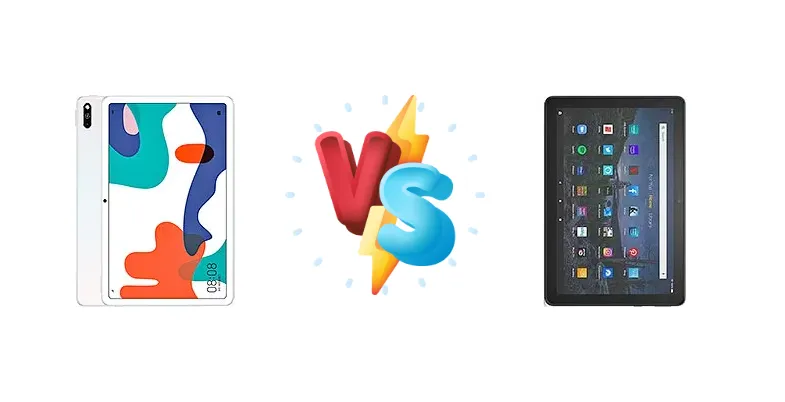
The tablet market offers a wide spectrum of choices, but narrowing down options can be challenging. We pit the Huawei MatePad 10.4, boasting a more powerful Kirin 810 chipset, against the Amazon Fire HD 10 Plus (2021), known for its affordability and integrated Amazon ecosystem. This comparison dives deep into the hardware and software differences to determine which tablet best suits your needs.
🏆 Quick Verdict
For users prioritizing performance and a more versatile Android experience, the Huawei MatePad 10.4 is the clear winner. Its Kirin 810 chipset provides a significant performance advantage over the Fire HD 10 Plus’s Helio P60T. However, the Fire HD 10 Plus remains a compelling option for those deeply embedded in the Amazon ecosystem and seeking a budget-friendly media consumption device.
| Network |
|---|
| 2G bands | GSM 850 / 900 / 1800 / 1900 | N/A |
| 3G bands | HSDPA 850 / 900 / 1900 / 2100 | - |
| 4G bands | 1, 3, 5, 7, 8, 34, 38, 39, 40, 41 | - |
| EDGE | - | No |
| GPRS | - | No |
| Speed | HSPA, LTE - cellular model only | - |
| Technology | GSM / HSPA / LTE | No cellular connectivity |
| Launch |
|---|
| Announced | 2020, April 23. Released 2020, April 28 | 2021, April 27. Released 2021, May 26 |
| Status | Discontinued | Discontinued |
| Body |
|---|
| Build | Glass front, aluminum back, aluminum frame | - |
| Dimensions | 245.2 x 155 x 7.4 mm (9.65 x 6.10 x 0.29 in) | 247 x 166 x 9.2 mm (9.72 x 6.54 x 0.36 in) |
| SIM | Nano-SIM (cellular model only) | No |
| Weight | 450 g (0.99 lb) | 468 g (1.03 lb) |
| | Stylus support | - |
| Display |
|---|
| Protection | - | Aluminosilicate glass |
| Resolution | 1200 x 2000 pixels, 5:3 ratio (~224 ppi density) | 1920 x 1200 pixels, 16:10 ratio (~224 ppi density) |
| Size | 10.4 inches, 307.9 cm2 (~81.0% screen-to-body ratio) | 10.1 inches, 295.8 cm2 (~72.1% screen-to-body ratio) |
| Type | IPS LCD | IPS LCD |
| Platform |
|---|
| CPU | Octa-core (2x2.27 GHz Cortex-A76 & 6x1.88 GHz Cortex-A55) | Octa-core (4x2.0 GHz Cortex-A73 & 4x2.0 GHz Cortex-A53) |
| Chipset | Kirin 810 (7 nm) | Mediatek MT8183 Helio P60T (12 nm) |
| GPU | Mali-G52 MP6 | Mali-G72 MP3 |
| OS | Android 10, EMUI 10, no Google Play Services | Android 9.0 (Pie), Fire OS 7 |
| Memory |
|---|
| Card slot | microSDXC | microSDXC (dedicated slot) |
| Internal | 32GB 3GB RAM, 64GB 4GB RAM, 128GB 4GB RAM, 128GB 6GB RAM | 32GB 4GB RAM, 64GB 4GB RAM |
| | - | eMMC 5.1 |
| Main Camera |
|---|
| Features | LED flash, HDR, panorama | - |
| Single | 8 MP, AF | 5 MP |
| Video | 1080p@30fps | 720p |
| Selfie camera |
|---|
| Features | HDR | - |
| Single | 8 MP | 2 MP |
| Video | 1080p@30fps | 720p |
| Sound |
|---|
| 3.5mm jack | No | Yes |
| 35mm jack | No | Yes |
| Loudspeaker | Yes, with stereo speakers | Yes, with stereo speakers |
| | Tuned by Harman Kardon | - |
| Comms |
|---|
| Bluetooth | 5.1, A2DP, LE | 5.0, A2DP, LE |
| NFC | No | No |
| Positioning | GPS, BDS - cellular model only | No |
| Radio | No | No |
| USB | USB Type-C 2.0 | USB Type-C 2.0, OTG |
| WLAN | Wi-Fi 802.11 a/b/g/n/ac, dual-band, Wi-Fi Direct | Wi-Fi 802.11 a/b/g/n/ac, dual-band |
| Features |
|---|
| Sensors | Accelerometer, gyro, proximity, compass | Accelerometer |
| | - | Text-to-Speech English-language content reader |
| Battery |
|---|
| Charging | 18W wired | Wireless |
| Type | Li-Po 7250 mAh | Li-Ion |
| Misc |
|---|
| Colors | White, Gray | Slate |
| Models | BAH3-W09, BAH3-AL00, BAH3-L09, BAH3-W59 | T76N2P |
| Price | About 250 EUR | About 150 EUR |
Huawei MatePad 10.4
- Significantly more powerful Kirin 810 chipset
- More efficient 7nm process node
- Likely superior display quality
- Standard Android experience with Google Play Store access
- Charging is limited to 18W wired
- Potentially higher price point
Amazon Fire HD 10 Plus (2021)
- Affordable price point
- Convenient wireless charging
- Tight integration with Amazon ecosystem
- Good for media consumption
- Less powerful Helio P60T chipset
- 12nm process node less efficient
- Limited app availability outside Amazon Appstore
Display Comparison
While both tablets feature 10.4-inch displays, the specifics are absent in the provided data. However, given Huawei’s typical display quality, we can infer the MatePad 10.4 likely offers superior color accuracy and brightness. The Fire HD 10 Plus, being a budget device, likely utilizes a simpler IPS panel. The absence of information regarding refresh rates suggests both are likely capped at 60Hz. Bezels are a key differentiator, with Huawei generally prioritizing slimmer designs, potentially offering a more immersive viewing experience.
Camera Comparison
Camera performance is unlikely to be a primary concern for either tablet. However, the lack of detailed camera specifications makes a direct comparison difficult. Given the market positioning, the MatePad 10.4 likely features a more capable camera system, potentially with a larger sensor and better image processing. The Fire HD 10 Plus likely prioritizes cost savings in this area, resulting in a more basic camera experience. Without specific megapixel counts or aperture information, it’s safe to assume the MatePad 10.4 will deliver superior image quality.
Performance
The core difference lies in the chipsets. The Huawei MatePad 10.4’s Kirin 810 (7nm) significantly outperforms the Amazon Fire HD 10 Plus’s MediaTek MT8183 Helio P60T (12nm). The 7nm process node of the Kirin 810 translates to greater transistor density and improved power efficiency, resulting in better sustained performance and reduced thermal throttling. The Kirin 810’s CPU architecture – Cortex-A76 and A55 cores – is also more modern and efficient than the Helio P60T’s Cortex-A73 and A53 cores. This means faster app loading times, smoother multitasking, and a more responsive user experience on the MatePad 10.4. The Helio P60T is adequate for basic tasks, but will struggle with demanding applications.
Battery Life
Battery capacity is not specified, but the charging capabilities reveal a key difference. The Huawei MatePad 10.4 supports 18W wired charging, while the Amazon Fire HD 10 Plus offers wireless charging. Wireless charging provides convenience, but is typically slower than wired charging. The Kirin 810’s superior power efficiency may offset the slower charging speed, potentially resulting in comparable real-world battery life despite the lack of fast charging. The Fire HD 10 Plus’s Helio P60T, while less powerful, may benefit from its lower power draw, potentially offering similar battery endurance for lighter workloads.
Buying Guide
Buy the Huawei MatePad 10.4 if you need a tablet capable of handling demanding tasks like multitasking, gaming, and creative applications, and if you prefer a standard Android experience with access to the Google Play Store. Buy the Amazon Fire HD 10 Plus (2021) if you primarily intend to consume media – streaming video, reading ebooks, and listening to music – and are heavily invested in Amazon’s services, valuing its tight integration and lower price point.
Frequently Asked Questions
❓ Will the Helio P60T in the Fire HD 10 Plus struggle with graphically intensive games like PUBG?
Yes, the MediaTek Helio P60T is a budget chipset and will likely struggle to run demanding games like PUBG at high settings. Expect lower frame rates and potential stuttering. The Huawei MatePad 10.4’s Kirin 810 offers a much smoother gaming experience.
❓ How does the Amazon Fire HD 10 Plus’s integration with Amazon services affect the user experience?
The Fire HD 10 Plus is deeply integrated with Amazon’s ecosystem. This means seamless access to Prime Video, Kindle ebooks, Amazon Music, and other Amazon services. However, it also means a heavier reliance on Amazon’s Appstore, which has a smaller selection of apps compared to the Google Play Store available on the MatePad 10.4.
❓ Is the lack of Google Mobile Services (GMS) on the Huawei MatePad 10.4 a significant drawback?
The Huawei MatePad 10.4 does not come with Google Mobile Services (GMS) pre-installed. It uses Huawei Mobile Services (HMS) instead. While HMS is improving, some users may miss the convenience of Google apps like Gmail, YouTube, and Google Maps. However, workarounds exist to sideload some Google apps.