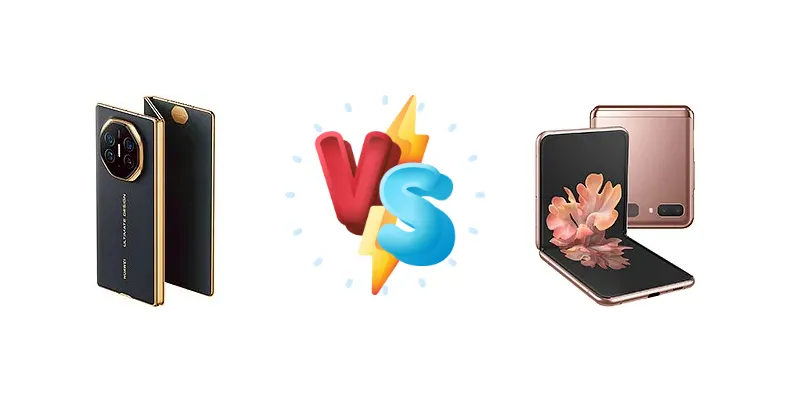
The foldable phone market presents a unique challenge: balancing innovation with practicality. The Huawei Mate XTs Ultimate, with its focus on rapid charging and a powerful in-house chipset, clashes with the Samsung Galaxy Z Flip 5G, leveraging Qualcomm's Snapdragon 865+ for optimized 5G performance and a more compact form factor. This comparison dissects these differences to determine which foldable reigns supreme.
🏆 Quick Verdict
For users prioritizing raw charging speed and potentially sustained performance, the Huawei Mate XTs Ultimate is the winner. Its 66W wired and 50W wireless charging significantly outpace the Z Flip 5G's 15W and 9W options. However, the Snapdragon 865+ in the Z Flip 5G offers a more mature software ecosystem and potentially better gaming optimization.
| Network |
|---|
| 2G bands | GSM 850 / 900 / 1800 / 1900 | GSM 850 / 900 / 1800 / 1900 |
| 3G bands | HSDPA 800 / 850 / 900 / 1700(AWS) / 1900 / 2100 | HSDPA 850 / 900 / 1700(AWS) / 1900 / 2100 - International, Canada |
| 4G bands | LTE | 1, 2, 3, 4, 5, 7, 8, 12, 13, 14, 18, 19, 20, 25, 26, 28, 29, 30, 38, 39, 40, 41, 66, 71 - International |
| 5G bands | SA/NSA | 1, 41, 77, 78, 79 Sub6 - China, Hong Kong |
| Speed | HSPA, LTE, 5G | HSPA 42.2/5.76 Mbps, LTE (6CA) Cat20 2000/200 Mbps, 5G |
| Technology | GSM / CDMA / HSPA / CDMA2000 / LTE / 5G | GSM / CDMA / HSPA / EVDO / LTE / 5G |
| | - | 41, 66, 71 Sub6 - Canada |
| Launch |
|---|
| Announced | 2025, September 04 | 2020, July 22 |
| Status | Available. Released 2025, September 29 | Available. Released 2020, August 07 |
| Body |
|---|
| Build | - | Plastic front, glass back (Gorilla Glass 6), aluminum frame |
| Dimensions | Unfolded: 156.7 x 219 x 3.6-4.8 mmFolded: 156.7 x 73.5 x 12.8 mm | Unfolded: 167.3 x 73.6 x 7.2 mm Folded: 87.4 x 73.6 x 17.3 mm |
| SIM | Nano-SIM + Nano-SIM | Nano-SIM + eSIM |
| Weight | 298 g (10.51 oz) | 183 g (6.46 oz) |
| Display |
|---|
| Resolution | 2232 x 3184 pixels (~381 ppi density) | 1080 x 2636 pixels (~425 ppi density) |
| Size | 10.2 inches, 315.5 cm2 (~91.9% screen-to-body ratio) | 6.7 inches, 101.6 cm2 (~82.5% screen-to-body ratio) |
| Type | Tri-foldable LTPO OLED, 1B colors, 90Hz, 1440Hz PWM | Foldable Dynamic AMOLED, HDR10+ |
| | - | Cover display:
Super AMOLED, 1.1 inches, 112 x 300 pixels |
| Platform |
|---|
| CPU | Octa-core (1x2.4 GHz & 3x2.00 GHz & 4x1.6GHz) | Octa-core (1x3.09 GHz Cortex-A77 & 3x2.40 GHz Cortex-A77 & 4x1.80 GHz Cortex-A55) |
| Chipset | Kirin 9020 (7 nm) | Qualcomm SM8250 Snapdragon 865 5G+ (7 nm+) |
| GPU | Maleoon 920 | Adreno 650 |
| OS | HarmonyOS 5.1 (China) | Android 10, upgradable to Android 13, One UI 5 |
| Memory |
|---|
| Card slot | No | No |
| Internal | 256GB 16GB RAM, 512GB 16GB RAM, 1TB 16GB RAM | 256GB 8GB RAM |
| | - | UFS 3.0 |
| Main Camera |
|---|
| Dual | - | 12 MP, f/1.8, 27mm (wide), 1/2.55", 1.4µm, dual pixel PDAF, OIS
12 MP, f/2.2, 123˚ (ultrawide), 1.12µm |
| Features | Laser AF, color spectrum sensor, LED flash, panorama, HDR | LED flash, HDR, panorama |
| Triple | 50 MP, f/1.4-f/4.0, 24mm (wide), 1/1.56", 1.0µm, PDAF, OIS
12 MP, f/3.4, 125mm (periscope telephoto), 1/3.6", 1.0µm, PDAF, OIS, 5.5x optical zoom
40 MP, f/2.2, 13mm (ultrawide), PDAF | - |
| Video | 4K@30/60fps, 1080p@30/60fps, gyro-EIS, OIS, HDR Vivid | 4K@30/60fps, 1080p@60/240fps, 720p@960fps, HDR10+ |
| Selfie camera |
|---|
| Features | HDR | HDR |
| Single | 8 MP, f/2.2, (wide), 1/3.6", 1.22µm | 10 MP, f/2.4, 26mm (wide), 1.22µm |
| Video | 4K@30fps, 1080p@30fps, HDR Vivid | 4K@30fps |
| Sound |
|---|
| 3.5mm jack | - | No |
| 35mm jack | No | No |
| Loudspeaker | Yes, with stereo speakers | Yes |
| | - | 32-bit/384kHz audio
Tuned by AKG |
| Comms |
|---|
| Bluetooth | 5.2, A2DP, LE, L2HC | 5.0, A2DP, LE |
| Infrared port | Yes | - |
| NFC | Yes | Yes |
| Positioning | GPS (L1+L5), GLONASS (L1), BDS (B1I+B1c+B2a+B2b), GALILEO (E1+E5a+E5b), QZSS (L1+L5), NavIC | GPS, GLONASS, GALILEO, BDS |
| Radio | No | No |
| USB | USB Type-C 3.1, DisplayPort 1.2, OTG | USB Type-C 2.0, OTG |
| WLAN | Wi-Fi 802.11 a/b/g/n/ac/6/7, dual-band | Wi-Fi 802.11 a/b/g/n/ac/6, dual-band, Wi-Fi Direct |
| Features |
|---|
| Sensors | Fingerprint (side-mounted), accelerometer, gyro, proximity, compass, barometer | Fingerprint (side-mounted), accelerometer, gyro, proximity, compass, barometer |
| | - | Samsung Pay (Visa, MasterCard certified) |
| Battery |
|---|
| Charging | 66W wired
50W wireless
7.5W reverse wireless
5W reverse wired | 15W wired
9W wireless |
| Type | Si/C Li-Ion 5600 mAh | Li-Po 3300 mAh |
| Misc |
|---|
| Colors | Red, Black, Purple, White | Mystic Grey, Mystic Bronze, Mystic White |
| Models | GRL-AL20 | SM-F707B, SM-F707N, SM-F7070, SM-F707U, SM-F707U1, SM-F707W |
| Price | About 2160 EUR | About 800 EUR |
| SAR | - | 0.80 W/kg (head) 1.01 W/kg (body) |
| SAR EU | - | 0.80 W/kg (head) 1.45 W/kg (body) |
Huawei Mate XTs Ultimate
- Blazing-fast 66W wired charging
- Impressive 50W wireless charging
- Potentially sustained performance with Kirin 9020
- Likely excellent OLED display quality
- Software ecosystem concerns (Huawei Mobile Services)
- Uncertainty regarding long-term software support
Samsung Galaxy Z Flip 5G
- Optimized Snapdragon 865+ performance
- Mature software ecosystem and updates
- Compact and pocketable foldable design
- Useful cover screen for quick interactions
- Significantly slower charging speeds
- Potentially more prone to thermal throttling
Display Comparison
While both devices feature foldable displays, the context data doesn't provide specifics for comparison. However, given Huawei's history with OLED panels, the Mate XTs Ultimate likely prioritizes color accuracy and peak brightness. The Z Flip 5G, benefiting from Samsung Display's expertise, likely offers a more refined hinge mechanism and potentially better durability. The Z Flip 5G's smaller cover screen is a key differentiator, offering quick access to notifications without unfolding.
Camera Comparison
The provided data lacks camera specifications, making a direct comparison impossible. However, given Huawei’s historical strength in computational photography, the Mate XTs Ultimate likely emphasizes image processing and low-light performance. Samsung typically focuses on vibrant, social media-ready images. Without sensor size or aperture information, it's difficult to assess dynamic range or bokeh quality. The absence of details regarding OIS (Optical Image Stabilization) is a significant omission for both devices.
Performance
The core of the performance difference lies in the chipsets. The Qualcomm Snapdragon 865+ (7nm+) in the Z Flip 5G boasts a higher peak clock speed (3.09 GHz) on its prime Cortex-A77 core compared to the Huawei Mate XTs Ultimate’s Kirin 9020 (2.4 GHz). While the Kirin 9020 utilizes a more complex core configuration, the Snapdragon 865+ benefits from Qualcomm’s optimized CPU architecture and Adreno 650 GPU. This translates to potentially smoother gaming and faster application loading times on the Z Flip 5G. The 7nm+ node of the Snapdragon also offers improved thermal efficiency, potentially mitigating throttling during extended use. The Z Flip 5G likely utilizes LPDDR5 RAM, while the Mate XTs Ultimate's RAM type is unspecified, but likely LPDDR4x, further favoring the Samsung device in memory bandwidth.
Battery Life
The charging capabilities are where the Mate XTs Ultimate truly shines. Its 66W wired charging is over four times faster than the Z Flip 5G’s 15W wired charging, allowing for a full charge in a fraction of the time. The 50W wireless charging is also significantly faster than the Z Flip 5G’s 9W wireless charging. While the Mate XTs Ultimate’s battery capacity is unknown, the superior charging speeds mitigate concerns about a potentially smaller battery. The Z Flip 5G’s slower charging speeds necessitate longer periods tethered to a power outlet.
Buying Guide
Buy the Huawei Mate XTs Ultimate if you need blazing-fast charging, value a potentially more sustained performance profile from the Kirin 9020, and are comfortable with Huawei’s software ecosystem. Buy the Samsung Galaxy Z Flip 5G if you prefer a more pocketable foldable, prioritize a widely supported and optimized Snapdragon chipset, and value the broader Samsung ecosystem and software updates.
Frequently Asked Questions
❓ Does the Kirin 9020 in the Mate XTs Ultimate overheat during prolonged gaming sessions?
While the Kirin 9020 is a powerful chipset, its thermal management is a key concern. Without detailed testing, it's difficult to say definitively. However, the Snapdragon 865+ in the Z Flip 5G benefits from a more efficient 7nm+ process, potentially leading to less throttling under sustained load. Huawei's cooling solutions will be critical in mitigating heat.
❓ How much faster is the 66W charging on the Mate XTs Ultimate compared to the 15W charging on the Z Flip 5G in real-world use?
The 66W charging on the Mate XTs Ultimate can realistically charge the device from 0-100% in around 30-40 minutes, while the Z Flip 5G’s 15W charging will likely take over 1.5 - 2 hours. This difference is substantial and caters to users who prioritize minimizing downtime.
❓ Is the lack of Google Mobile Services on the Mate XTs Ultimate a significant drawback for most users?
Yes, the absence of Google Mobile Services (GMS) is a major consideration. It means no pre-installed Google apps like Gmail, YouTube, or the Play Store. Users must rely on Huawei’s AppGallery and sideloading apps, which can be inconvenient and may not offer the same level of compatibility or security.