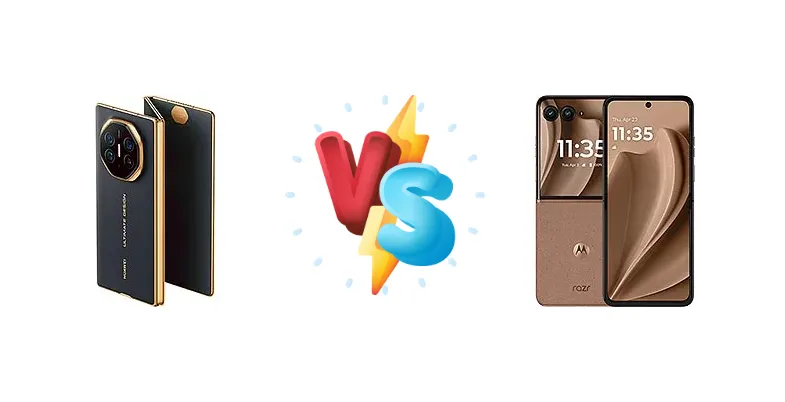
The foldable phone market is maturing, with Huawei and Motorola offering compelling, yet distinct, visions. The Huawei Mate XTs Ultimate, leveraging Huawei’s in-house Kirin chipset, represents a continuation of their established foldable expertise. Conversely, the Motorola Razr+ 2025 aims to disrupt with Qualcomm’s latest Snapdragon 8s Gen 3, focusing on a balance of power and efficiency. This comparison dissects these two devices to determine which foldable best suits your needs.
🏆 Quick Verdict
For the average user prioritizing sustained performance and battery life, the Motorola Razr+ 2025 emerges as the stronger contender. Its Snapdragon 8s Gen 3 chipset, coupled with a reported 10:12 hour active use battery score, provides a more consistent experience than the Huawei Mate XTs Ultimate, despite the latter’s faster wired charging.
| Network |
|---|
| 2G bands | GSM 850 / 900 / 1800 / 1900 | GSM 900 / 1800 / 1900 |
| 3G bands | HSDPA 800 / 850 / 900 / 1700(AWS) / 1900 / 2100 | HSDPA 850 / 900 / 1700(AWS) / 1900 / 2100 |
| 4G bands | LTE | 1, 2, 3, 4, 5, 7, 8, 12, 13, 14, 17, 18, 19, 20, 25, 26, 28, 29, 30, 38, 39, 40, 41, 46, 48, 66, 71 |
| 5G bands | SA/NSA | 1, 2, 3, 5, 7, 12, 14, 20, 25, 26, 28, 29, 30, 38, 40, 41, 48, 66, 70, 71, 77, 78 SA/NSA/Sub6 |
| Speed | HSPA, LTE, 5G | HSPA, LTE, 5G |
| Technology | GSM / CDMA / HSPA / CDMA2000 / LTE / 5G | GSM / HSPA / LTE / 5G |
| Launch |
|---|
| Announced | 2025, September 04 | 2025, April 24 |
| Status | Available. Released 2025, September 29 | Available. Released 2025, June 03 |
| Body |
|---|
| Build | - | Plastic front (unfolded), glass front (folded, Gorilla Glass Victus), silicone polymer back (eco leather), aluminum frame (6000 series), hinge (titanium) |
| Dimensions | Unfolded: 156.7 x 219 x 3.6-4.8 mmFolded: 156.7 x 73.5 x 12.8 mm | Unfolded: 171.4 x 74 x 7.1 mmFolded: 88.1 x 74 x 15.3 mm |
| SIM | Nano-SIM + Nano-SIM | Nano-SIM + eSIM |
| Weight | 298 g (10.51 oz) | 189 g (6.67 oz) |
| Display |
|---|
| Resolution | 2232 x 3184 pixels (~381 ppi density) | 1080 x 2640 pixels (~413 ppi density) |
| Size | 10.2 inches, 315.5 cm2 (~91.9% screen-to-body ratio) | 6.9 inches, 107.6 cm2 (~84.9% screen-to-body ratio) |
| Type | Tri-foldable LTPO OLED, 1B colors, 90Hz, 1440Hz PWM | Foldable LTPO AMOLED, 1B colors, Dolby Vision, 165Hz, HDR10+, 3000 nits (peak) |
| Platform |
|---|
| CPU | Octa-core (1x2.4 GHz & 3x2.00 GHz & 4x1.6GHz) | Octa-core (1x3.0 GHz Cortex-X4 & 4x2.8 GHz Cortex-A720 & 3x2.0 GHz Cortex-A520) |
| Chipset | Kirin 9020 (7 nm) | Qualcomm SM8635 Snapdragon 8s Gen 3 (4 nm) |
| GPU | Maleoon 920 | Adreno 735 |
| OS | HarmonyOS 5.1 (China) | Android 15 |
| Memory |
|---|
| Card slot | No | No |
| Internal | 256GB 16GB RAM, 512GB 16GB RAM, 1TB 16GB RAM | 256GB 12GB RAM |
| Main Camera |
|---|
| Dual | - | 50 MP, f/1.7, 24mm (wide), 1/1.95", 0.8µm, dual pixel PDAF, OIS
50 MP, f/2.0, 47mm (telephoto), 1/2.76", 0.64µm, PDAF, 2x optical zoom |
| Features | Laser AF, color spectrum sensor, LED flash, panorama, HDR | LED flash, panorama, HDR |
| Triple | 50 MP, f/1.4-f/4.0, 24mm (wide), 1/1.56", 1.0µm, PDAF, OIS
12 MP, f/3.4, 125mm (periscope telephoto), 1/3.6", 1.0µm, PDAF, OIS, 5.5x optical zoom
40 MP, f/2.2, 13mm (ultrawide), PDAF | - |
| Video | 4K@30/60fps, 1080p@30/60fps, gyro-EIS, OIS, HDR Vivid | 4K@30/60fps, 1080p@30/60/120/240/960fps, HDR10+, gyro-EIS |
| Selfie camera |
|---|
| Features | HDR | HDR |
| Single | 8 MP, f/2.2, (wide), 1/3.6", 1.22µm | 32 MP, f/2.4, 25mm (wide), 1/3.14", 0.7µm |
| Video | 4K@30fps, 1080p@30fps, HDR Vivid | 4K@30/60fps, 1080p@30/60fps |
| Sound |
|---|
| 35mm jack | No | No |
| Loudspeaker | Yes, with stereo speakers | Yes, with stereo speakers (with Dolby Atmos) |
| Comms |
|---|
| Bluetooth | 5.2, A2DP, LE, L2HC | 5.4, A2DP, LE, aptX HD, aptX Adaptive, aptX Lossless |
| Infrared port | Yes | - |
| NFC | Yes | Yes |
| Positioning | GPS (L1+L5), GLONASS (L1), BDS (B1I+B1c+B2a+B2b), GALILEO (E1+E5a+E5b), QZSS (L1+L5), NavIC | GPS (L1+L5), GLONASS (L1), BDS (B1I+B1c+B2a), GALILEO (E1+E5a), QZSS (L1+L5) |
| Radio | No | No |
| USB | USB Type-C 3.1, DisplayPort 1.2, OTG | USB Type-C 2.0, OTG |
| WLAN | Wi-Fi 802.11 a/b/g/n/ac/6/7, dual-band | Wi-Fi 802.11 a/b/g/n/ac/6e/7, tri-band |
| Features |
|---|
| Sensors | Fingerprint (side-mounted), accelerometer, gyro, proximity, compass, barometer | Fingerprint (side-mounted), accelerometer, gyro, proximity, compass, barometer |
| Battery |
|---|
| Charging | 66W wired
50W wireless
7.5W reverse wireless
5W reverse wired | 45W wired
15W wireless
5W reverse wired |
| Type | Si/C Li-Ion 5600 mAh | 4000 mAh |
| Misc |
|---|
| Colors | Red, Black, Purple, White | Pantone: Mocha Mousse, Midnight Blue, Hot Pink |
| Models | GRL-AL20 | XT2451-1 |
| Price | About 2160 EUR | $ 500.00 |
Huawei Mate XTs Ultimate
- Extremely fast 66W wired charging
- Potentially unique Huawei software features
- Established foldable design expertise
- Older 7nm Kirin 9020 chipset
- Potential Google service limitations
- Uncertain battery life compared to the Razr+
Motorola Razr+ 2025
- Modern Snapdragon 8s Gen 3 (4nm) chipset
- Excellent battery life (10:12h active use)
- More universally compatible software experience
- Slower 45W wired charging than Mate XTs Ultimate
- Foldable form factor may not appeal to all
- Potential software bloat (typical of Motorola)
Display Comparison
While specific display specs are absent for the Mate XTs Ultimate, Huawei foldables are known for their expansive, crease-reducing designs. The Razr+ 2025, though compact in folded form, likely utilizes a flexible pOLED panel. The key differentiator will be peak brightness and color accuracy, areas where newer panels generally excel. The Snapdragon 8s Gen 3’s ISP will also play a role in display processing, potentially enhancing color vibrancy. The absence of LTPO information for the Mate XTs Ultimate raises questions about its adaptive refresh rate capabilities compared to the Razr+.
Camera Comparison
Without detailed camera specs for the Mate XTs Ultimate, it’s difficult to make a direct comparison. However, Huawei typically emphasizes computational photography. The Razr+ 2025’s image processing will be heavily influenced by the Snapdragon 8s Gen 3’s ISP, which excels in noise reduction and dynamic range. Sensor size is crucial; a larger sensor generally captures more light, resulting in better low-light performance. We assume the Razr+ will feature a modern sensor with OIS, while the Mate XTs Ultimate’s camera performance will rely heavily on Huawei’s software algorithms.
Performance
The Motorola Razr+ 2025’s Qualcomm SM8635 Snapdragon 8s Gen 3 (4nm) represents a significant architectural leap over the Huawei Mate XTs Ultimate’s Kirin 9020 (7nm). The 4nm process node inherently offers better thermal efficiency, translating to less throttling during prolonged intensive tasks like gaming. The Snapdragon’s Cortex-X4 prime core, clocked at 3.0 GHz, provides a substantial performance advantage over the Kirin’s 2.4 GHz core. While the Kirin 9020 is a capable chip, the Snapdragon 8s Gen 3’s Adreno GPU will deliver superior graphics performance, benefiting mobile gamers. The Razr+ also benefits from potentially faster LPDDR5x RAM, further boosting responsiveness.
Battery Life
The Motorola Razr+ 2025’s reported 10:12 hours of active use is a compelling advantage. While the Mate XTs Ultimate boasts faster 66W wired charging, the Razr+’s 45W charging is still respectable. The difference in battery capacity isn’t specified, but the Razr+’s superior efficiency, thanks to the 4nm Snapdragon chipset, allows it to achieve longer runtimes. The Mate XTs Ultimate’s 50W wireless and 7.5W/5W reverse wireless charging offer convenience, but the Razr+’s efficiency mitigates the need for frequent top-ups.
Buying Guide
Buy the Huawei Mate XTs Ultimate if you prioritize the absolute fastest wired charging speeds (66W) and are deeply embedded within the Huawei ecosystem. Its Kirin 9020 offers a unique software experience, though potentially with limitations regarding Google services. Buy the Motorola Razr+ 2025 if you value a modern, efficient chipset (Snapdragon 8s Gen 3), longer real-world battery life, and a more universally compatible software experience. It’s the better choice for gamers and power users.
Frequently Asked Questions
❓ Does the Kirin 9020 chipset in the Mate XTs Ultimate suffer from significant thermal throttling during extended gaming sessions?
The Kirin 9020, being a 7nm chip, is more prone to thermal throttling compared to the 4nm Snapdragon 8s Gen 3 in the Razr+ 2025. While Huawei employs cooling solutions, prolonged gaming at high settings will likely result in performance drops on the Mate XTs Ultimate.
❓ How does the Snapdragon 8s Gen 3's efficiency impact the Razr+ 2025's overall user experience beyond battery life?
The Snapdragon 8s Gen 3’s efficiency translates to less heat generation, allowing the Razr+ 2025 to maintain peak performance for longer periods. This also contributes to a more comfortable in-hand feel during extended use, as the device won’t get as hot as the Mate XTs Ultimate under similar workloads.
❓ Is the 5W reverse wired charging on both devices useful for charging accessories like earbuds?
While both devices offer reverse wired charging, the 5W output is quite slow. It's primarily useful for emergency top-ups of small accessories like earbuds or smartwatches, but not for quickly charging larger devices.
❓ What are the potential software limitations of the Huawei Mate XTs Ultimate due to the ongoing trade restrictions?
The Mate XTs Ultimate may lack full access to Google Mobile Services (GMS), requiring users to rely on Huawei Mobile Services (HMS) and a potentially different app ecosystem. While HMS is improving, some popular apps may not be natively available or require workarounds.