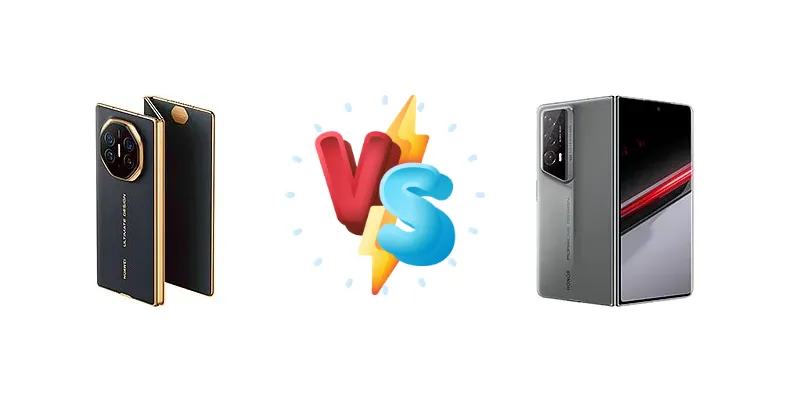
Both the Huawei Mate XTs Ultimate and the Honor Magic V2 RSR Porsche Design represent the pinnacle of foldable phone technology, but they approach the market from different angles. The Mate XTs Ultimate, leveraging Huawei’s Kirin chipset, aims for a refined, self-contained ecosystem. The Magic V2 RSR, powered by the Snapdragon 8 Gen 2 and boasting a Porsche Design aesthetic, targets performance enthusiasts and those seeking a premium, globally-compatible experience.
🏆 Quick Verdict
For the average user prioritizing raw performance and broader app compatibility, the Honor Magic V2 RSR Porsche Design is the clear winner. The Snapdragon 8 Gen 2’s 4nm process and superior CPU architecture deliver a noticeable performance edge, while the wider software ecosystem offers greater flexibility. However, Huawei loyalists may prefer the Mate XTs Ultimate’s unique features.
| Network |
|---|
| 2G bands | GSM 850 / 900 / 1800 / 1900 | GSM 850 / 900 / 1800 / 1900 |
| 3G bands | HSDPA 800 / 850 / 900 / 1700(AWS) / 1900 / 2100 | HSDPA 800 / 850 / 900 / 1700(AWS) / 1900 / 2100 |
| 4G bands | LTE | 1, 2, 3, 4, 5, 7, 8, 12, 17, 18, 19, 20, 26, 28, 34, 38, 39, 40, 41, 66 |
| 5G bands | SA/NSA | 1, 3, 5, 8, 28, 38, 41, 77, 78 SA/NSA |
| Speed | HSPA, LTE, 5G | HSPA, LTE, 5G |
| Technology | GSM / CDMA / HSPA / CDMA2000 / LTE / 5G | GSM / CDMA / HSPA / CDMA2000 / LTE / 5G |
| Launch |
|---|
| Announced | 2025, September 04 | 2024, January 11 |
| Status | Available. Released 2025, September 29 | Available. Released 2024, January 12 |
| Body |
|---|
| Build | - | Glass front, glass back, magnesium alloy frame, titanium alloy folding mechanism |
| Dimensions | Unfolded: 156.7 x 219 x 3.6-4.8 mmFolded: 156.7 x 73.5 x 12.8 mm | Unfolded: 156.7 x 145.4 x 4.7 mm or 4.8 mmFolded: 156.7 x 74 x 9.9 mm or 10.1 mm |
| SIM | Nano-SIM + Nano-SIM | · Nano-SIM + eSIM· Nano-SIM + Nano-SIM |
| Weight | 298 g (10.51 oz) | 234 g (8.25 oz) |
| Display |
|---|
| Resolution | 2232 x 3184 pixels (~381 ppi density) | 2156 x 2344 pixels (~402 ppi density) |
| Size | 10.2 inches, 315.5 cm2 (~91.9% screen-to-body ratio) | 7.92 inches, 201.6 cm2 (~88.5% screen-to-body ratio) |
| Type | Tri-foldable LTPO OLED, 1B colors, 90Hz, 1440Hz PWM | Foldable LTPO OLED, 1B colors, 120Hz, HDR10+, 1600 nits (peak) |
| Platform |
|---|
| CPU | Octa-core (1x2.4 GHz & 3x2.00 GHz & 4x1.6GHz) | Octa-core (1x3.36 GHz Cortex-X3 & 2x2.8 GHz Cortex-A715 & 2x2.8 GHz Cortex-A710 & 3x2.0 GHz Cortex-A510) |
| Chipset | Kirin 9020 (7 nm) | Qualcomm SM8550-AC Snapdragon 8 Gen 2 (4 nm) |
| GPU | Maleoon 920 | Adreno 740 |
| OS | HarmonyOS 5.1 (China) | Android 13, upgradable to Android 14, MagicOS 8 |
| Memory |
|---|
| Card slot | No | No |
| Internal | 256GB 16GB RAM, 512GB 16GB RAM, 1TB 16GB RAM | 1TB 16GB RAM |
| Main Camera |
|---|
| Features | Laser AF, color spectrum sensor, LED flash, panorama, HDR | Multi-zone Laser AF (8x8 dToF), color spectrum sensor, LED flash, HDR, panorama |
| Triple | 50 MP, f/1.4-f/4.0, 24mm (wide), 1/1.56", 1.0µm, PDAF, OIS
12 MP, f/3.4, 125mm (periscope telephoto), 1/3.6", 1.0µm, PDAF, OIS, 5.5x optical zoom
40 MP, f/2.2, 13mm (ultrawide), PDAF | 50 MP, f/1.9, (wide), PDAF, OIS
20 MP, f/2.4, 62mm (telephoto), PDAF, 2.5x optical zoom, OIS
50 MP, f/2.0, 13mm (ultrawide), AF |
| Video | 4K@30/60fps, 1080p@30/60fps, gyro-EIS, OIS, HDR Vivid | 4K@30/60fps (10-bit), 1080p@30/60fps, gyro-EIS, HDR10+, OIS |
| Selfie camera |
|---|
| Features | HDR | HDR |
| Single | 8 MP, f/2.2, (wide), 1/3.6", 1.22µm | 16 MP, f/2.2, (wide) |
| Video | 4K@30fps, 1080p@30fps, HDR Vivid | 4K@30fps, 1080p@30fps, gyro-EIS |
| Sound |
|---|
| 35mm jack | No | No |
| Loudspeaker | Yes, with stereo speakers | Yes, with stereo speakers |
| Comms |
|---|
| Bluetooth | 5.2, A2DP, LE, L2HC | 5.3, A2DP, LE, aptX HD |
| Infrared port | Yes | Yes |
| NFC | Yes | Yes |
| Positioning | GPS (L1+L5), GLONASS (L1), BDS (B1I+B1c+B2a+B2b), GALILEO (E1+E5a+E5b), QZSS (L1+L5), NavIC | GPS (L1+L5), GLONASS (L1), BDS (B1I+B1c+B2a), GALILEO (E1+E5a), QZSS (L1+L5) |
| Radio | No | No |
| USB | USB Type-C 3.1, DisplayPort 1.2, OTG | USB Type-C 3.1, OTG, Display Port 1.2 |
| WLAN | Wi-Fi 802.11 a/b/g/n/ac/6/7, dual-band | Wi-Fi 802.11 a/b/g/n/ac/6e/7, dual-band, Wi-Fi Direct |
| Features |
|---|
| Sensors | Fingerprint (side-mounted), accelerometer, gyro, proximity, compass, barometer | Fingerprint (side-mounted), accelerometer, gyro, proximity, compass |
| Battery |
|---|
| Charging | 66W wired
50W wireless
7.5W reverse wireless
5W reverse wired | 66W wired
5W reverse wired |
| Type | Si/C Li-Ion 5600 mAh | Si/C Li-Ion 5000 mAh |
| Misc |
|---|
| Colors | Red, Black, Purple, White | Agate Gray |
| Models | GRL-AL20 | VER-AN10 |
| Price | About 2160 EUR | About 2700 EUR |
Huawei Mate XTs Ultimate
- Faster Wireless Charging (50W)
- Reverse Wired Charging (5W)
- Potentially superior image processing (Huawei's strength)
- Older 7nm chipset (Kirin 9020)
- Potential software limitations (Huawei ecosystem)
Honor Magic V2 RSR Porsche Design
- Superior Performance (Snapdragon 8 Gen 2)
- 4nm Fabrication (Better efficiency)
- Full Google Play Store Access
- Porsche Design Branding
- Lacks Reverse Wired Charging
- Wireless charging slower than Mate XTs Ultimate
Display Comparison
While both devices feature foldable displays, detailed display specs are missing. However, given the price point and target market, both likely employ LTPO panels for adaptive refresh rates, maximizing battery efficiency. The Honor Magic V2 RSR, being newer, may benefit from advancements in panel technology, potentially offering slightly improved color accuracy and brightness. The Porsche Design branding suggests a focus on visual appeal, potentially translating to tighter bezel control.
Camera Comparison
Detailed camera specs are unavailable. However, both devices likely feature multi-camera systems. The absence of specific sensor details makes a direct comparison difficult. Given Huawei’s historical strength in computational photography, the Mate XTs Ultimate may excel in image processing, particularly in challenging lighting conditions. The Honor Magic V2 RSR, benefiting from the Snapdragon’s ISP, should offer excellent video recording capabilities and potentially faster image processing speeds. Without sensor size information, it's difficult to assess low-light performance.
Performance
The core difference lies in the chipset. The Honor Magic V2 RSR’s Qualcomm Snapdragon 8 Gen 2 (4nm) is a significant leap over the Huawei Mate XTs Ultimate’s Kirin 9020 (7nm). The Snapdragon 8 Gen 2’s Cortex-X3 prime core, clocked at 3.36 GHz, provides substantially higher single-core performance, crucial for responsive UI and demanding applications. The 4nm fabrication process also translates to superior thermal efficiency, reducing the likelihood of throttling during sustained workloads like gaming. The Kirin 9020, while capable, will struggle to match the Snapdragon’s sustained performance.
Battery Life
Both phones offer 66W wired charging, ensuring relatively quick top-ups. The Mate XTs Ultimate distinguishes itself with 50W wireless charging and both 7.5W reverse wireless and 5W reverse wired charging, offering greater versatility for charging accessories. While battery capacity is unknown for both, the Snapdragon 8 Gen 2’s superior efficiency should translate to longer real-world battery life for the Honor Magic V2 RSR, despite potentially having a similar or smaller battery capacity. The faster charging speeds on both devices mitigate concerns about battery size.
Buying Guide
Buy the Huawei Mate XTs Ultimate if you are deeply embedded in the Huawei ecosystem, value the 66W wireless charging and 5W reverse wired charging, and are comfortable with potential software limitations. Buy the Honor Magic V2 RSR Porsche Design if you prioritize peak performance, gaming, access to the full Google Play Store, and a globally-supported device with the prestige of the Porsche Design branding.
Frequently Asked Questions
❓ Does the Kirin 9020 in the Mate XTs Ultimate struggle with demanding games like Genshin Impact?
The Kirin 9020 is a capable chipset, but the Snapdragon 8 Gen 2 in the Magic V2 RSR offers significantly better sustained performance. Expect lower frame rates and potential throttling in graphically intensive games on the Mate XTs Ultimate, especially during extended play sessions.
❓ Is the Porsche Design branding on the Magic V2 RSR just cosmetic, or does it offer any functional benefits?
The Porsche Design branding primarily focuses on aesthetics, with unique design elements and materials. However, it often signifies a premium build quality and attention to detail, potentially including optimized thermal solutions or exclusive software features, though these are not explicitly stated in the provided specs.
❓ How does the lack of Google Mobile Services (GMS) on the Huawei Mate XTs Ultimate affect the user experience?
The Mate XTs Ultimate relies on Huawei Mobile Services (HMS) and the AppGallery. While the AppGallery has grown, it still lacks many popular apps readily available on the Google Play Store. Users may need to sideload apps or rely on workarounds, which can be inconvenient.
❓ What is the real-world benefit of the 50W wireless charging on the Mate XTs Ultimate?
50W wireless charging is significantly faster than the 5W offered by the Magic V2 RSR. It allows for a substantial battery top-up in a relatively short amount of time, making it convenient for users who frequently rely on wireless charging.