
Huawei Mate XTs Ultimate vs. Google Pixel Fold: A Deep Dive into Foldable Power
| Phones Images | |||||
|---|---|---|---|---|---|
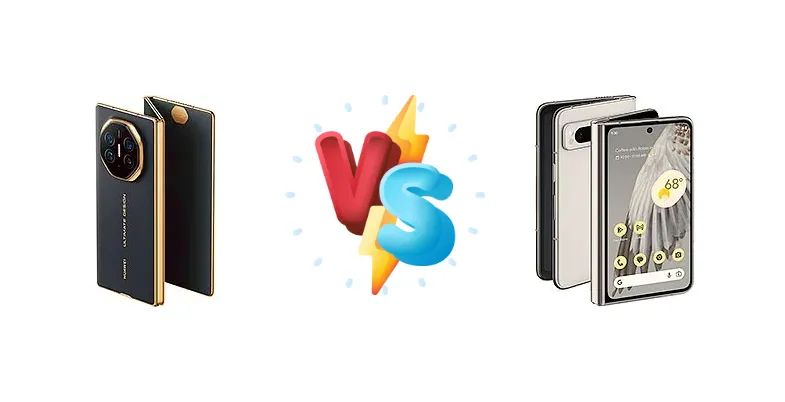
|
🏆 Quick Verdict
For users prioritizing raw charging speed and potentially sustained performance in specific workloads, the Huawei Mate XTs Ultimate edges out the Pixel Fold. However, the Pixel Fold’s Tensor G2 offers a more refined software experience and benefits from Google’s AI capabilities, making it the better choice for the average user.
| PHONES | ||
|---|---|---|
| Phone Names | Huawei Mate XTs Ultimate | Google Pixel Fold |
| Network | ||
|---|---|---|
| 2G bands | GSM 850 / 900 / 1800 / 1900 | GSM 850 / 900 / 1800 / 1900 |
| 3G bands | HSDPA 800 / 850 / 900 / 1700(AWS) / 1900 / 2100 | HSDPA 800 / 850 / 900 / 1700(AWS) / 1900 / 2100 |
| 4G bands | LTE | 1, 2, 3, 4, 5, 7, 8, 12, 13, 14, 17, 18, 19, 20, 21, 25, 26, 28, 29, 30, 32, 38, 39, 40, 41, 42, 46, 48, 66, 71 |
| 5G bands | SA/NSA | 1, 2, 3, 5, 7, 8, 12, 14, 20, 25, 28, 30, 38, 40, 41, 48, 66, 71, 75, 76, 77, 78, 79, 257, 258, 260, 261 SA/NSA/Sub6/mmWave |
| Speed | HSPA, LTE, 5G | HSPA, LTE, 5G |
| Technology | GSM / CDMA / HSPA / CDMA2000 / LTE / 5G | GSM / CDMA / HSPA / EVDO / LTE / 5G |
| - | CDMA2000 1xEV-DO | |
| Launch | ||
|---|---|---|
| Announced | 2025, September 04 | 2023, May 10 |
| Status | Available. Released 2025, September 29 | Available. Released 2023, June 27 |
| Body | ||
|---|---|---|
| Build | - | Glass front (Gorilla Glass Victus) (folded), plastic front (unfolded), glass back (Gorilla Glass Victus), aluminum frame |
| Dimensions | Unfolded: 156.7 x 219 x 3.6-4.8 mmFolded: 156.7 x 73.5 x 12.8 mm | Unfolded: 139.7 x 158.7 x 5.8 mmFolded: 139.7 x 79.5 x 12.1 mm |
| SIM | Nano-SIM + Nano-SIM | Nano-SIM + eSIM |
| Weight | 298 g (10.51 oz) | 283 g (9.98 oz) |
| - | IPX8 water resistant | |
| Display | ||
|---|---|---|
| Resolution | 2232 x 3184 pixels (~381 ppi density) | 1840 x 2208 pixels (~378 ppi density) |
| Size | 10.2 inches, 315.5 cm2 (~91.9% screen-to-body ratio) | 7.6 inches, 183.3 cm2 (~82.7% screen-to-body ratio) |
| Type | Tri-foldable LTPO OLED, 1B colors, 90Hz, 1440Hz PWM | Foldable OLED, 120Hz, HDR10+, 1000 nits (HBM), 1450 nits (peak) |
| - | Cover display: OLED, 120Hz, HDR, Corning Gorilla Glass Victus 5.8 inches, 1080 x 2092 pixels, 17.4:9 ratio, 408 ppi 1200 nits (HBM), 1550 nits (peak) | |
| Platform | ||
|---|---|---|
| CPU | Octa-core (1x2.4 GHz & 3x2.00 GHz & 4x1.6GHz) | Octa-core (2x2.85 GHz Cortex-X1 & 2x2.35 GHz Cortex-A78 & 4x1.80 GHz Cortex-A55) |
| Chipset | Kirin 9020 (7 nm) | Google Tensor G2 (5 nm) |
| GPU | Maleoon 920 | Mali-G710 MP7 |
| OS | HarmonyOS 5.1 (China) | Android 13, upgradable to Android 15, up to 5 major Android upgrades |
| Memory | ||
|---|---|---|
| Card slot | No | No |
| Internal | 256GB 16GB RAM, 512GB 16GB RAM, 1TB 16GB RAM | 256GB 12GB RAM, 512GB 12GB RAM |
| - | UFS 3.1 | |
| Main Camera | ||
|---|---|---|
| Features | Laser AF, color spectrum sensor, LED flash, panorama, HDR | Laser AF, Dual-LED flash, HDR, panorama |
| Triple | 50 MP, f/1.4-f/4.0, 24mm (wide), 1/1.56", 1.0µm, PDAF, OIS 12 MP, f/3.4, 125mm (periscope telephoto), 1/3.6", 1.0µm, PDAF, OIS, 5.5x optical zoom 40 MP, f/2.2, 13mm (ultrawide), PDAF | 48 MP, f/1.7, 25mm (wide), 1/2.0", 0.8µm, dual pixel PDAF, OIS 10.8 MP, f/3.1, 112mm (telephoto), 1/3.1", 1.22µm, dual pixel PDAF, OIS, 5x optical zoom 10.8 MP, f/2.2, 121˚, (ultrawide), 1/3.0", 1.25µm |
| Video | 4K@30/60fps, 1080p@30/60fps, gyro-EIS, OIS, HDR Vivid | 4K@30/60fps, 1080p@30/60/120/240fps, 10-bit HDR |
| Selfie camera | ||
|---|---|---|
| Features | HDR | HDR, panorama |
| Single | 8 MP, f/2.2, (wide), 1/3.6", 1.22µm | 8 MP, f/2.0, 24mm (wide), 1/4.0", 1.12µm Cover camera: 9.5 MP, f/2.2, 24mm (wide), 1.22µm, dual pixel PDAF |
| Video | 4K@30fps, 1080p@30fps, HDR Vivid | 4K@30/60fps, 1080p@30/60fps |
| Sound | ||
|---|---|---|
| 3.5mm jack | - | No |
| 35mm jack | No | No |
| Loudspeaker | Yes, with stereo speakers | Yes, with stereo speakers |
| Comms | ||
|---|---|---|
| Bluetooth | 5.2, A2DP, LE, L2HC | 5.2, A2DP, LE, aptX HD |
| Infrared port | Yes | - |
| NFC | Yes | Yes |
| Positioning | GPS (L1+L5), GLONASS (L1), BDS (B1I+B1c+B2a+B2b), GALILEO (E1+E5a+E5b), QZSS (L1+L5), NavIC | GPS, GLONASS, GALILEO, BDS |
| Radio | No | No |
| USB | USB Type-C 3.1, DisplayPort 1.2, OTG | USB Type-C 3.2, OTG |
| WLAN | Wi-Fi 802.11 a/b/g/n/ac/6/7, dual-band | Wi-Fi 802.11 a/b/g/n/ac/6e, tri-band, Wi-Fi Direct |
| Features | ||
|---|---|---|
| Sensors | Fingerprint (side-mounted), accelerometer, gyro, proximity, compass, barometer | Fingerprint (side-mounted), accelerometer, gyro, proximity, compass, barometer |
| - | Ultra Wideband (UWB) support | |
| Battery | ||
|---|---|---|
| Charging | 66W wired 50W wireless 7.5W reverse wireless 5W reverse wired | Wired, PD3.0 Wireless |
| Type | Si/C Li-Ion 5600 mAh | Li-Po 4821 mAh |
| Misc | ||
|---|---|---|
| Colors | Red, Black, Purple, White | Porcelain, Obsidian |
| Models | GRL-AL20 | G9FPL |
| Price | About 2160 EUR | € 670.87 / $ 389.26 / £ 899.99 |
Huawei Mate XTs Ultimate
- Significantly faster charging speeds (66W wired, 50W wireless)
- Potentially more sustained performance in specific workloads due to Kirin 9020
- Reverse wireless and wired charging capabilities
- Software experience may lack the polish of Google’s Pixel UI
- Potential concerns regarding app availability due to geopolitical factors
Google Pixel Fold
- Seamless Android experience with guaranteed updates
- Google’s AI-powered features and computational photography
- Modern chipset architecture (Tensor G2) with improved efficiency
- Slower charging speeds compared to the Mate XTs Ultimate
- Potential for thermal throttling under sustained heavy load
Display Comparison
While both devices feature foldable displays, specifics beyond the form factor are missing. However, given Huawei’s history with OLED panels, the Mate XTs Ultimate likely prioritizes color accuracy and peak brightness. The Pixel Fold, benefiting from Google’s software optimization, will likely focus on adaptive refresh rates and color calibration. The absence of LTPO information makes a direct comparison difficult, but the foldable nature of both displays will inherently present crease visibility concerns.
Camera Comparison
Without detailed camera specs, a direct comparison is limited. However, Huawei has historically excelled in camera technology. The Mate XTs Ultimate likely features a sophisticated image processing pipeline leveraging the Kirin 9020’s ISP. The Pixel Fold benefits from Google’s computational photography expertise, known for its excellent dynamic range and accurate color reproduction. The Tensor G2’s dedicated image processing unit will be crucial for features like Magic Eraser and Photo Unblur. Sensor size and lens apertures will be key differentiators, but are currently unknown.
Performance
The core difference lies in the chipsets. The Huawei Mate XTs Ultimate’s Kirin 9020 (7nm) utilizes a tri-cluster CPU configuration, aiming for efficiency and performance balance. The Google Pixel Fold’s Tensor G2 (5nm) employs a more modern architecture with Cortex-X1 cores, designed for peak performance. The 5nm process of the Tensor G2 inherently offers better transistor density and thermal efficiency compared to the 7nm Kirin 9020, potentially leading to less throttling under sustained load. The Tensor G2’s focus on AI and machine learning tasks will also provide a noticeable advantage in features like voice recognition and image processing. The Pixel Fold's LPDDR5x RAM will also contribute to faster data transfer speeds.
Battery Life
The Huawei Mate XTs Ultimate boasts a significant charging advantage with 66W wired, 50W wireless, and even reverse wireless charging capabilities. The Pixel Fold offers wired charging with PD3.0 and wireless charging, but lacks the speed of Huawei’s solution. While battery capacity is unknown for both, the faster charging of the Mate XTs Ultimate mitigates the impact of a potentially smaller battery. The 66W charging could deliver a 0-100% charge in under 40 minutes, while the Pixel Fold will likely take considerably longer.
Buying Guide
Buy the Huawei Mate XTs Ultimate if you need exceptionally fast 66W wired and 50W wireless charging, and value a potentially more consistent performance profile in demanding tasks due to its Kirin chipset. Buy the Google Pixel Fold if you prioritize a seamless Android experience, Google’s AI-powered features, and a more balanced overall package, even if it means slightly slower charging speeds.