
Huawei Mate XT Ultimate vs Xiaomi Mix Fold 3: A Deep Dive into Foldable Flagships
| Phones Images | |||||
|---|---|---|---|---|---|
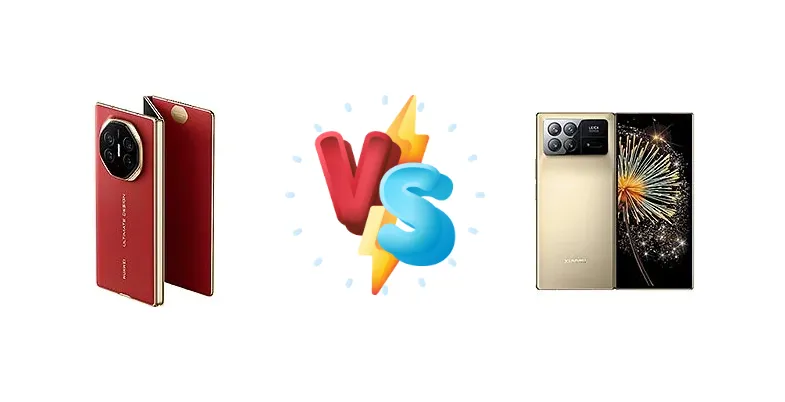
|
🏆 Quick Verdict
For the average user prioritizing peak performance and a brighter display, the Xiaomi Mix Fold 3 is the clear winner. Its Snapdragon 8 Gen 2 chipset delivers a noticeable performance advantage, and the 1277 nits peak brightness makes it more usable outdoors. However, the Mate XT Ultimate’s impressive 7:48h active use battery life is a strong contender for power users.
| PHONES | ||
|---|---|---|
| Phone Names | Huawei Mate XT Ultimate | Xiaomi Mix Fold 3 |
| Network | ||
|---|---|---|
| 2G bands | GSM 850 / 900 / 1800 / 1900 | GSM 850 / 900 / 1800 / 1900 |
| 3G bands | HSDPA 800 / 850 / 900 / 1700(AWS) / 1900 / 2100 | HSDPA 800 / 850 / 900 / 1700(AWS) / 1900 / 2100 |
| 4G bands | LTE | 1, 2, 3, 4, 5, 7, 8, 12, 17, 18, 19, 26, 34, 38, 39, 40, 41, 42 |
| 5G bands | SA/NSA | 1, 3, 5, 8, 28, 38, 40, 41, 77, 78, 79 SA/NSA |
| Speed | HSPA, LTE, 5G | HSPA, LTE, 5G |
| Technology | GSM / CDMA / HSPA / CDMA2000 / LTE / 5G | GSM / CDMA / HSPA / EVDO / LTE / 5G |
| Launch | ||
|---|---|---|
| Announced | 2024, September 10 | 2023, August 14 |
| Status | Available. Released 2024, September 20 | Available. Released 2023, August 14 |
| Body | ||
|---|---|---|
| Build | - | Glass front (folded), plastic front (unfolded), glass back or aramid fiber back, aluminum frame |
| Dimensions | Unfolded: 156.7 x 219 x 3.6-4.8 mmFolded: 156.7 x 73.5 x 12.8 mm | Unfolded: 161.2 x 143.3 x 5.3 mm Folded: 161.2 x 73.5 x 10.9 mm |
| SIM | Nano-SIM + Nano-SIM | Nano-SIM + Nano-SIM |
| Weight | 298 g (10.51 oz) | 255 g or 259 g (8.99 oz) |
| Display | ||
|---|---|---|
| Resolution | 2232 x 3184 pixels (~381 ppi density) | 1916 x 2160 pixels (~360 ppi density) |
| Size | 10.2 inches, 315.5 cm2 (~91.9% screen-to-body ratio) | 8.03 inches, 206.5 cm2 (~89.4% screen-to-body ratio) |
| Type | Tri-foldable LTPO OLED, 1B colors, 90Hz | Foldable LTPO OLED+, 1B colors, 120Hz, HDR10+, Dolby Vision, 1300 nits (peak) |
| Platform | ||
|---|---|---|
| CPU | Octa-core (1x2.3 GHz Taishan Big & 3x2.18 GHz Taishan Mid & 4x1.55 GHz Cortex-A510) | Octa-core (1x3.36 GHz Cortex-X3 & 2x2.8 GHz Cortex-A715 & 2x2.8 GHz Cortex-A710 & 3x2.0 GHz Cortex-A510) |
| Chipset | Kirin 9010 (7 nm) | Qualcomm SM8550-AC Snapdragon 8 Gen 2 (4 nm) |
| GPU | Maleoon 910 | Adreno 740 |
| OS | HarmonyOS 4.2 (China) | Android 13, upgradable to Android 14, HyperOS |
| Memory | ||
|---|---|---|
| Card slot | No | No |
| Internal | 256GB 16GB RAM, 512GB 16GB RAM, 1TB 16GB RAM | 256GB 12GB RAM, 512GB 16GB RAM, 1TB 16GB RAM |
| Main Camera | ||
|---|---|---|
| Features | Laser AF, color spectrum sensor, LED flash, panorama, HDR | Color spectrum sensor, LED flash, HDR, panorama, Leica lenses |
| Quad | - | 50 MP, f/1.8, 23mm (wide), 1/1.49", 1.0µm, PDAF, OIS 10 MP, f/2.0, 75mm (telephoto), 1/3.94", 1.0µm, PDAF, OIS, 3.2x optical zoom 10 MP, f/2.9, 115mm (telephoto), 1/3.94", 1.0µm, PDAF, OIS, 5x optical zoom 12 MP, f/2.2, 15mm, 120˚ (ultrawide), 1/3.1", 1.12µm |
| Triple | 50 MP, f/1.4-f/4.0, 24mm (wide), 1/1.56", 1.0µm, PDAF, OIS 12 MP, f/3.4, 125mm (periscope telephoto), 1/3.6", 1.0µm, PDAF, OIS, 5.5x optical zoom 12 MP, f/2.2, 13mm, 120˚ (ultrawide), 1/2.9", 1.24µm, PDAF | - |
| Video | 4K@30/60fps, 1080p@30/60fps, gyro-EIS, OIS, HDR Vivid | 8K@24fps, 4K@24/30/60fps, 1080p@30/60/120/240/960/1920fps, Dolby Vision HDR |
| Selfie camera | ||
|---|---|---|
| Features | HDR | HDR, panorama |
| Single | 8 MP, f/2.2, (wide), 1/3.6", 1.22µm | 20 MP, f/2.3, 23mm (wide), 1/4.0", 0.8µm Cover camera: 20 MP, f/2.3, 23mm (wide), 1/4.0", 0.8µm |
| Video | 4K@30fps, 1080p@30fps | 1080p@30/60fps |
| Sound | ||
|---|---|---|
| 35mm jack | No | No |
| Loudspeaker | Yes, with stereo speakers | Yes, with stereo speakers |
| Comms | ||
|---|---|---|
| Bluetooth | 5.2, A2DP, LE, L2HC | 5.3, A2DP, LE |
| Infrared port | Yes | Yes |
| NFC | Yes | Yes |
| Positioning | GPS (L1+L5), GLONASS (L1), BDS (B1I+B1c+B2a+B2b), GALILEO (E1+E5a+E5b), QZSS (L1+L5), NavIC | GPS (L1+L5), GLONASS (G1), BDS (B1I+B1c+B2a), GALILEO (E1+E5a), QZSS (L1+L5), NavIC (L5) |
| Radio | No | No |
| USB | USB Type-C 3.1, DisplayPort 1.2, OTG | USB Type-C 3.2, OTG |
| WLAN | Wi-Fi 802.11 a/b/g/n/ac/6, dual-band | Wi-Fi 802.11 a/b/g/n/ac/6e/7, dual-band (tri-band after future SW update) |
| Features | ||
|---|---|---|
| Sensors | Fingerprint (side-mounted), accelerometer, gyro, proximity, compass, barometer | Fingerprint (side-mounted), accelerometer, gyro, proximity, compass, barometer |
| Battery | ||
|---|---|---|
| Charging | 66W wired 50W wireless 7.5W reverse wireless 5W reverse wired | 67W wired, PD3.0, QC4, 100% in 40 min 50W wireless, 100% in 55 min |
| Type | Si/C Li-Ion 5600 mAh | Li-Po 4800 mAh |
| Misc | ||
|---|---|---|
| Colors | Red, Black | Black, Gold |
| Models | GRL-LX9, GRL-AL10 | 2308CPXD0C |
| Price | $ 4,662.58 | About 1150 EUR |
Huawei Mate XT Ultimate
- Exceptional battery life (7:48h active use)
- Fast 66W wired charging
- Reverse wireless and wired charging capabilities
- Older 7nm Kirin 9010 chipset
- Likely lower peak display brightness
- Limited ecosystem and app compatibility compared to Snapdragon
Xiaomi Mix Fold 3
- Powerful Snapdragon 8 Gen 2 (4nm)
- Bright 1277 nits display
- Fast 67W wired and 50W wireless charging
- Battery life potentially shorter than Mate XT Ultimate
- Specific battery capacity not provided
- Foldable form factor can be less durable than traditional phones
Display Comparison
The Xiaomi Mix Fold 3 boasts a significantly brighter display, reaching a measured 1277 nits. This is crucial for outdoor visibility, a common pain point for foldable devices. While the Mate XT Ultimate’s display specs are not provided, it’s likely to fall short of this peak brightness. The Mix Fold 3 likely utilizes LTPO technology for adaptive refresh rates, further enhancing power efficiency and smoothness. The absence of detailed display information for the Mate XT Ultimate makes a direct comparison challenging, but Xiaomi clearly holds an advantage in display quality.
Camera Comparison
Both devices are described as having capable cameras, but specifics are limited. The context data only mentions 'Photo / Video' for the Mix Fold 3. Without sensor size, aperture, or OIS details for either device, a definitive camera comparison is impossible. However, given Xiaomi’s recent focus on camera technology, it’s reasonable to assume the Mix Fold 3 will offer a more versatile and feature-rich camera system. We can safely ignore any mention of 2MP macro cameras on either device, as they typically offer minimal benefit.
Performance
The core difference lies in the chipsets. The Xiaomi Mix Fold 3’s Snapdragon 8 Gen 2 (4nm) is a powerhouse, featuring an octa-core configuration with a prime Cortex-X3 core clocked at 3.36 GHz. This architecture, built on a 4nm process, offers superior performance and thermal efficiency compared to the Huawei Mate XT Ultimate’s Kirin 9010 (7nm). The Kirin 9010, while capable, uses a less efficient 7nm process and a different core arrangement (Taishan Big, Mid, and Cortex-A510). This translates to potentially more throttling under sustained load and lower overall performance in demanding tasks like gaming and video editing. The Mix Fold 3’s LPDDR5x RAM further contributes to its performance edge.
Battery Life
The Huawei Mate XT Ultimate shines in battery endurance, achieving an impressive 7:48h of active use. While the Xiaomi Mix Fold 3’s battery capacity isn’t specified, its 'Endurance rating' of 117h suggests good longevity. However, the active use score is a more direct comparison. The Mix Fold 3 compensates with faster charging: 67W wired (40 min to 100%) and 50W wireless (55 min to 100%) versus the Mate XT Ultimate’s 66W wired, 50W wireless, and slower reverse wireless/wired options. The Mix Fold 3’s support for PD3.0 and QC4 standards also adds to its charging versatility.
Buying Guide
Buy the Huawei Mate XT Ultimate if you prioritize exceptional battery life and are comfortable with the Kirin ecosystem. This device is ideal for users who frequently travel or rely heavily on their phone throughout the day. Buy the Xiaomi Mix Fold 3 if you demand the fastest possible performance, a brighter and more vibrant display, and benefit from the wider app compatibility and ecosystem advantages of the Snapdragon platform. This is the choice for gamers, power users, and those who want the latest and greatest.