
Huawei Mate XT Ultimate vs. Samsung Galaxy Z Fold5: A Deep Dive into Foldable Supremacy
| Phones Images | |||||
|---|---|---|---|---|---|
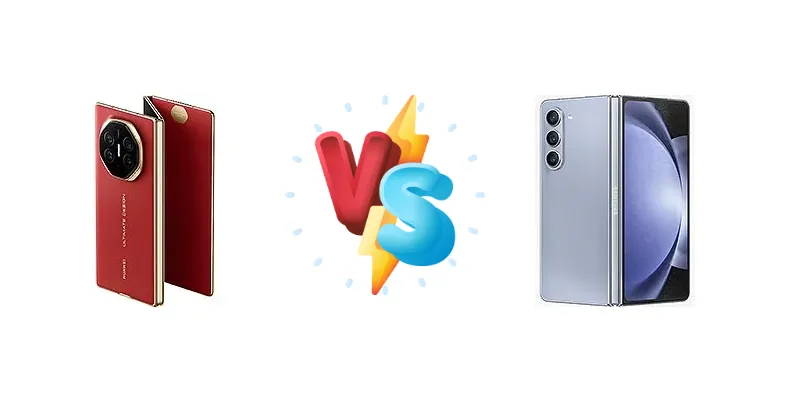
|
🏆 Quick Verdict
For most users, the Samsung Galaxy Z Fold5 is the better choice. Its significantly longer battery life (12:01h active use vs 7:48h) and brighter 1257 nit display provide a more consistently enjoyable experience. However, the Mate XT Ultimate’s 66W wired charging offers a compelling advantage for those prioritizing speed.
| PHONES | ||
|---|---|---|
| Phone Names | Huawei Mate XT Ultimate | Samsung Galaxy Z Fold5 |
| Network | ||
|---|---|---|
| 2G bands | GSM 850 / 900 / 1800 / 1900 | GSM 850 / 900 / 1800 / 1900 |
| 3G bands | HSDPA 800 / 850 / 900 / 1700(AWS) / 1900 / 2100 | HSDPA 850 / 900 / 1700(AWS) / 1900 / 2100 |
| 4G bands | LTE | 1, 2, 3, 4, 5, 7, 8, 12, 13, 17, 18, 19, 20, 25, 26, 28, 38, 39, 40, 41, 66 - International |
| 5G bands | SA/NSA | 1, 2, 3, 5, 7, 8, 12, 20, 25, 28, 38, 40, 41, 66, 77, 78 SA/NSA/Sub6 - International |
| Speed | HSPA, LTE, 5G | HSPA, LTE, 5G |
| Technology | GSM / CDMA / HSPA / CDMA2000 / LTE / 5G | GSM / CDMA / HSPA / EVDO / LTE / 5G |
| Launch | ||
|---|---|---|
| Announced | 2024, September 10 | 2023, July 26 |
| Status | Available. Released 2024, September 20 | Available. Released 2023, August 11 |
| Body | ||
|---|---|---|
| Build | - | Glass front (Gorilla Glass Victus 2) (folded), plastic front (unfolded), glass back (Gorilla Glass Victus 2), aluminum frame |
| Dimensions | Unfolded: 156.7 x 219 x 3.6-4.8 mmFolded: 156.7 x 73.5 x 12.8 mm | Unfolded: 154.9 x 129.9 x 6.1 mmFolded: 154.9 x 67.1 x 13.4 mm |
| SIM | Nano-SIM + Nano-SIM | · Nano-SIM + eSIM· Nano-SIM + Nano-SIM + eSIM (max 2 at a time) |
| Weight | 298 g (10.51 oz) | 253 g (8.92 oz) |
| Display | ||
|---|---|---|
| Resolution | 2232 x 3184 pixels (~381 ppi density) | 1812 x 2176 pixels (~373 ppi density) |
| Size | 10.2 inches, 315.5 cm2 (~91.9% screen-to-body ratio) | 7.6 inches, 183.2 cm2 (~91.1% screen-to-body ratio) |
| Type | Tri-foldable LTPO OLED, 1B colors, 90Hz | Foldable Dynamic AMOLED 2X, 120Hz, HDR10+ |
| Platform | ||
|---|---|---|
| CPU | Octa-core (1x2.3 GHz Taishan Big & 3x2.18 GHz Taishan Mid & 4x1.55 GHz Cortex-A510) | Octa-core (1x3.36 GHz Cortex-X3 & 2x2.8 GHz Cortex-A715 & 2x2.8 GHz Cortex-A710 & 3x2.0 GHz Cortex-A510) |
| Chipset | Kirin 9010 (7 nm) | Qualcomm SM8550-AC Snapdragon 8 Gen 2 (4 nm) |
| GPU | Maleoon 910 | Adreno 740 |
| OS | HarmonyOS 4.2 (China) | Android 13, up to 4 major Android upgrades, One UI 6.1.1 |
| Memory | ||
|---|---|---|
| Card slot | No | No |
| Internal | 256GB 16GB RAM, 512GB 16GB RAM, 1TB 16GB RAM | 256GB 12GB RAM, 512GB 12GB RAM, 1TB 12GB RAM |
| Main Camera | ||
|---|---|---|
| Features | Laser AF, color spectrum sensor, LED flash, panorama, HDR | LED flash, HDR, panorama |
| Triple | 50 MP, f/1.4-f/4.0, 24mm (wide), 1/1.56", 1.0µm, PDAF, OIS 12 MP, f/3.4, 125mm (periscope telephoto), 1/3.6", 1.0µm, PDAF, OIS, 5.5x optical zoom 12 MP, f/2.2, 13mm, 120˚ (ultrawide), 1/2.9", 1.24µm, PDAF | 50 MP, f/1.8, 23mm (wide), 1/1.56", 1.0µm, dual pixel PDAF, OIS 10 MP, f/2.4, 66mm (telephoto), 1/3.94", 1.0µm, PDAF, OIS, 3x optical zoom 12 MP, f/2.2, 12mm, 123˚ (ultrawide), 1/3.06", 1.12µm |
| Video | 4K@30/60fps, 1080p@30/60fps, gyro-EIS, OIS, HDR Vivid | 8K@30fps, 4K@60fps, 1080p@60/240fps (gyro-EIS), HDR10+ |
| Selfie camera | ||
|---|---|---|
| Features | HDR | HDR |
| Single | 8 MP, f/2.2, (wide), 1/3.6", 1.22µm | 4 MP, f/1.8, 26mm (wide), 1/3.0", 2.0µm, under display Cover camera: 10 MP, f/2.2, 24mm (wide), 1/3.0", 1.22µm |
| Video | 4K@30fps, 1080p@30fps | 4K@30/60fps, 1080p@30/60fps, gyro-EIS |
| Sound | ||
|---|---|---|
| 35mm jack | No | No |
| Loudspeaker | Yes, with stereo speakers | Yes, with stereo speakers |
| Comms | ||
|---|---|---|
| Bluetooth | 5.2, A2DP, LE, L2HC | 5.3, A2DP, LE, aptX HD |
| Infrared port | Yes | - |
| NFC | Yes | Yes |
| Positioning | GPS (L1+L5), GLONASS (L1), BDS (B1I+B1c+B2a+B2b), GALILEO (E1+E5a+E5b), QZSS (L1+L5), NavIC | GPS, GLONASS, GALILEO, BDS |
| Radio | No | No |
| USB | USB Type-C 3.1, DisplayPort 1.2, OTG | USB Type-C 3.2, OTG |
| WLAN | Wi-Fi 802.11 a/b/g/n/ac/6, dual-band | Wi-Fi 802.11 a/b/g/n/ac/6e, tri-band, Wi-Fi Direct |
| Features | ||
|---|---|---|
| Sensors | Fingerprint (side-mounted), accelerometer, gyro, proximity, compass, barometer | Fingerprint (side-mounted), accelerometer, gyro, proximity, compass, barometer |
| Battery | ||
|---|---|---|
| Charging | 66W wired 50W wireless 7.5W reverse wireless 5W reverse wired | 25W wired, 50% in 30 min 15W wireless 4.5W reverse wireless |
| Type | Si/C Li-Ion 5600 mAh | Li-Po 4400 mAh |
| Misc | ||
|---|---|---|
| Colors | Red, Black | Icy Blue, Phantom Black, Cream, Gray, Blue |
| Models | GRL-LX9, GRL-AL10 | SM-F946B, SM-F946B/DS, SM-F946U, SM-F946U1, SM-F946N, SM-F946W, SM-F9460 |
| Price | $ 4,662.58 | € 660.00 / $ 607.00 / £ 520.69 / ₹ 86,000 |
| SAR | - | 1.16 W/kg (head) |
| SAR EU | - | 1.24 W/kg (head) 1.19 W/kg (body) |
Huawei Mate XT Ultimate
- Blazing-fast 66W wired charging
- 50W Wireless Charging
- Potentially strong camera performance (based on Huawei's reputation)
- Significantly shorter battery life
- Older 7nm Kirin 9010 chipset
- Limited software ecosystem compared to Samsung
Samsung Galaxy Z Fold5
- Exceptional battery life (12:01h active use)
- Bright 1257 nit display
- Powerful Snapdragon 8 Gen 2 chipset
- Slower 25W wired charging
- Lower reverse wireless charging speed
- Higher price point (typically)
Display Comparison
The Samsung Galaxy Z Fold5 immediately distinguishes itself with a measured peak brightness of 1257 nits, ensuring excellent visibility even in direct sunlight. While the Mate XT Ultimate’s display specs are not provided, Samsung’s LTPO display technology dynamically adjusts refresh rates for improved efficiency. The Z Fold5’s refined hinge and minimized bezel contribute to a more immersive viewing experience, a crucial factor for a foldable device. The lack of detailed display information for the Mate XT Ultimate makes a direct comparison difficult, but Samsung clearly leads in measured brightness.
Camera Comparison
While both devices feature camera systems, the context data is limited for the Mate XT Ultimate. The Z Fold5’s camera is expected to deliver strong photo and video quality, leveraging Samsung’s image processing expertise. The absence of sensor size or aperture details for the Mate XT Ultimate makes a direct comparison challenging. However, given Huawei’s historical strength in mobile photography, it’s reasonable to expect competitive image quality, though likely with a different processing style. We’d need sample images to assess the true differences.
Performance
The Qualcomm Snapdragon 8 Gen 2 (4nm) in the Galaxy Z Fold5 represents a significant leap in efficiency and performance over the Huawei Mate XT Ultimate’s Kirin 9010 (7nm). The Snapdragon’s Cortex-X3 prime core, clocked at 3.36 GHz, delivers superior single-core performance, while its optimized architecture minimizes thermal throttling during sustained workloads. The Kirin 9010, while capable, is built on an older process node, potentially leading to higher temperatures and reduced sustained performance. The Z Fold5’s LPDDR5x RAM further enhances responsiveness and multitasking capabilities. This translates to smoother gaming, faster app loading, and a more fluid overall user experience for the Z Fold5.
Battery Life
Battery life is where the Galaxy Z Fold5 truly shines. Its active use score of 12:01h significantly surpasses the Mate XT Ultimate’s 7:48h. While the Mate XT Ultimate compensates with incredibly fast 66W wired charging (and 50W wireless), the Z Fold5’s endurance means fewer trips to the charger. The Z Fold5 can reach 50% charge in 30 minutes with its 25W wired charging, but the Mate XT Ultimate will likely achieve a full charge in a similar timeframe. The Mate XT Ultimate also offers 7.5W reverse wireless and 5W reverse wired charging, while the Z Fold5 provides 4.5W reverse wireless – a minor difference for emergency top-ups.
Buying Guide
Buy the Huawei Mate XT Ultimate if you prioritize incredibly fast charging and are comfortable with the Huawei ecosystem. Its 66W wired and 50W wireless charging are unmatched in this comparison. Buy the Samsung Galaxy Z Fold5 if you value all-day battery life, a brighter and more refined display, and the broader software support and app compatibility of the Android ecosystem.