
Huawei Mate XT Ultimate vs. Samsung Galaxy Z Fold4: A Deep Dive into Foldable Power
| Phones Images | |||||
|---|---|---|---|---|---|
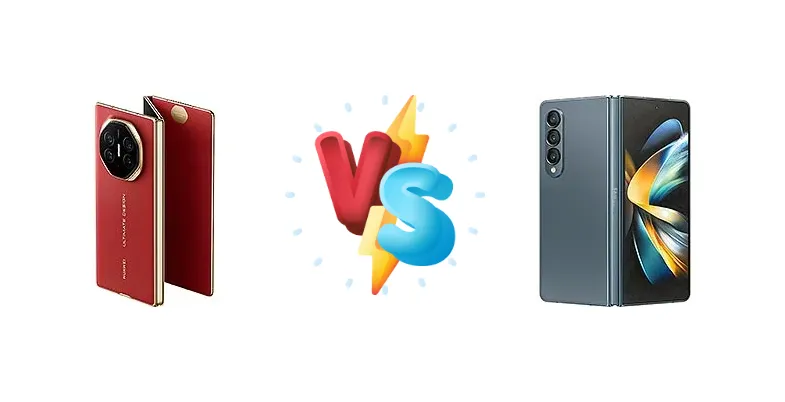
|
🏆 Quick Verdict
For the average user prioritizing all-day battery life and fast charging, the Huawei Mate XT Ultimate emerges as the winner. Its impressive 7:48h active use score significantly surpasses the Z Fold4’s endurance rating, despite the Samsung’s more efficient 4nm chipset. However, the Z Fold4’s brighter display and established software ecosystem remain compelling advantages.
| PHONES | ||
|---|---|---|
| Phone Names | Huawei Mate XT Ultimate | Samsung Galaxy Z Fold4 |
| Network | ||
|---|---|---|
| 2G bands | GSM 850 / 900 / 1800 / 1900 | GSM 850 / 900 / 1800 / 1900 |
| 3G bands | HSDPA 800 / 850 / 900 / 1700(AWS) / 1900 / 2100 | HSDPA 850 / 900 / 1700(AWS) / 1900 / 2100 |
| 4G bands | LTE | 1, 2, 3, 4, 5, 7, 8, 12, 13, 17, 18, 19, 20, 25, 26, 28, 32, 38, 39, 40, 41, 66 - International |
| 5G bands | SA/NSA | 1, 2, 3, 5, 7, 8, 12, 20, 25, 28, 38, 40, 41, 66, 75, 77, 78 SA/NSA/Sub6 - International |
| Speed | HSPA, LTE, 5G | HSPA 42.2/5.76 Mbps, LTE (7CA) Cat20 2000/200 Mbps, 5G |
| Technology | GSM / CDMA / HSPA / CDMA2000 / LTE / 5G | GSM / CDMA / HSPA / EVDO / LTE / 5G |
| - | CDMA2000 1xEV-DO | |
| Launch | ||
|---|---|---|
| Announced | 2024, September 10 | 2022, August 10 |
| Status | Available. Released 2024, September 20 | Available. Released 2022, August 25 |
| Body | ||
|---|---|---|
| Build | - | Glass front (Gorilla Glass Victus+) (folded), plastic front (unfolded), glass back (Gorilla Glass Victus+), aluminum frame |
| Dimensions | Unfolded: 156.7 x 219 x 3.6-4.8 mmFolded: 156.7 x 73.5 x 12.8 mm | Unfolded: 155.1 x 130.1 x 6.3 mmFolded: 155.1 x 67.1 x 14.2-15.8 mm |
| SIM | Nano-SIM + Nano-SIM | · Nano-SIM + eSIM· Nano-SIM + Nano-SIM + eSIM (max 2 at a time) |
| Weight | 298 g (10.51 oz) | 263 g (9.28 oz) |
| - | IPX8 water resistant (up to 1.5m for 30 min) Armor aluminum frame with tougher drop and scratch resistance (advertised) Stylus support | |
| Display | ||
|---|---|---|
| Resolution | 2232 x 3184 pixels (~381 ppi density) | 1812 x 2176 pixels (~373 ppi density) |
| Size | 10.2 inches, 315.5 cm2 (~91.9% screen-to-body ratio) | 7.6 inches, 183.2 cm2 (~90.9% screen-to-body ratio) |
| Type | Tri-foldable LTPO OLED, 1B colors, 90Hz | Foldable Dynamic AMOLED 2X, 120Hz, HDR10+, 1200 nits (peak) |
| - | Cover display: Dynamic AMOLED 2X, 120Hz, Corning Gorilla Glass Victus+ 6.2 inches, 904 x 2316 pixels, 23.1:9 ratio | |
| Platform | ||
|---|---|---|
| CPU | Octa-core (1x2.3 GHz Taishan Big & 3x2.18 GHz Taishan Mid & 4x1.55 GHz Cortex-A510) | Octa-core (1x3.19 GHz Cortex-X2 & 3x2.75 GHz Cortex-A710 & 4x1.80 GHz Cortex-A510) |
| Chipset | Kirin 9010 (7 nm) | Qualcomm SM8475 Snapdragon 8+ Gen 1 (4 nm) |
| GPU | Maleoon 910 | Adreno 730 |
| OS | HarmonyOS 4.2 (China) | Android 12L, up to 4 major Android upgrades, One UI 6.1.1 |
| Memory | ||
|---|---|---|
| Card slot | No | No |
| Internal | 256GB 16GB RAM, 512GB 16GB RAM, 1TB 16GB RAM | 256GB 12GB RAM, 512GB 12GB RAM, 1TB 12GB RAM |
| - | UFS 3.1 | |
| Main Camera | ||
|---|---|---|
| Features | Laser AF, color spectrum sensor, LED flash, panorama, HDR | LED flash, HDR, panorama |
| Triple | 50 MP, f/1.4-f/4.0, 24mm (wide), 1/1.56", 1.0µm, PDAF, OIS 12 MP, f/3.4, 125mm (periscope telephoto), 1/3.6", 1.0µm, PDAF, OIS, 5.5x optical zoom 12 MP, f/2.2, 13mm, 120˚ (ultrawide), 1/2.9", 1.24µm, PDAF | 50 MP, f/1.8, 23mm (wide), 1/1.56", 1.0µm, dual pixel PDAF, OIS 10 MP, f/2.4, 66mm (telephoto), 1/3.94", 1.0µm, PDAF, OIS, 3x optical zoom 12 MP, f/2.2, 12mm, 123˚ (ultrawide), 1/3.06", 1.12µm |
| Video | 4K@30/60fps, 1080p@30/60fps, gyro-EIS, OIS, HDR Vivid | 8K@24fps, 4K@60fps, 1080p@60/240fps (gyro-EIS), HDR10+ |
| Selfie camera | ||
|---|---|---|
| Features | HDR | HDR |
| Single | 8 MP, f/2.2, (wide), 1/3.6", 1.22µm | 4 MP, f/1.8, 26mm (wide), 1/3.0", 2.0µm, under display Cover camera: 10 MP, f/2.2, 24mm (wide), 1/3.0", 1.22µm |
| Video | 4K@30fps, 1080p@30fps | 4K@30/60fps, 1080p@30/60fps, gyro-EIS |
| Sound | ||
|---|---|---|
| 3.5mm jack | - | No |
| 35mm jack | No | No |
| Loudspeaker | Yes, with stereo speakers | Yes, with stereo speakers |
| - | 32-bit/384kHz audio Tuned by AKG | |
| Comms | ||
|---|---|---|
| Bluetooth | 5.2, A2DP, LE, L2HC | 5.2, A2DP, LE, aptX HD |
| Infrared port | Yes | - |
| NFC | Yes | Yes |
| Positioning | GPS (L1+L5), GLONASS (L1), BDS (B1I+B1c+B2a+B2b), GALILEO (E1+E5a+E5b), QZSS (L1+L5), NavIC | GPS, GLONASS, GALILEO, BDS |
| Radio | No | No |
| USB | USB Type-C 3.1, DisplayPort 1.2, OTG | USB Type-C 3.2, OTG |
| WLAN | Wi-Fi 802.11 a/b/g/n/ac/6, dual-band | Wi-Fi 802.11 a/b/g/n/ac/6e, dual-band, Wi-Fi Direct |
| Features | ||
|---|---|---|
| Sensors | Fingerprint (side-mounted), accelerometer, gyro, proximity, compass, barometer | Fingerprint (side-mounted), accelerometer, gyro, proximity, compass, barometer |
| - | Bixby natural language commands and dictation Samsung DeX (desktop experience support) Samsung Pay (Visa, MasterCard certified) Ultra Wideband (UWB) support | |
| Battery | ||
|---|---|---|
| Charging | 66W wired 50W wireless 7.5W reverse wireless 5W reverse wired | 25W wired, 50% in 30 min 15W wireless 4.5W reverse wireless |
| Type | Si/C Li-Ion 5600 mAh | Li-Po 4400 mAh |
| Misc | ||
|---|---|---|
| Colors | Red, Black | Graygreen, Phantom Black, Beige, Burgundy |
| Models | GRL-LX9, GRL-AL10 | SM-F936B, SM-F936B/DS, SM-F936U, SM-F936U1, SM-F936N, SM-F936W, SM-F9360 |
| Price | $ 4,662.58 | $ 457.00 / € 511.80 / £ 485.00 / ₹ 73,899 |
| SAR | - | 0.96 W/kg (head) 0.92 W/kg (body) |
| SAR EU | - | 1.30 W/kg (head) 1.51 W/kg (body) |
| Tests | ||
|---|---|---|
| Battery life | - | Endurance rating 101h |
| Camera | - | Photo / Video |
| Display | - | Contrast ratio: Infinite (nominal) |
| Loudspeaker | - | -28.3 LUFS (Average) |
| Performance | - | AnTuTu: 964530 (v9) GeekBench: 3981 (v5.1) GFXBench: 43fps (ES 3.1 onscreen) |
Huawei Mate XT Ultimate
- Exceptional battery life (7:48h active use)
- Ultra-fast 66W wired charging
- Versatile charging options (50W wireless, reverse wireless)
- Chipset architecture is less efficient than Snapdragon 8+ Gen 1
- Limited camera information available
Samsung Galaxy Z Fold4
- Brighter 1000 nits display
- More efficient Snapdragon 8+ Gen 1 chipset
- Refined foldable design and hinge
- Lower battery endurance compared to Mate XT Ultimate
- Slower charging speeds (25W wired, 15W wireless)
Display Comparison
The Samsung Galaxy Z Fold4 boasts a 1000 nits peak brightness, offering superior visibility in direct sunlight compared to the Mate XT Ultimate (brightness data unavailable). While both utilize foldable OLED technology, the Z Fold4’s infinite contrast ratio suggests deeper blacks and a more vibrant image. The Z Fold4’s LTPO panel likely contributes to better power efficiency during static content viewing, but the Mate XT Ultimate’s display specs are not available for a direct comparison. The Z Fold4’s hinge mechanism is also more refined, offering a less noticeable crease.
Camera Comparison
Both devices feature capable camera systems, but detailed specifications are limited. The Z Fold4’s camera is described as ‘Photo / Video’ without specifics, while the Mate XT Ultimate’s camera details are also absent. Without sensor size, aperture, or OIS information, a direct comparison is difficult. However, Samsung’s image processing is generally known for vibrant colors and strong dynamic range, while Huawei often prioritizes detail and natural tones. The absence of information regarding the Mate XT Ultimate’s camera suggests it may not be a primary selling point.
Performance
The Qualcomm Snapdragon 8+ Gen 1 (4nm) in the Z Fold4 offers a clear architectural advantage over the Huawei Mate XT Ultimate’s Kirin 9010 (7nm). The 4nm process node translates to improved thermal efficiency and potentially higher sustained performance under load. The Z Fold4’s CPU, featuring a Cortex-X2 prime core clocked at 3.19 GHz, is expected to outperform the Kirin 9010’s Taishan cores in single-core tasks. However, the Kirin 9010’s octa-core configuration and ample RAM (spec not provided, but likely high) could provide competitive multi-core performance. The Z Fold4’s LPDDR5x RAM further enhances its memory bandwidth.
Battery Life
The Huawei Mate XT Ultimate shines in battery performance, achieving an impressive 7:48h of active use. This significantly outperforms the Galaxy Z Fold4’s endurance rating of 101h (which is a different metric, but still indicates lower real-world usage). While the Z Fold4’s battery capacity is unknown, the Mate XT Ultimate’s charging capabilities are superior, offering 66W wired, 50W wireless, and even 7.5W/5W reverse wireless charging. The Z Fold4 is limited to 25W wired and 15W wireless, with a slower 4.5W reverse wireless option. The Mate XT Ultimate’s faster charging speeds translate to significantly quicker top-ups.
Buying Guide
Buy the Huawei Mate XT Ultimate if you need exceptional battery life, prioritize fast wired and wireless charging, and are comfortable with Huawei’s software experience. This phone is ideal for power users who demand longevity. Buy the Samsung Galaxy Z Fold4 if you prefer a brighter, more polished display, a wider range of software features, and a more established foldable experience, even if it means compromising on battery endurance.