
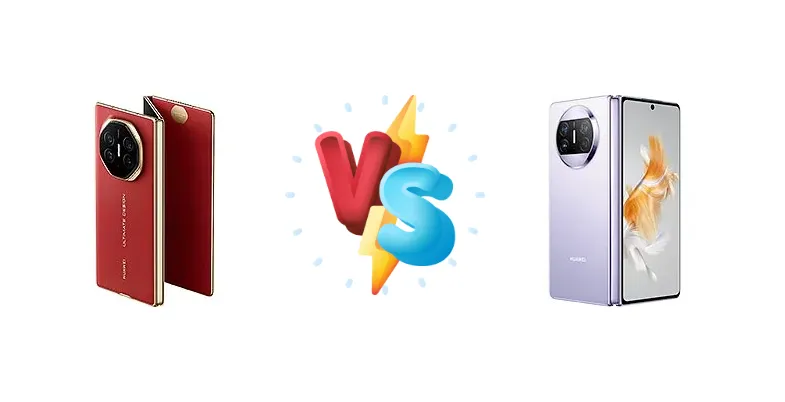
Huawei Mate X3 vs Mate XT Ultimate: Which Foldable Reigns Supreme?
| Phones Images | |||||
|---|---|---|---|---|---|
|
🏆 Quick Verdict
For most users, the Huawei Mate X3 emerges as the superior choice. The Snapdragon 8+ Gen 1 provides a noticeable performance uplift and improved thermal efficiency, translating to smoother multitasking and sustained gaming. While the XT Ultimate boasts impressive battery endurance in active use, the X3’s overall package is more refined.
| PHONES | ||
|---|---|---|
| Phone Names | Huawei Mate XT Ultimate | Huawei Mate X3 |
| Network | ||
|---|---|---|
| 2G bands | GSM 850 / 900 / 1800 / 1900 | GSM 850 / 900 / 1800 / 1900 |
| 3G bands | HSDPA 800 / 850 / 900 / 1700(AWS) / 1900 / 2100 | HSDPA 800 / 850 / 900 / 1700(AWS) / 1900 / 2100 |
| 4G bands | LTE | 1, 2, 3, 4, 5, 7, 8, 12, 17, 18, 19, 20, 26, 28, 34, 38, 39, 40, 41 |
| 5G bands | SA/NSA | - |
| Speed | HSPA, LTE, 5G | HSPA, LTE |
| Technology | GSM / CDMA / HSPA / CDMA2000 / LTE / 5G | GSM / CDMA / HSPA / EVDO / LTE |
| - | CDMA2000 1xEV-DO | |
| Launch | ||
|---|---|---|
| Announced | 2024, September 10 | 2023, March 23 |
| Status | Available. Released 2024, September 20 | Available. Released 2023, April 08 |
| Body | ||
|---|---|---|
| Build | - | Glass front, glass back or eco leather back, aluminum frame |
| Dimensions | Unfolded: 156.7 x 219 x 3.6-4.8 mmFolded: 156.7 x 73.5 x 12.8 mm | Unfolded: 156.9 x 141.5 x 5.3 mmFolded: 156.9 x 72.4 x 11.1 mm |
| SIM | Nano-SIM + Nano-SIM | Nano-SIM + Nano-SIM |
| Weight | 298 g (10.51 oz) | 239 g or 241 g (8.43 oz) |
| - | IPX8 dust/water resistant (up to 1.5m for 30 min) | |
| Display | ||
|---|---|---|
| Protection | - | Kunlun Glass (cover display only) |
| Resolution | 2232 x 3184 pixels (~381 ppi density) | 2224 x 2496 pixels (~426 ppi density) |
| Size | 10.2 inches, 315.5 cm2 (~91.9% screen-to-body ratio) | 7.85 inches, 197.5 cm2 (~88.9% screen-to-body ratio) |
| Type | Tri-foldable LTPO OLED, 1B colors, 90Hz | Foldable OLED, 1B colors, 120Hz |
| - | Cover display: OLED, 120Hz, 6.4 inches, 1080 x 2504 pixels | |
| Platform | ||
|---|---|---|
| CPU | Octa-core (1x2.3 GHz Taishan Big & 3x2.18 GHz Taishan Mid & 4x1.55 GHz Cortex-A510) | Octa-core (1x3.19 GHz Cortex-X2 & 3x2.75 GHz Cortex-A710 & 4x2.0 GHz Cortex-A510) |
| Chipset | Kirin 9010 (7 nm) | Qualcomm SM8475 Snapdragon 8+ Gen 1 4G (4 nm) |
| GPU | Maleoon 910 | Adreno 730 |
| OS | HarmonyOS 4.2 (China) | HarmonyOS 3.1 (China), EMUI 13.1 (Europe), no Google Play Services |
| Memory | ||
|---|---|---|
| Card slot | No | Nano Memory (uses shared SIM slot) |
| Internal | 256GB 16GB RAM, 512GB 16GB RAM, 1TB 16GB RAM | 256GB 12GB RAM, 512GB 12GB RAM, 1TB 12GB RAM |
| - | UFS | |
| Main Camera | ||
|---|---|---|
| Features | Laser AF, color spectrum sensor, LED flash, panorama, HDR | Laser AF, color spectrum sensor, LED flash, panorama, HDR |
| Triple | 50 MP, f/1.4-f/4.0, 24mm (wide), 1/1.56", 1.0µm, PDAF, OIS 12 MP, f/3.4, 125mm (periscope telephoto), 1/3.6", 1.0µm, PDAF, OIS, 5.5x optical zoom 12 MP, f/2.2, 13mm, 120˚ (ultrawide), 1/2.9", 1.24µm, PDAF | 50 MP, f/1.8, 23mm (wide), PDAF, OIS 12 MP, f/3.4, 125mm (periscope telephoto), PDAF, OIS, 5x optical zoom 13 MP, f/2.2, 13mm (ultrawide), AF |
| Video | 4K@30/60fps, 1080p@30/60fps, gyro-EIS, OIS, HDR Vivid | 4K@30/60fps, 1080p@30/60fps, gyro-EIS |
| Selfie camera | ||
|---|---|---|
| Features | HDR | HDR, panorama |
| Single | 8 MP, f/2.2, (wide), 1/3.6", 1.22µm | 8 MP, f/2.4, (wide) Cover camera: 8 MP, f/2.4, (wide) |
| Video | 4K@30fps, 1080p@30fps | 4K@30fps, 1080p@30fps |
| Sound | ||
|---|---|---|
| 3.5mm jack | - | No |
| 35mm jack | No | No |
| Loudspeaker | Yes, with stereo speakers | Yes, with stereo speakers |
| Comms | ||
|---|---|---|
| Bluetooth | 5.2, A2DP, LE, L2HC | 5.2, A2DP, LE |
| Infrared port | Yes | Yes |
| NFC | Yes | Yes |
| Positioning | GPS (L1+L5), GLONASS (L1), BDS (B1I+B1c+B2a+B2b), GALILEO (E1+E5a+E5b), QZSS (L1+L5), NavIC | GPS (L1+L5), GLONASS (B1I+B1c+B2a), BDS (B1I+B1c+B2a), GALILEO (E1+E5a), QZSS (L1+L5), NavIC |
| Radio | No | No |
| USB | USB Type-C 3.1, DisplayPort 1.2, OTG | USB Type-C 3.1, DisplayPort 1.2, OTG |
| WLAN | Wi-Fi 802.11 a/b/g/n/ac/6, dual-band | Wi-Fi 802.11 a/b/g/n/ac/6, dual-band, Wi-Fi Direct |
| Features | ||
|---|---|---|
| Sensors | Fingerprint (side-mounted), accelerometer, gyro, proximity, compass, barometer | Fingerprint (side-mounted), accelerometer, gyro, proximity, compass, barometer, altimeter |
| - | BDS Satellite Message | |
| Battery | ||
|---|---|---|
| Charging | 66W wired 50W wireless 7.5W reverse wireless 5W reverse wired | 66W wired 50W wireless 7.5W reverse wireless |
| Type | Si/C Li-Ion 5600 mAh | Market-dependent versions:· Li-Po 4800 mAh (Global)· Si/C Li-Ion 5060 mAh (China only) |
| Misc | ||
|---|---|---|
| Colors | Red, Black | Black, White, Violet, Dark Green, Gold |
| Models | GRL-LX9, GRL-AL10 | ALT-AL00, ALT-L29 |
| Price | $ 4,662.58 | About 1500 EUR |
| Tests | ||
|---|---|---|
| Battery life | - | Endurance rating 81h |
| Camera | - | Photo / Video |
| Display | - | Contrast ratio: Infinite (nominal) |
| Loudspeaker | - | -26.3 LUFS (Good) |
| Performance | - | AnTuTu: 993592 (v9) GeekBench: 4283 (v5.5), 4512 (v6) GFXBench: 41fps (ES 3.1 onscreen) |
Huawei Mate XT Ultimate
- Exceptional battery life in active use (7:48h)
- Fast 66W wired and 50W wireless charging
- Potentially lower price point due to age
- Kirin 9010 chipset is less powerful than Snapdragon 8+ Gen 1
- 7nm process node may lead to more thermal throttling
Huawei Mate X3
- Superior performance with Snapdragon 8+ Gen 1 (4nm)
- Brighter display (926 nits) for better outdoor visibility
- Improved thermal efficiency for sustained performance
- Active use battery life data unavailable, potentially less than XT Ultimate
- Likely higher price point
Display Comparison
The Mate X3 boasts a significantly brighter display, reaching a measured 926 nits, compared to the XT Ultimate (brightness data unavailable). This translates to better visibility outdoors. Both feature foldable OLED panels with an infinite contrast ratio, typical of OLED technology. However, the X3’s higher peak brightness is a clear advantage for HDR content and sunlight readability. The absence of refresh rate data for the XT Ultimate makes a direct comparison difficult, but the X3 likely benefits from a more modern panel with adaptive refresh rate capabilities.
Camera Comparison
Both devices are listed as having Photo/Video capabilities, but detailed camera specifications are missing. Given Huawei’s history, both likely feature multi-camera systems with strong image processing. However, without sensor size, aperture, or OIS details, a meaningful comparison is impossible. We can assume the X3, being the newer model, benefits from improved image processing algorithms and potentially more advanced camera hardware. The lack of detail regarding the 2MP macro cameras on either device suggests limited utility.
Performance
The core difference lies in the chipsets. The Mate X3’s Qualcomm SM8475 Snapdragon 8+ Gen 1 (4nm) is a substantial upgrade over the Mate XT Ultimate’s Kirin 9010 (7nm). The Snapdragon 8+ Gen 1’s Cortex-X2 prime core, clocked at 3.19 GHz, delivers significantly faster single-core performance than the Kirin 9010’s Taishan Big core at 2.3 GHz. The X3 also benefits from more efficient Cortex-A710 performance cores (2.75 GHz vs 2.18 GHz on the XT Ultimate). The 4nm process node of the Snapdragon 8+ Gen 1 also contributes to better thermal efficiency, reducing the likelihood of throttling during extended gaming sessions. While the Kirin 9010 is no slouch, the Snapdragon 8+ Gen 1 offers a clear performance advantage.
Battery Life
The Mate XT Ultimate shines in battery endurance, achieving 7:48h of active use. The Mate X3, while having an endurance rating of 81h, doesn’t provide a direct active use time. However, the 81h rating suggests excellent standby efficiency. Both devices support 66W wired charging, 50W wireless charging, and 7.5W/5W reverse wireless charging. The X3’s Snapdragon 8+ Gen 1, being more power-efficient, may offset the XT Ultimate’s longer active use time, resulting in comparable real-world battery life despite potentially having a smaller battery capacity (data unavailable for X3).
Buying Guide
Buy the Huawei Mate XT Ultimate if you prioritize maximum battery life during heavy usage and are comfortable with the Kirin 9010's performance profile. It’s a strong contender for power users who need all-day endurance. Buy the Huawei Mate X3 if you demand the best possible performance for demanding tasks like gaming and video editing, and appreciate the benefits of Qualcomm’s Snapdragon 8+ Gen 1 chipset and its associated optimizations.