
Huawei Mate XT Ultimate vs. Honor Magic Vs2: A Deep Dive into Foldable Power
| Phones Images | |||||
|---|---|---|---|---|---|
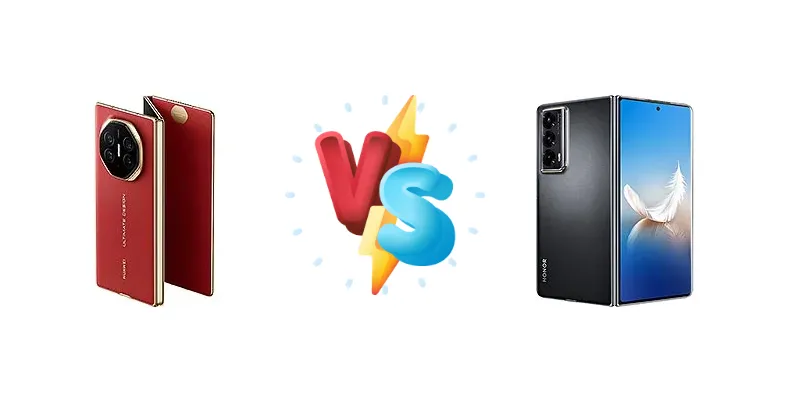
|
🏆 Quick Verdict
For the average user prioritizing sustained performance and gaming, the Honor Magic Vs2 emerges as the winner. The Snapdragon 8+ Gen 1’s 4nm process provides a clear advantage in efficiency and raw power, despite the Mate XT Ultimate’s impressive battery life. However, the Mate XT Ultimate is a strong contender for users who value extended battery life above all else.
| PHONES | ||
|---|---|---|
| Phone Names | Huawei Mate XT Ultimate | Honor Magic Vs2 |
| Network | ||
|---|---|---|
| 2G bands | GSM 850 / 900 / 1800 / 1900 | GSM 850 / 900 / 1800 / 1900 |
| 3G bands | HSDPA 800 / 850 / 900 / 1700(AWS) / 1900 / 2100 | HSDPA 800 / 850 / 900 / 1700(AWS) / 1900 / 2100 |
| 4G bands | LTE | LTE |
| 5G bands | SA/NSA | SA/NSA |
| Speed | HSPA, LTE, 5G | HSPA, LTE, 5G |
| Technology | GSM / CDMA / HSPA / CDMA2000 / LTE / 5G | GSM / CDMA / HSPA / CDMA2000 / LTE / 5G |
| Launch | ||
|---|---|---|
| Announced | 2024, September 10 | 2023, October 12 |
| Status | Available. Released 2024, September 20 | Available. Released 2023, October 17 |
| Body | ||
|---|---|---|
| Build | - | Glass front, glass back or eco leather back, magnesium alloy frame, titanium alloy folding mechanism |
| Dimensions | Unfolded: 156.7 x 219 x 3.6-4.8 mmFolded: 156.7 x 73.5 x 12.8 mm | Unfolded: 157.5 x 146.2 x 5.1 mmFolded: 157.5 x 74.4 x 10.7 mm |
| SIM | Nano-SIM + Nano-SIM | Nano-SIM + Nano-SIM |
| Weight | 298 g (10.51 oz) | 229 g (8.08 oz) |
| Display | ||
|---|---|---|
| Resolution | 2232 x 3184 pixels (~381 ppi density) | 2156 x 2344 pixels (~402 ppi density) |
| Size | 10.2 inches, 315.5 cm2 (~91.9% screen-to-body ratio) | 7.92 inches, 201.6 cm2 (~87.6% screen-to-body ratio) |
| Type | Tri-foldable LTPO OLED, 1B colors, 90Hz | Foldable LTPO OLED, 1B colors, 120Hz, HDR10+, Dolby Vision |
| Platform | ||
|---|---|---|
| CPU | Octa-core (1x2.3 GHz Taishan Big & 3x2.18 GHz Taishan Mid & 4x1.55 GHz Cortex-A510) | Octa-core (1x3.0 GHz Cortex-X2 & 3x2.5 GHz Cortex-A710 & 4x1.80 GHz Cortex-A510) |
| Chipset | Kirin 9010 (7 nm) | Qualcomm SM8475 Snapdragon 8+ Gen 1 (4 nm) |
| GPU | Maleoon 910 | Adreno 730 |
| OS | HarmonyOS 4.2 (China) | Android 13, MagicOS 7.2 |
| Memory | ||
|---|---|---|
| Card slot | No | No |
| Internal | 256GB 16GB RAM, 512GB 16GB RAM, 1TB 16GB RAM | 256GB 12GB RAM, 512GB 16GB RAM |
| Main Camera | ||
|---|---|---|
| Features | Laser AF, color spectrum sensor, LED flash, panorama, HDR | LED flash, HDR, panorama |
| Triple | 50 MP, f/1.4-f/4.0, 24mm (wide), 1/1.56", 1.0µm, PDAF, OIS 12 MP, f/3.4, 125mm (periscope telephoto), 1/3.6", 1.0µm, PDAF, OIS, 5.5x optical zoom 12 MP, f/2.2, 13mm, 120˚ (ultrawide), 1/2.9", 1.24µm, PDAF | 50 MP, f/1.9, 25mm (wide), PDAF 20 MP, f/2.4, 62mm (telephoto), PDAF, 2.5x optical zoom, OIS 12 MP, f/2.2, 16mm (ultrawide), AF |
| Video | 4K@30/60fps, 1080p@30/60fps, gyro-EIS, OIS, HDR Vivid | 4K@30/60fps (10-bit), 1080p@30/60fps, gyro-EIS, HDR10+ |
| Selfie camera | ||
|---|---|---|
| Features | HDR | HDR |
| Single | 8 MP, f/2.2, (wide), 1/3.6", 1.22µm | 16 MP, f/2.2, (wide) |
| Video | 4K@30fps, 1080p@30fps | 4K@30fps, 1080p@30fps, gyro-EIS |
| Sound | ||
|---|---|---|
| 35mm jack | No | No |
| Loudspeaker | Yes, with stereo speakers | Yes, with stereo speakers |
| Comms | ||
|---|---|---|
| Bluetooth | 5.2, A2DP, LE, L2HC | 5.2, A2DP, LE, aptX HD |
| Infrared port | Yes | Yes |
| NFC | Yes | Yes |
| Positioning | GPS (L1+L5), GLONASS (L1), BDS (B1I+B1c+B2a+B2b), GALILEO (E1+E5a+E5b), QZSS (L1+L5), NavIC | GPS (L1+L5), GLONASS (L1), BDS (B1I+B1c+B2a), GALILEO (E1+E5a), QZSS (L1+L5) |
| Radio | No | No |
| USB | USB Type-C 3.1, DisplayPort 1.2, OTG | USB Type-C 3.1, OTG, Display Port 1.2 |
| WLAN | Wi-Fi 802.11 a/b/g/n/ac/6, dual-band | Wi-Fi 802.11 a/b/g/n/ac/6, dual-band, Wi-Fi Direct |
| Features | ||
|---|---|---|
| Sensors | Fingerprint (side-mounted), accelerometer, gyro, proximity, compass, barometer | Fingerprint (side-mounted), accelerometer, gyro, proximity, compass |
| Battery | ||
|---|---|---|
| Charging | 66W wired 50W wireless 7.5W reverse wireless 5W reverse wired | 66W wired 5W reverse wired |
| Type | Si/C Li-Ion 5600 mAh | Li-Po 5000 mAh |
| Misc | ||
|---|---|---|
| Colors | Red, Black | Black, Blue, Purple |
| Models | GRL-LX9, GRL-AL10 | VER-AN00 |
| Price | $ 4,662.58 | About 910 EUR |
Huawei Mate XT Ultimate
- Exceptional battery life (7:48h active use)
- Versatile charging options (66W wired, 50W wireless, reverse wireless)
- Potential for optimized software experience within Huawei ecosystem
- Less powerful chipset (Kirin 9010) compared to Snapdragon 8+ Gen 1
- 7nm process may lead to thermal throttling under sustained load
- Limited access to Google Mobile Services (GMS) depending on region
Honor Magic Vs2
- Superior performance with Snapdragon 8+ Gen 1 (4nm)
- Better thermal management and sustained performance
- Wider app compatibility and access to Google Mobile Services (GMS)
- Potentially shorter battery life compared to Mate XT Ultimate
- Limited reverse charging options (5W wired only)
- May require more frequent charging for heavy users
Display Comparison
While both devices are foldables, detailed display specs are missing. However, given the Mate XT Ultimate’s positioning, it likely prioritizes color accuracy and potentially a higher refresh rate for media consumption. The Magic Vs2, geared towards performance, may lean towards a slightly more responsive panel. The absence of LTPO information is a key omission; LTPO would significantly impact battery efficiency by dynamically adjusting refresh rates.
Camera Comparison
Without detailed camera specifications, a direct comparison is limited. However, both brands typically focus on computational photography. The Snapdragon 8+ Gen 1’s ISP (Image Signal Processor) is generally regarded as more advanced, offering superior noise reduction and dynamic range. The Mate XT Ultimate may rely more heavily on Huawei’s software algorithms to compensate for potential hardware limitations. The absence of sensor size information is critical; larger sensors generally capture more light and detail.
Performance
The core difference lies in the chipsets. The Honor Magic Vs2’s Qualcomm Snapdragon 8+ Gen 1 (4nm) boasts a Cortex-X2 prime core clocked at 3.0 GHz, offering a significant performance uplift compared to the Huawei Mate XT Ultimate’s Kirin 9010 (7nm). The Snapdragon’s 4nm fabrication process translates to superior thermal efficiency, mitigating throttling during prolonged intensive tasks. The Kirin 9010’s Taishan cores, while capable, are less efficient and likely to exhibit more thermal throttling. This means the Magic Vs2 will maintain higher sustained performance in gaming and demanding applications.
Battery Life
The Huawei Mate XT Ultimate shines in battery life, achieving an impressive 7:48h of active use. While the Honor Magic Vs2’s battery capacity is unknown, the Snapdragon 8+ Gen 1’s efficiency helps offset the potential difference. Both devices offer 66W wired charging, providing rapid replenishment. The Mate XT Ultimate further includes 50W wireless and reverse wireless charging options (7.5W/5W), offering greater versatility, while the Magic Vs2 only offers 5W reverse wired charging.
Buying Guide
Buy the Huawei Mate XT Ultimate if you need exceptional battery life and prefer a more self-contained ecosystem, potentially benefiting from Huawei’s software optimizations. Buy the Honor Magic Vs2 if you prioritize peak performance for demanding tasks like gaming and video editing, and prefer the broader compatibility and established ecosystem of Qualcomm-powered devices.