
Huawei Mate Xs vs Xiaomi Mix Fold 2: A Deep Dive into Foldable Flagships
| Phones Images | |||||
|---|---|---|---|---|---|
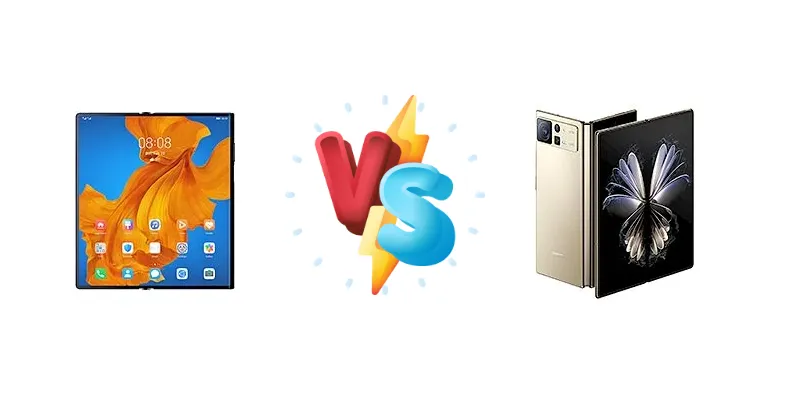
|
🏆 Quick Verdict
For most users, the Xiaomi Mix Fold 2 emerges as the superior choice. Its significantly brighter display (1054 nits vs 413 nits) and more efficient Snapdragon 8+ Gen 1 chipset, coupled with faster charging, provide a smoother and more enjoyable daily experience. While the Mate Xs boasts a respectable endurance rating, it's outmatched in key areas.
| PHONES | ||
|---|---|---|
| Phone Names | Huawei Mate Xs | Xiaomi Mix Fold 2 |
| Network | ||
|---|---|---|
| 2G bands | GSM 850 / 900 / 1800 / 1900 | GSM 850 / 900 / 1800 / 1900 |
| 3G bands | HSDPA 800 / 850 / 900 / 1700(AWS) / 1900 / 2100 | HSDPA 850 / 900 / 1700(AWS) / 1900 / 2100 |
| 4G bands | 1, 2, 3, 4, 5, 6, 7, 8, 9, 12, 17, 18, 19, 20, 26, 28, 32, 34, 38, 39, 40, 41 | 1, 2, 3, 4, 5, 7, 8, 12, 17, 18, 19, 20, 26, 28, 34, 38, 39, 40, 41, 42 |
| 5G bands | 1, 3, 28, 38, 41, 77, 78, 79 SA/NSA | 1, 3, 5, 8, 20, 28, 38, 40, 41, 77, 78, 79 SA/NSA |
| Speed | HSPA 42.2/5.76 Mbps, LTE Cat21 1400/200 Mbps, 5G (2+ Gbps DL) | HSPA, LTE, 5G |
| Technology | GSM / HSPA / LTE / 5G | GSM / CDMA / HSPA / EVDO / LTE / 5G |
| - | CDMA2000 1xEV-DO | |
| Launch | ||
|---|---|---|
| Announced | 2020, February 24. Released 2020, March 05 | 2022, August 11 |
| Status | Discontinued | Available. Released 2022, August 26 |
| Body | ||
|---|---|---|
| Build | Plastic front, aluminum back, aluminum frame | - |
| Dimensions | Unfolded: 161.3 x 146.2 x 5.4 mmFolded: 161.3 x 78.5 x 11 mm | Unfolded: 161.1 x 144.7 x 5.4 mm Folded: 161.1 x 73.9 x 11.2 mm |
| SIM | Nano-SIM + Nano-SIM | Nano-SIM + Nano-SIM |
| Weight | 300 g (10.58 oz) | 262 g (9.24 oz) |
| Display | ||
|---|---|---|
| Protection | Corning Gorilla Glass | Schott UTG glass |
| Resolution | 2200 x 2480 pixels (~414 ppi density) | 1914 x 2160 pixels (~360 ppi density) |
| Size | 8.0 inches, 205.0 cm2 (~86.9% screen-to-body ratio) | 8.02 inches, 206.0 cm2 (~88.4% screen-to-body ratio) |
| Type | Foldable OLED | Foldable LTPO2 OLED, 1B colors, 120Hz, HDR10+, Dolby Vision, 1000 nits (HBM), 1300 nits (peak) |
| Folded cover display: AMOLED, 6.6 inches, 1148 x 2480 pixels, 19.5:9 ratio | Cover display: AMOLED, 120Hz, HDR10+, Dolby Vision, 1000 nits (HBM), 1300 nits (peak) 6.56 inches, 1080 x 2520 pixels, 21:9 ratio Corning Gorilla Glass Victus | |
| Platform | ||
|---|---|---|
| CPU | Octa-core (2x2.86 GHz Cortex-A76 & 2x2.36 GHz Cortex-A76 & 4x1.95 GHz Cortex-A55) | Octa-core (1x3.19 GHz Cortex-X2 & 3x2.75 GHz Cortex-A710 & 4x1.80 GHz Cortex-A510) |
| Chipset | Kirin 990 5G (7 nm+) | Qualcomm SM8475 Snapdragon 8+ Gen 1 (4 nm) |
| GPU | Mali-G76 MP16 | Adreno 730 |
| OS | Android 10, EMUI 10, no Google Play Services | Android 12, MIUI Fold 13 |
| Memory | ||
|---|---|---|
| Card slot | Nano Memory (uses shared SIM slot) | No |
| Internal | 512GB 8GB RAM | 256GB 12GB RAM, 512GB 12GB RAM, 1TB 12GB RAM |
| UFS 2.1 | UFS 3.1 | |
| Main Camera | ||
|---|---|---|
| Features | Leica optics, dual-LED dual-tone flash, panorama, HDR | Color spectrum sensor, Dual-LED flash, HDR, panorama, Leica lenses |
| Single | 5 MP, AF 5 MP, AF | - |
| Triple | 40 MP, f/1.8, 27mm (wide), 1/1.7", PDAF 8 MP, f/2.4, 81mm (telephoto), PDAF, OIS, 3x optical zoom 16 MP, f/2.2, 17mm (ultrawide), AF TOF 3D, (depth) | 50 MP, f/1.8, (wide), 1/1.56", 1.0µm, PDAF, OIS 8 MP, f/2.6, 45mm (telephoto), dual pixel PDAF, 2x optical zoom 13 MP, f/2.4, 15mm, 123˚ (ultrawide), 1.12µm, AF |
| Video | 4K@30fps, 1080p@30fps | 8K@24fps, 4K@30/60fps, 1080p@30/60/120/240/960fps, gyro-EIS |
| Selfie camera | ||
|---|---|---|
| Features | HDR | HDR, panorama |
| Single | Yes | 20 MP, f/2.4, 23mm (wide) |
| Video | 1080p@30fps | 1080p@30/60fps, 720p@120fps |
| No - uses main camera | - | |
| Sound | ||
|---|---|---|
| 3.5mm jack | No | No |
| 35mm jack | No | No |
| Loudspeaker | Yes | Yes, with stereo speakers |
| - | 24-bit/192kHz audio Tuned by Harman Kardon | |
| Comms | ||
|---|---|---|
| Bluetooth | 5.0, A2DP, LE | 5.2, A2DP, LE, aptX HD, aptX Adaptive |
| Infrared port | Yes | Yes |
| NFC | Yes | Yes |
| Positioning | GPS (L1+L5), GLONASS (L1), BDS (B1), GALILEO (E1+E5a), QZSS (L1+L5) | GPS (L1+L5), GLONASS (L1), BDS (B1I+B1c+B2a), GALILEO (E1+E5a), QZSS (L1+L5), NavIC (L5) |
| Radio | No | No |
| USB | USB Type-C 3.1 | USB Type-C |
| WLAN | Wi-Fi 802.11 a/b/g/n/ac, dual-band, Wi-Fi Direct | Wi-Fi 802.11 a/b/g/n/ac/6e, dual-band, Wi-Fi Direct |
| Features | ||
|---|---|---|
| Browser | HTML, Adobe Flash | - |
| Sensors | Fingerprint (side-mounted), accelerometer, gyro, proximity, compass, barometer | Fingerprint (side-mounted), accelerometer, gyro, proximity, compass, barometer |
| Battery | ||
|---|---|---|
| Charging | 55W wired, 85% in 30 min | 67W wired, PD3.0, QC4, 100% in 40 min |
| Stand-by | Up to 312 h | - |
| Talk time | Up to 6 h | - |
| Type | Li-Po 4500 mAh | Li-Po 4500 mAh |
| Misc | ||
|---|---|---|
| Colors | Interstellar Blue | Black, Gold |
| Models | TAH-N29m | 22061218C |
| Price | About 1950 EUR | About 1300 EUR |
| SAR | 0.29 W/kg (head) 0.54 W/kg (body) | - |
| Tests | ||
|---|---|---|
| Battery life | Endurance rating 69h | Endurance rating 82h |
| Camera | Photo / Video | Photo / Video |
| Display | Contrast ratio: Infinite (nominal) | Contrast ratio: Infinite (nominal) |
| Loudspeaker | -27.0 LUFS (Good) | -26.2 LUFS (Good) |
| Performance | AnTuTu: 459274 (v8), 461406 (unfolded) GeekBench: 12213 (v4.4), 2980 (v5.1) GFXBench: 16fps (ES 3.1 onscreen unfolded) | AnTuTu: 1050139 (v9) GeekBench: 4368 (v5.1) GFXBench: 52fps (ES 3.1 onscreen) |
Huawei Mate Xs
- Potentially longer software support within Huawei ecosystem
- Respectable battery endurance rating of 69 hours
- 55W fast charging capability
- Significantly dimmer display (413 nits)
- Older Kirin 990 chipset with less efficient 7nm+ process
- Likely inferior image processing compared to newer ISPs
Xiaomi Mix Fold 2
- Much brighter display (1054 nits) for superior visibility
- Powerful and efficient Snapdragon 8+ Gen 1 (4nm) chipset
- Faster 67W charging with PD3.0 and QC4 support
- Potential concerns regarding software updates and ecosystem
- Foldable design may be more prone to durability issues (general foldable concern)
- May be more expensive than the Mate Xs
Display Comparison
The Xiaomi Mix Fold 2’s display is a clear standout, achieving a measured peak brightness of 1054 nits compared to the Mate Xs’ 413 nits. This translates to significantly better outdoor visibility and a more immersive viewing experience in bright conditions. Both devices feature an 'Infinite' contrast ratio, a common marketing term for OLED panels, but the difference in peak brightness is substantial. While both are foldable, the Mix Fold 2’s design appears to prioritize a more seamless crease, though detailed crease analysis requires physical testing beyond the provided data.
Camera Comparison
Both devices are listed as having 'Photo / Video' capabilities, lacking specific details. However, given the market positioning, we can infer both feature multi-camera systems. The absence of sensor size or aperture information makes a direct comparison impossible. It’s likely the Mix Fold 2 benefits from Qualcomm’s image signal processor (ISP) advancements, potentially offering superior image processing and low-light performance. The Mate Xs, while capable, is likely limited by the older Kirin 990’s ISP.
Performance
The Xiaomi Mix Fold 2 leverages the Qualcomm Snapdragon 8+ Gen 1 (4nm) chipset, a significant leap forward in efficiency and performance compared to the Huawei Mate Xs’ Kirin 990 5G (7nm+). The Snapdragon’s Cortex-X2 prime core, clocked at 3.19 GHz, offers a substantial performance boost over the Mate Xs’ Cortex-A76 cores. The 4nm process node of the Snapdragon also contributes to better thermal management, reducing the likelihood of performance throttling during sustained workloads. This benefits gamers and users running demanding applications.
Battery Life
The Xiaomi Mix Fold 2 boasts an endurance rating of 82 hours, exceeding the Huawei Mate Xs’ 69 hours. While the Mate Xs offers 55W wired charging, reaching 85% in 30 minutes, the Mix Fold 2’s 67W charging with PD3.0 and QC4 support achieves a full charge in 40 minutes. The Snapdragon 8+ Gen 1’s improved efficiency also contributes to the Mix Fold 2’s longer battery life, offsetting any potential capacity differences not specified in the data.
Buying Guide
Buy the Huawei Mate Xs if you prioritize a potentially longer software support lifecycle within the Huawei ecosystem and are comfortable with the older Kirin 990 chipset. Buy the Xiaomi Mix Fold 2 if you demand a brighter, more vibrant display, superior processing power for demanding tasks, and faster charging speeds – making it ideal for power users and multimedia enthusiasts.